Founded in 1984, Air Holland emerged from the ambition of Dutch aviation entrepreneur John Nicolaas Block, who sought to disrupt a tightly controlled airline market dominated by legacy carriers like KLM and Transavia. Based out of Amsterdam Schiphol Airport, the airline positioned itself uniquely within the Dutch aviation industry as a charter and cargo operator, establishing a reputation for flexibility and global reach. However, despite its operational successes, Air Holland’s trajectory would be marred by financial turbulence, competitive resistance, and eventual absorption by other entities.
In its early years, Air Holland faced stiff regulatory challenges. Powerful incumbent airlines such as KLM and Transavia Airlines worked diligently to hinder the newcomer’s licensing efforts. Nevertheless, by mid-1985, the airline had secured its operating certificate and began flying under the banner of independence and innovation. Specializing in charter flights, it offered services to Africa, Asia, and the Mediterranean, supporting both leisure travel and specialized cargo routes that larger flag carriers often overlooked.
A Business Model Built on Charter Flexibility
Air Holland’s decision to focus on charter and cargo services allowed it to maintain an agile and cost-effective model. Unlike scheduled carriers, charter operators adapt to seasonal demand and contract-based travel, giving them resilience in turbulent markets. Throughout the late 1980s, Air Holland carved out a significant market share in Dutch outbound holiday traffic, becoming a key carrier for tour operators seeking reliable long-haul charter services.
The airline’s strategy also included wet leasing and dry leasing operations, where it leased out its aircraft and crew to other airlines. This diversified revenue stream helped buffer Air Holland against fluctuations in passenger demand. At its operational peak, the fleet expanded to 21 aircraft, including various models of Boeing jets, known for their reliability and cost-efficiency.
Fleet and Operational Infrastructure
Air Holland operated an all-Boeing fleet, which simplified maintenance and pilot training requirements. The fleet’s composition reflected the company’s mission to provide medium and long-haul charter services. Key aircraft in its roster included:
- Boeing 727-200: Operated briefly from 1985 to 1988. Used for early charter routes.
- Boeing 737-300: Short-lived tenure between 1997 and 2000, mainly for European charters.
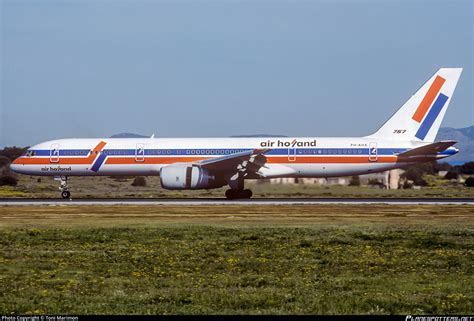
- Boeing 757-200: Backbone of the fleet with 11 aircraft, introduced in 1988 and operated until closure.
- Boeing 767-200ER: Leased in 1990 from Britannia Airways, returned in 1991.
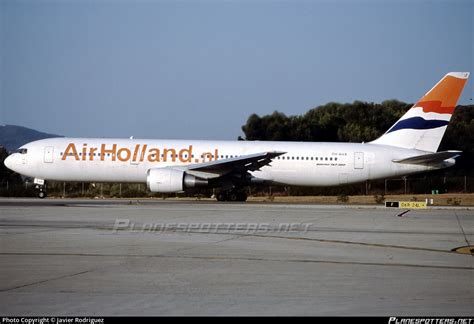
- Boeing 767-300ER: Introduced in 2002, later transferred to HollandExel post-closure.
The consistent use of Boeing aircraft gave Air Holland a strategic advantage in terms of fleet standardization, reducing overhead and improving operational efficiency.
The Turning Point: Financial Crisis and Restructuring
Despite operational successes, 1990 marked the beginning of financial instability. A loss of DFL 30 million led to a temporary suspension of operations in early 1991. This crisis opened the door for a management change, with A.R. Marx stepping in as the new CEO. Under his leadership, Air Holland resumed flights on 20 December 1991, signaling a fresh start. Marx’s tenure focused on stabilizing finances and expanding fleet capacity through new leasing agreements.
However, the financial structure remained fragile. The airline’s over-reliance on seasonal charter income made it vulnerable to macroeconomic shifts and fuel price volatility. Additionally, attempts by Transavia to acquire Air Holland in the early ’90s signaled its growing importance—but also highlighted how its success was seen as a competitive threat.
Final Years: Acquisition Attempts and the HollandExel Transition
Entering the 2000s, Air Holland faced mounting operational pressures. In February 2004, the airline suspended all operations, citing insurmountable financial difficulties. The suspension was short-lived, however, as Erik de Vlieger, a businessman from Amsterdam, intervened by transferring aircraft and operations to a new entity: HollandExel. While this move temporarily preserved employment and aircraft utility, it effectively marked the end of Air Holland as an independent carrier.
On 25 March 2004, Air Holland was officially declared bankrupt, and its operating certificate was revoked. The move marked the end of a 20-year journey for a carrier that had once promised a bold alternative in Dutch aviation. Its fleet and much of its staff were absorbed into HollandExel, which itself later restructured into TUI fly Netherlands.

Cultural and Industry Impact
Air Holland holds a unique place in the Dutch aviation narrative. More than just a defunct carrier, it symbolized entrepreneurial spirit and market liberalization in a space long dominated by legacy players. It played a crucial role in:
- Broadening consumer choice in long-haul leisure travel.
- Demonstrating the viability of the charter + leasing hybrid model.
- Setting precedents in legal battles for market entry and fair competition.
Additionally, the airline maintained a cult following among aviation enthusiasts, with active fan pages, forums, and even a Virtual Airline simulator community that preserved its brand ethos well into the 2010s.
The Legacy of John Block and A.R. Marx
Founder John Nicolaas Block is remembered for his tenacity in the face of immense institutional resistance. His early vision laid the groundwork for the airline’s operational strategy and network growth. The subsequent leadership of A.R. Marx ensured the airline’s survival during its most volatile years, implementing critical operational changes that kept Air Holland in the skies for more than a decade after its first shutdown.
Both men left indelible marks on European charter aviation. Their differing styles—Block’s risk-taking innovation versus Marx’s conservative fiscal recovery—combined to shape the carrier’s dual identity as both a disruptor and a survivor.
Conclusion: A Vanished Carrier, an Enduring Narrative
Air Holland may no longer fly, but its story continues to resonate in discussions about airline deregulation, entrepreneurial resilience, and the volatility of charter markets. Its trajectory from bold upstart to industry cautionary tale reflects the complex realities of aviation economics, where vision must often contend with regulatory power and market fluctuations.
Even in its absence, the orange-striped aircraft of Air Holland remain iconic, a symbol of what is possible when ambition meets opportunity—even if only for a fleeting two decades.