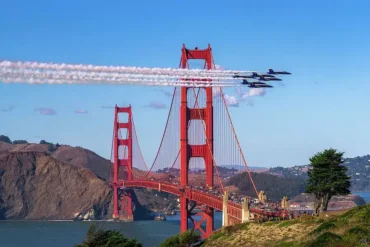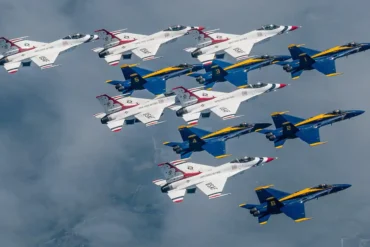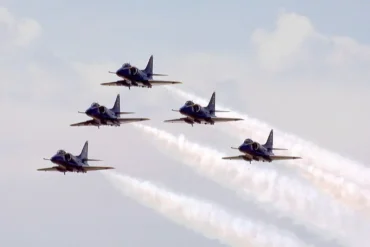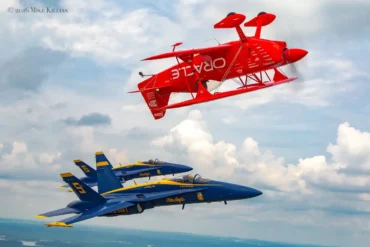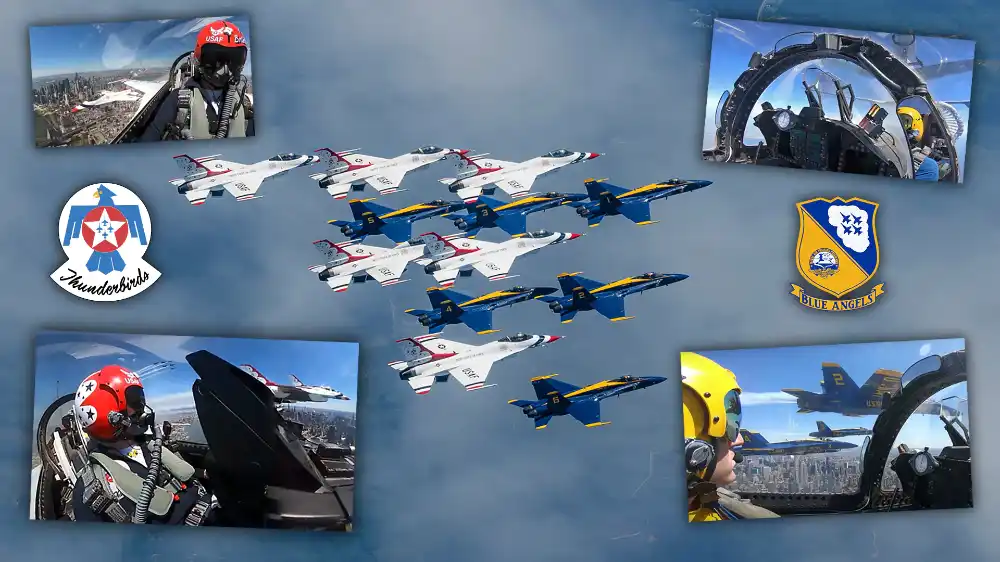
The United States Air Force Thunderbirds and the United States Navy Blue Angels represent the pinnacle of military aviation demonstration teams. These elite squadrons captivate millions worldwide with their breathtaking aerobatic performances. While both teams share a common goal of showcasing the skill and precision of American military pilots, they differ significantly in their aircraft, maneuvers, and operational philosophies.
Origins and Military Affiliation
Thunderbirds: The Air Force’s Aerial Ambassadors
Founded in 1953, the Thunderbirds serve as the official demonstration squadron of the United States Air Force (USAF). They were the world’s first aerobatic team to fly supersonic fighter jets and continue to represent the power and precision of Air Force aviation. The squadron has performed in over 3,000 shows across the globe, reaching an estimated 200 million spectators.
Blue Angels: The Legacy of Naval Aviation
Established in 1946, the Blue Angels are the oldest active aerobatic demonstration team in the world. Their name originates from a small bar called “Blue Angel” in Jacksonville, Florida. As representatives of U.S. Naval Aviation, they emphasize teamwork and the unique capabilities of carrier-based aircraft. Over the decades, the Blue Angels have evolved into a powerful symbol of Navy and Marine Corps excellence.
Aircraft and Performance Capabilities
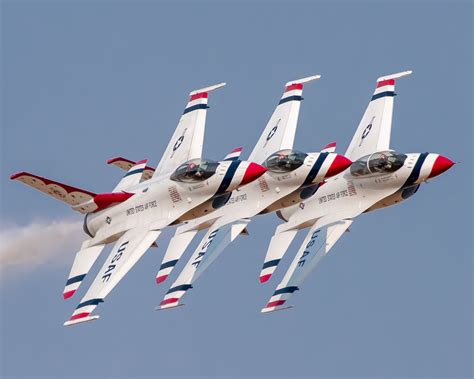
Thunderbirds: F-16 Fighting Falcon
- Current Aircraft: F-16C/D “Fighting Falcon”
- Engine: Single-engine, afterburning turbofan
- Top Speed: Over 1,500 mph (Mach 2)
- Role: Lightweight multirole fighter
- Key Strength: High agility, precision in tight formations
The Thunderbirds fly the F-16 Fighting Falcon, a lightweight supersonic fighter designed for speed and maneuverability. It is known for its sharp handling and tight turn radius, making it ideal for intricate formations such as the diamond and wedge patterns. In certain maneuvers, the Thunderbirds’ aircraft fly with less than a 1-meter gap between wingtips, demonstrating their unparalleled precision.
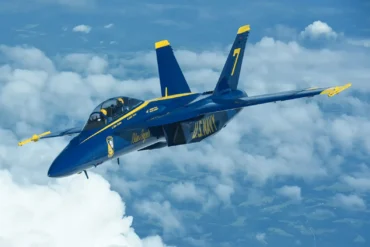
Blue Angels: F/A-18 Super Hornet
- Current Aircraft: F/A-18E/F “Super Hornet”
- Engine: Twin-engine, afterburning turbofan
- Top Speed: Over 1,190 mph (Mach 1.8)
- Role: Carrier-based fighter and attack aircraft
- Key Strength: Superior low-altitude stability, high-speed close formations
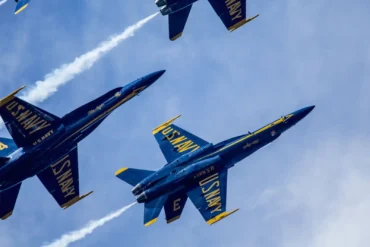
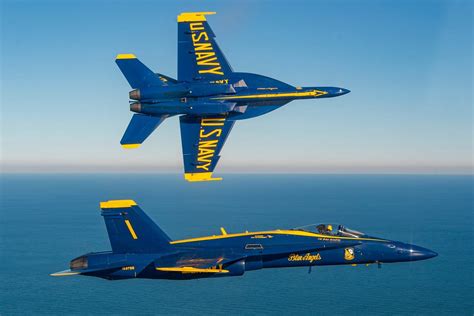
The Blue Angels operate the F/A-18E/F Super Hornet, a twin-engine fighter optimized for carrier operations. Compared to the F-16, it is heavier but provides enhanced low-speed handling and stability. The Blue Angels’ performances feature high-speed, low-altitude passes, sometimes flying at just 15 meters above ground.
Signature Maneuvers and Performance Styles
Thunderbirds: Precision and Symmetry
- Diamond Roll: Four aircraft perform a synchronized roll while maintaining tight formation.
- Opposing Knife-Edge Pass: Two jets approach from opposite directions and pass each other at close range.
- Solo Vertical Climb: A single jet pulls up into a near-vertical climb, showcasing the F-16’s powerful thrust.
The Thunderbirds focus on symmetry and discipline, aligning their movements with Air Force principles of accuracy and tactical execution. Their formations are crisp, calculated, and emphasize military precision.
Blue Angels: Thrill and Theatrics
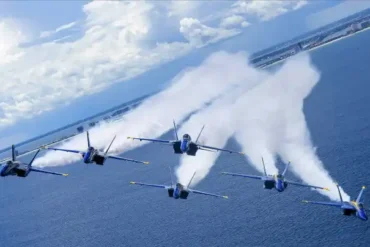
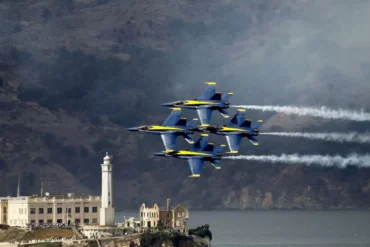
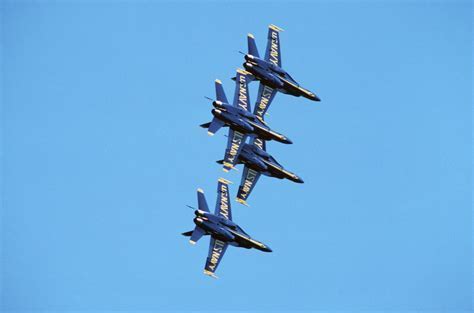
- Diamond Loop: Four aircraft perform a tight vertical loop in close formation.
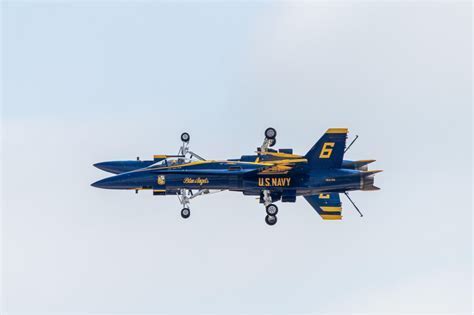
- Mirror Pass: One jet flies upright while another flies inverted beneath it with a gap of just 0.9 meters.
- Sneak Pass: A single jet approaches the crowd at nearly 700 mph, taking spectators by surprise.
The Blue Angels prioritize entertainment and daring close-quarters flying, making their demonstrations more visually striking and adrenaline-inducing than the Thunderbirds’ technical precision.
Cultural Impact and Public Engagement
Thunderbirds: Symbol of Air Force Power
The Thunderbirds symbolize the Air Force’s dominance in air superiority and global reach. Their performances have become a highlight at international airshows, and they frequently participate in national celebrations. In 2020, they joined the Blue Angels for a flyover of New York City, honoring frontline healthcare workers during the COVID-19 pandemic.
Blue Angels: Navy’s Pride in the Sky
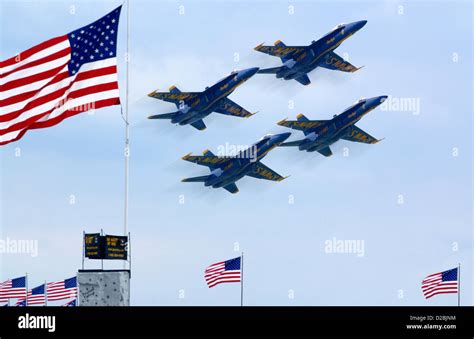
The Blue Angels are deeply ingrained in Navy culture, incorporating elements such as carrier landings into their displays. Their performances often include patriotic Navy music, reinforcing their connection to naval aviation heritage. Their history of commemorative shows, such as recreating WWII dogfights, cements their role as both entertainers and educators.
Visual Identity and Branding
Thunderbirds: Red, White, and Blue Precision
- Aircraft painted in patriotic red, white, and blue.
- Tail art: The Thunderbird symbol, inspired by Native American mythology.
- Sleek, modern aesthetic reflecting the high-speed nature of Air Force operations.
Blue Angels: The Golden Standard
- Aircraft painted in deep blue with gold accents.
- Performances often accompanied by traditional Navy music.
- Strong connection to naval history and heritage.
Conclusion: Which Team Reigns Supreme?
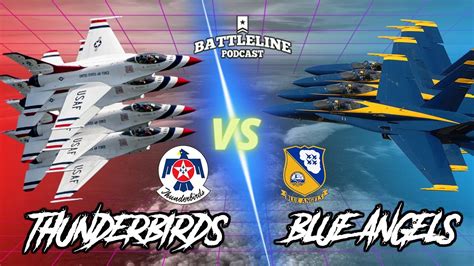
Both the Thunderbirds and Blue Angels represent the best of American military aviation. The Thunderbirds excel in precision and formation flying, highlighting Air Force capabilities, while the Blue Angels captivate audiences with thrilling, close-quarters maneuvers that emphasize Navy and Marine Corps traditions. Regardless of preference, these two teams continue to inspire millions with their unparalleled skill and aerial mastery.
FAQ
1. What is the main difference between the Thunderbirds and Blue Angels?
The Thunderbirds, as part of the U.S. Air Force, focus on precise formation flying using F-16 Fighting Falcons. The Blue Angels, part of the U.S. Navy, emphasize daring, high-energy maneuvers with F/A-18 Super Hornets.
2. Which team flies faster aircraft?
The Thunderbirds’ F-16 Fighting Falcon can reach speeds over 1,500 mph (Mach 2), while the Blue Angels’ F/A-18 Super Hornet has a top speed of 1,190 mph (Mach 1.8).
3. Do the Thunderbirds and Blue Angels ever perform together?
Yes! In 2020, the teams performed joint flyovers across multiple U.S. cities to honor frontline workers during the COVID-19 pandemic.
With their rich history, elite pilots, and breathtaking performances, the Thunderbirds and Blue Angels continue to serve as the pride of American military aviation. Whether it’s the Thunderbirds’ precision or the Blue Angels’ daring displays, both teams exemplify the highest levels of skill, discipline, and teamwork in aerial combat aviation.