Microgravity Is Quietly Reshaping the Human Brain
Human spaceflight has always been a negotiation between ambition and biology. Rockets can be engineered, trajectories calculated, habitats pressurized. The human brain, however, evolved under one relentless condition: gravity. Remove that constant, and the nervous system begins to adapt in ways that are only now becoming fully visible. Recent research confirms that time in space can physically change the shape of an astronaut’s brain, not just temporarily disorienting it, but subtly deforming it.
Earlier studies already demonstrated that microgravity causes the brain to shift within the skull. What makes the latest findings so consequential is that they go deeper. Brain regions themselves undergo nonlinear deformation, meaning the tissue stretches, compresses, and relocates in complex patterns rather than moving as a single unit. This discovery reframes how scientists think about neurological risk during long-duration spaceflight.
These changes are not abstract curiosities. They affect how astronauts balance, orient themselves, and process sensory information, all while performing precision tasks in an environment where mistakes are unforgiving.
The Landmark Brain Deformation Study Explained
In January 2026, a multinational team of seven researchers from the University of Florida, the German Aerospace Center, and the NASA Johnson Space Center published a detailed analysis in the journal Proceedings of the National Academy of Sciences. The study, titled “Brain displacement and nonlinear deformation following human spaceflight,” examined one of the largest astronaut brain imaging datasets to date.
Using high-resolution MRI brain scans, researchers analyzed 26 astronauts who had completed space missions and compared them with 24 control participants who experienced simulated spaceflight conditions on Earth. The contrast was striking. Astronauts showed a pronounced upward and backward shift of brain tissue, while control subjects displayed far less dramatic changes.
Crucially, the deformation was not evenly distributed. Regions involved in motor coordination, balance, and sensory integration were the most affected. This helps explain why astronauts frequently report spatial disorientation and motion sickness in orbit, followed by balance problems upon returning to Earth.
Where the Brain Changes Most—and Why It Matters
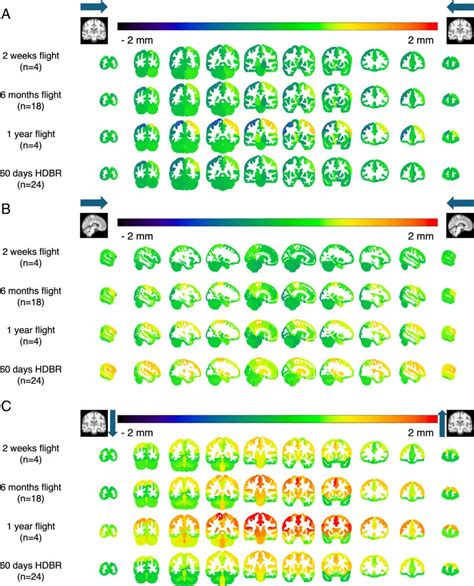
The areas most affected by space-induced deformation include structures responsible for interpreting body position and coordinating movement. In microgravity, the vestibular system—the inner-ear mechanism that senses orientation—no longer receives reliable gravitational cues. The brain compensates, reorganizing how it processes sensory inputs.
This neural adaptation is effective in space but becomes problematic during re-entry and readjustment to Earth’s gravity. Astronauts often struggle to walk in a straight line, experience delayed reflexes, and feel disoriented for weeks. The study confirms that these symptoms are not merely functional but are linked to measurable structural brain changes.
Encouragingly, researchers found no evidence of serious neurological damage. There were no increases in chronic headaches, no signs of tissue degeneration, and no lasting cognitive impairment directly tied to the deformation. Most changes resolved within approximately six months of returning to Earth. Still, duration mattered. The longer the mission, the more pronounced the deformation.
Brain Cavities, Cognitive Shifts, and Compounding Risks
This research does not exist in isolation. It builds on earlier findings that spaceflight can cause ventricular expansion, where fluid-filled cavities in the brain enlarge and may take years to fully recover. A separate 2024 study also reported signs of cognitive decline after just three days in space, raising questions about how quickly the brain responds to microgravity.
Taken together, these findings suggest a layered neurological response to spaceflight. Short missions trigger functional adaptation. Longer missions introduce structural deformation. Extended habitation may push these changes into unknown territory.
The absence of immediate catastrophic effects should not be mistaken for safety. The brain is remarkably plastic, but plasticity has limits. Understanding where those limits lie is now one of the most urgent questions in space medicine.
Implications for Moon Bases and Mars Missions
NASA’s Artemis program plans to return humans to the Moon and establish a long-term research presence. Mars missions, meanwhile, would require astronauts to remain in space or reduced gravity for years. These ambitions collide directly with what the new brain research reveals.
If months in orbit reshape the brain, what happens after years? How does partial gravity, such as the Moon’s one-sixth or Mars’ one-third of Earth’s, influence neural recovery or further deformation? The study raises uncomfortable but necessary questions about long-term neurological resilience.
Operationally, impaired sensory processing in space is not a minor inconvenience. Astronauts perform extravehicular activities, operate machinery, and make high-stakes decisions under extreme conditions. Even small delays in perception or balance can escalate into serious risks.
Beyond Astronauts: Space Tourism and Human Limits
The findings also resonate beyond professional astronauts. Space tourism is no longer theoretical. Private companies are already flying civilians into suborbital and orbital space. These passengers do not undergo years of physical conditioning or neurological screening.
Understanding how the average brain responds to microgravity is essential before spaceflight becomes accessible to broader populations. The same deformations that trained astronauts adapt to could be far more disruptive for untrained individuals.
Why This Research Changes the Future of Spaceflight
This study marks a turning point in how space agencies approach human exploration. It shifts the conversation from whether the brain adapts to how much adaptation is too much. Brain deformation may be reversible, but reversibility does not equal harmlessness.
As humanity pushes toward permanent off-world presence, the brain becomes a critical design constraint, just like radiation shielding or life-support systems. Future missions may require artificial gravity habitats, redesigned work schedules, or targeted neurological countermeasures.
Space can reshape the human brain. Whether humans can reshape spaceflight to protect it will define the next era of exploration.