Modern warfare is increasingly defined by information dominance, and few military assets embody that principle more clearly than Airborne Warning and Control System (AWACS) aircraft. These large radar-equipped aircraft act as the eyes and command centers of the sky, coordinating complex air operations while detecting threats hundreds of miles away. When an AWACS platform is destroyed or even damaged, the impact extends far beyond the loss of a single aircraft—it can disrupt entire air campaigns.
Recent incidents involving the U.S. E-3 Sentry, Russia’s A-50, and Pakistan’s Saab Erieye highlight how vulnerable yet strategically critical these aircraft have become. Each case demonstrates how targeting AWACS platforms is emerging as a central strategy in modern air warfare, where the battle for situational awareness can determine the success or failure of large-scale military operations.
The destruction or damage of these aircraft has sparked global attention not simply because of their cost—often hundreds of millions of dollars per platform—but because of the enormous operational advantage they provide to the forces that deploy them.
The Strategic Role of AWACS in Modern Air Combat
An AWACS aircraft serves as a high-altitude airborne command center equipped with powerful radar and communications systems. These platforms provide early warning, surveillance, and battle management, enabling commanders to monitor vast areas of airspace and coordinate multiple aircraft simultaneously.
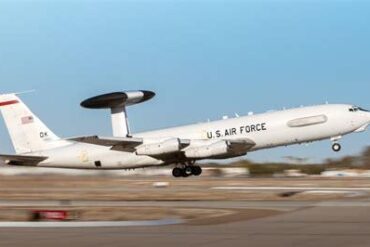
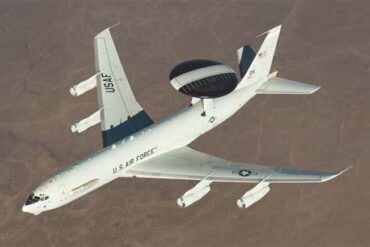
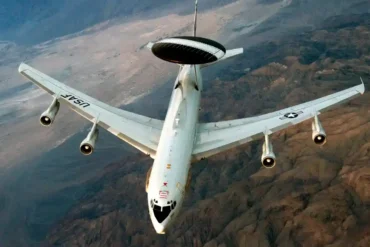
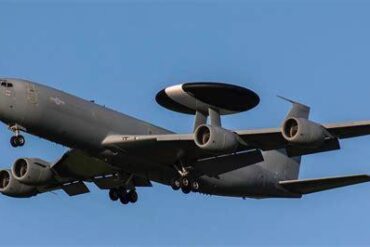
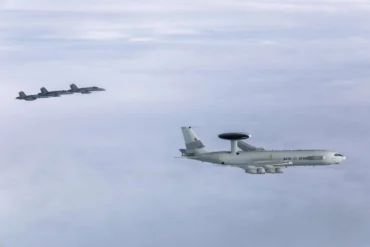
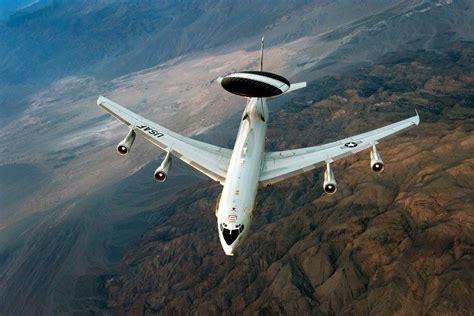
The U.S. Air Force E-3 Sentry, perhaps the most recognizable AWACS aircraft in the world, is based on the Boeing 707 airframe and features a distinctive rotating radar dome mounted above the fuselage. This radar can detect aircraft, missiles, and ships at distances of up to 250 miles, providing commanders with real-time awareness of the entire battlefield.
This capability transforms how air wars are fought. Fighter jets no longer need to rely solely on their onboard radar systems. Instead, AWACS aircraft guide them toward targets while allowing the fighters to remain electronically silent, significantly reducing the chance of detection.
This coordinated approach enables modern air forces to conduct complex multi-aircraft operations, involving stealth fighters, bombers, drones, and naval assets, all synchronized through a single airborne command platform.
Because of this central role, destroying an AWACS aircraft effectively blinds the enemy’s air defense network, forcing fighter pilots to operate with limited situational awareness.
The Iranian Strike on a U.S. E-3 Sentry
A dramatic example of this vulnerability occurred on March 27, 2026, when an E-3 Sentry stationed at Prince Sultan Air Base in Saudi Arabia was severely damaged during an Iranian attack. The strike reportedly involved a Shahed-136 one-way attack drone, a low-cost weapon that has gained notoriety in recent conflicts.
The attack took place amid escalating tensions following Operation Epic Fury, a U.S.-led military campaign launched against Iranian targets earlier in the year. As part of its response posture, the United States had deployed approximately six E-3 Sentry aircraft to the region to provide surveillance and command capabilities.
The Iranian drone strike not only damaged the AWACS aircraft but also injured several U.S. personnel and damaged multiple refueling tankers stationed at the base.
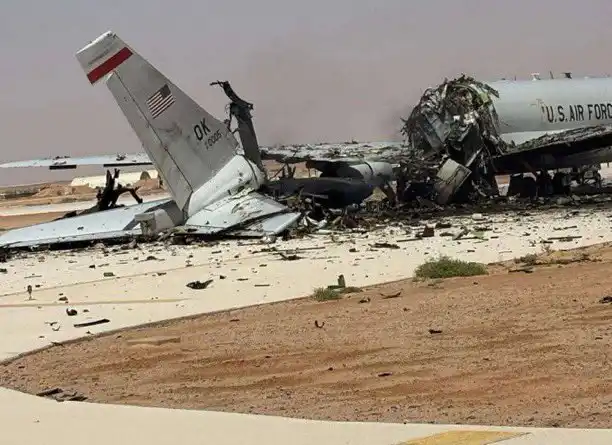
If confirmed as a combat loss, the incident would mark the first operational destruction of an E-3 Sentry in nearly five decades of service. Beyond the financial loss—estimated at roughly $700 million per aircraft—the attack highlighted the vulnerability of even the most sophisticated surveillance platforms to asymmetric threats such as inexpensive drones.
The symbolic significance was equally powerful: a weapon costing roughly $20,000 had reportedly crippled one of the most advanced airborne command systems ever built.
Why AWACS Are Prime Targets in Warfare
Military planners often emphasize a simple strategic principle: neutralize the enemy’s support systems before engaging frontline forces. AWACS aircraft sit at the top of that list because they enable almost every other element of an air campaign.
When operational, an AWACS platform can:
- Detect enemy aircraft long before ground radar systems
- Coordinate dozens of fighter jets simultaneously
- Track missile launches and drone swarms
- Provide battle management and communications relay
- Extend radar coverage over oceans or mountainous terrain
Without this airborne coordination, fighter pilots must rely on limited onboard sensors and fragmented communication networks.
As a result, the destruction of an AWACS platform can create dangerous blind spots in the air defense network, delaying threat detection and reducing the time available to intercept hostile aircraft or missiles.
This is why many air combat doctrines prioritize a simple operational objective: “first kill the AWACS.”
Russia’s Costly Losses of A-50 Early Warning Aircraft
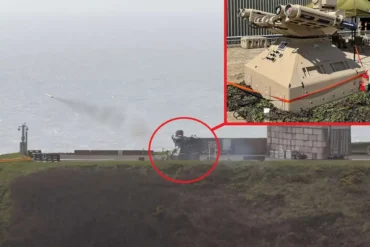
Russia experienced the consequences of losing AWACS platforms during the war in Ukraine. In January 2024, Ukrainian forces successfully shot down a Russian A-50U airborne early warning aircraft over the Sea of Azov, marking one of the most significant air defense successes of the conflict.
The A-50, built on the Ilyushin Il-76 transport aircraft, plays a role similar to the American E-3 Sentry. It carries a large rotating radar capable of tracking multiple aerial targets and coordinating Russian fighter jets.
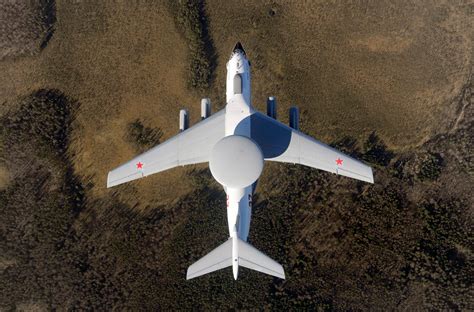
The aircraft was reportedly destroyed using a U.S.-supplied Patriot PAC-2 missile, demonstrating how advanced surface-to-air systems can threaten even high-value airborne assets operating far behind the front line.
Just weeks later, Ukrainian forces struck again. A second A-50U aircraft was destroyed in February 2024, this time deeper within Russian-controlled territory near Krasnodar Krai. The attack reportedly involved a Soviet-era S-200 missile system, modified for long-range engagement.
These back-to-back losses dealt a severe blow to Russia’s airborne surveillance capabilities. The country possesses only a limited number of A-50 aircraft, meaning each loss significantly reduces its ability to monitor airspace and coordinate fighter operations.
In response, Russia reportedly grounded parts of its fleet and began deploying fighter escorts to protect its remaining AWACS aircraft.
Pakistan’s Saab Erieye Loss During South Asian Tensions
A similar scenario unfolded in South Asia during the 2025 India-Pakistan border crisis. Reports emerged that an Indian S-400 air defense system successfully shot down a Pakistan Air Force Saab Erieye-2000 airborne early warning aircraft.
The Erieye system, mounted on the Saab 2000 turboprop aircraft, is a highly capable surveillance platform designed to detect airborne threats across large regions. Unlike traditional rotating radar domes, the Erieye uses a fixed active electronically scanned array (AESA) mounted along the top of the fuselage.
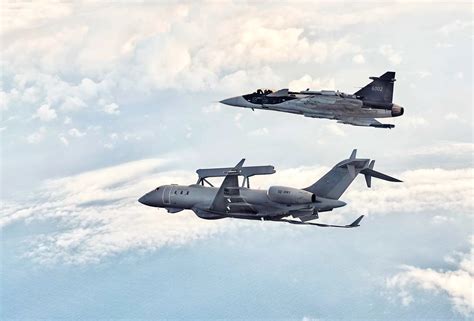
According to statements from Indian Air Force leadership, the aircraft was destroyed from a distance of approximately 300 kilometers, representing one of the longest recorded surface-to-air missile kills.
The loss was particularly significant because Pakistan operates only a small fleet of Erieye aircraft, meaning the destruction of even one platform dramatically affects the country’s airborne surveillance coverage.
Some reports even suggested that a second Erieye aircraft may have been damaged or destroyed during an Indian missile strike on Bholari Air Base, though Pakistan has not officially confirmed these losses.
The Design Vulnerabilities of AWACS Platforms
Despite their immense value, AWACS aircraft possess inherent vulnerabilities rooted in their design priorities. To fulfill their mission effectively, these aircraft must carry large radar arrays, powerful communication equipment, and multiple operators, resulting in large and easily detectable airframes.
This means AWACS platforms typically sacrifice:
- Stealth capability
- High maneuverability
- Supersonic speed
- Extensive defensive systems
Instead, they rely heavily on distance from the battlefield and fighter escorts for protection.
However, the emergence of long-range air defense systems, hypersonic missiles, and drone swarms has begun to erode the safety previously afforded by operating far behind the front lines.
Even relatively inexpensive weapons can now threaten these aircraft if they manage to penetrate defensive layers.
The Future of Airborne Early Warning Systems
The recent incidents involving the E-3 Sentry, A-50, and Saab Erieye illustrate a broader shift in modern warfare: the battle for sensor dominance is becoming just as important as the battle for air superiority.
Countries around the world are now investing in next-generation airborne surveillance platforms such as the Boeing E-7 Wedgetail, which features advanced radar systems and improved networking capabilities.
However, even these modern systems will remain high-value targets in any major conflict.
As warfare continues to evolve with the integration of drones, artificial intelligence, and network-centric combat, the importance of AWACS aircraft will only grow. At the same time, adversaries will continue developing strategies specifically designed to neutralize these airborne command centers.
The destruction of a single AWACS aircraft can disrupt an entire air campaign, degrade coordination between fighter jets, and weaken the overall effectiveness of a nation’s air power.
In the high-stakes environment of modern aerial warfare, eliminating the enemy’s eyes in the sky may prove more decisive than shooting down dozens of fighter jets.