The announcement of the Trump-class battleship has stirred both intrigue and controversy, not only for its audacious specifications but also for the stark contradictions it presents against modern naval strategy. Positioned as the most formidable maritime war machine ever conceived, the plan may already be sailing against a headwind of logistical, strategic, and technological challenges that threaten to sink it long before the keel is laid.
The Announcement Heard Around the Seas
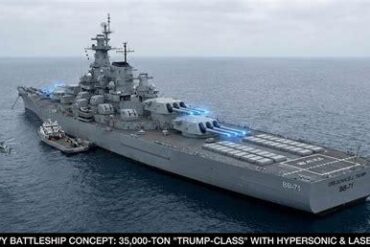
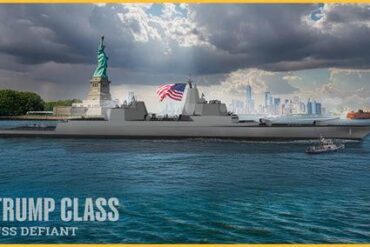
In a grand address from his Mar-a-Lago residence, President Donald Trump declared the approval of a plan for two revolutionary battleships, headlined by the USS Defiant (BBG-1). Labelled the “largest we’ve ever built,” the vessel promises to be the fastest, the biggest, and 100 times more powerful than any warship that has previously sailed under the American flag.
Trump emphasized that these ships will lead a ‘Golden Fleet’—a future vision of 20 to 25 super battleships. The first of its kind is aimed for launch in the early 2030s, flaunting a staggering length of up to 880 feet and displacing over 35,000 tons. This sets it far apart from the current generation of U.S. Navy surface combatants in both scale and ambition.
A Floating Fortress or an Unwieldy Relic?
At the heart of the Trump-class initiative lies an apparent desire to revive the bygone era of dreadnought supremacy. However, experts are quick to point out that battleships became militarily obsolete by the mid-20th century. Aircraft carriers and missile destroyers, with their long-range strike capabilities, made these massive steel giants redundant.
According to Bernard Loo of the S. Rajaratnam School of International Studies, the Trump-class is less about strategic necessity and more about national prestige. He likens it to Japan’s Yamato and Musashi, World War II’s behemoths that were sunk before they could leave a mark.
Overwhelming Armament Meets Overdue Technology
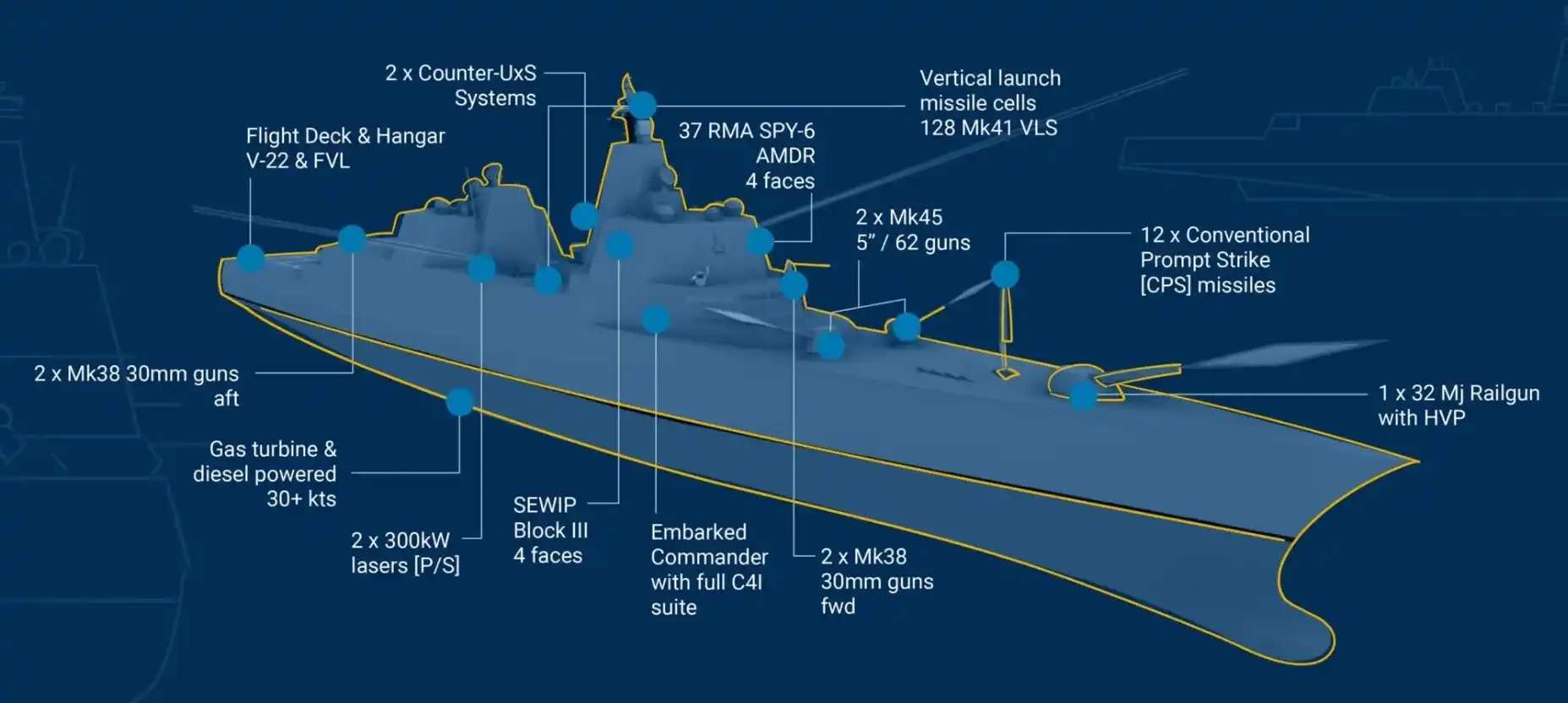
The projected armament of the Trump-class reads like a catalog of the most futuristic and destructive tools in naval warfare:
- A 32 MJ Railgun with Hypervelocity Projectiles (HVP)
- 128 Mk41 Vertical Launch System (VLS) cells
- Surface Launch Cruise Missile-Nuclear (SLCM-N)
- 12 Conventional Prompt Strike (CPS) hypersonic missiles
- High-energy lasers (either two 300kW or two 600kW systems)
- Close-in weapon systems including 30mm guns, RAM launchers, and counter-uncrewed systems
However, many of these systems are still in developmental limbo. The electromagnetic railgun project was officially paused in 2021 due to overwhelming technical hurdles and budget overruns. Directed-energy weapons, while tested, are not yet robust enough for deployment in combat conditions on this scale.
Size as Both Strength and Vulnerability
The colossal proportions of the Trump-class—a length nearing three football fields and displacement over double that of Zumwalt-class destroyers—grant it unmatched weapons payload capacity. But this very size also makes it a liability in modern naval warfare.
As Mark Cancian from the Center for Strategic and International Studies (CSIS) notes, the ship would be a “bomb magnet.” In an era dominated by hypersonic missiles, sea drones, and long-range satellite-guided systems, a vessel of this magnitude could easily become a high-priority target.
Modern naval doctrine has embraced distributed lethality—dispersing firepower across many smaller, interconnected platforms. The Trump-class, with its supermassive presence and high cost, contradicts this principle, drawing unnecessary attention and risk.
The Golden Price Tag of Vanity
Bryan Clark from the Hudson Institute estimates that each Trump-class vessel could cost over $8 billion, possibly reaching $13.5 billion once first-ship premiums, supply chain inflation, and workforce limitations are factored in.
To put this in context:
- Arleigh Burke-class destroyers cost approximately $2.7 billion.
- The USS Gerald R. Ford aircraft carrier cost around $13.3 billion.
Given the steep price and questionable value, such expenditures are being labeled as “strategic hubris.” The U.S. Navy’s history with the Zumwalt-class destroyers, initially slated for 32 ships but reduced to just three due to budgetary overruns, stands as a cautionary tale.
Misaligned with Naval Evolution
Modern naval strategy emphasizes agility, stealth, networked coordination, and distributed threat response. The Trump-class represents a regression to centralized firepower and hulking visibility—tactical disadvantages in today’s multi-domain operational theater.
Cancian explains that the Navy’s focus has shifted to many smaller nodes—each acting as both sensor and shooter—linked by a high-speed, secure network. The Trump-class, by contrast, centralizes immense power into a few highly visible targets, undermining the entire distributed operations model.
The Mirage of Completion
Even assuming political continuity and defense budget stability, construction timelines are daunting. The DDG-1000 took over a decade from concept to commissioning. The Trump-class, being double the size and exponentially more complex, would require a similar or even longer timeframe, pushing its operational readiness potentially into the late 2030s or beyond.
Moreover, the design itself remains speculative, with engineers yet to integrate several of the key weapon systems. The lack of mature technology, combined with shipyard labor shortages, compounds delays and cost inflation.
Political Fragility and the Specter of Cancellation
If historical precedent is any guide, the Trump-class battleship may not survive the turbulent tides of U.S. political transition. Defense programs have often been casualties of shifting administrations. The Constellation-class frigate program was scrapped as recently as last month, demonstrating the precariousness of such ambitious undertakings.
With a new administration, the entire philosophy of building concentrated platforms may be re-evaluated and deemed incompatible with evolving naval priorities. The Trump-class could ultimately be remembered as a campaign headline rather than a hull number.
The Verdict: Sunk by Its Own Ambition?
While the Trump-class battleship is cloaked in grandeur and coated with the gold leaf of military fantasy, it rests on fragile structural, strategic, and fiscal foundations. It draws inspiration from a romanticized past while ignoring the hard-won lessons of modern naval warfare.
The ambition to field a platform with unparalleled firepower is understandable, even laudable. But in execution, the concept remains riddled with paradoxes:
- It aims to revive a warship class long rendered obsolete.
- It commits to weapon systems still years from battlefield readiness.
- It contradicts the very doctrines guiding today’s fleet design.
- It burdens taxpayers with astronomical costs for uncertain benefits.
The Trump-class may very well become a symbol—not of dominance—but of the perils of nostalgia-driven defense strategy, where politics and vanity steer the helm while practicality is cast overboard.
Whether the USS Defiant ever floats or not, the larger question remains: Should 21st-century naval warfare be led by symbols of might or systems of smart?
As things stand, the Trump-class appears poised to join the long list of defense programs that promised too much, cost too dearly, and delivered too little.