In the early hours of July 30, 2025, the Pacific region was rocked by a devastating 8.8-magnitude earthquake originating near Russia’s Kamchatka Peninsula. As the seismic waves rippled through the Pacific Ring of Fire, immediate tsunami warnings were issued across multiple nations, triggering a wave of global travel disruptions. The magnitude of this natural disaster has led to the cancellation, rerouting, and grounding of flights across key aviation hubs in Hawaii, Japan, and the U.S. West Coast, with major airlines like Alaska Airlines, Hawaiian Airlines, Delta, American Airlines, and Southwest taking emergency precautions.
Kamchatka Quake Sends Shockwaves Across the Pacific
At 1:12 AM GMT, a seismic event struck approximately 136 kilometers east of Petropavlovsk-Kamchatsky, a city located deep within the seismically active Kamchatka region. This remote but geopolitically crucial area is a hotspot of tectonic activity, making the quake’s 8.8 magnitude not only rare but globally consequential. The tremor sent shockwaves through the Pacific Ocean, and within minutes, the Pacific Tsunami Warning Center (PTWC) issued emergency alerts.
Although the PTWC initially assessed the situation as posing no imminent threat of a major tsunami to Hawaii or the U.S. mainland, it stressed the danger of minor sea level changes and dangerous coastal currents. In disaster-prone zones, this was enough to warrant immediate suspension of air and maritime operations, even in the absence of visible damage.
Airlines Ground Flights Across the Pacific Theater
Major U.S. carriers swiftly executed emergency contingency plans. Alaska Airlines and Hawaiian Airlines led the response by grounding all flights to and from Hawaii, especially on high-traffic routes connecting the mainland to Maui (OGG), Honolulu (HNL), Kona (KOA), and Lihue (LIH). Several en-route flights were either diverted to alternate airports or reversed midair to minimize the risk of flying over unstable oceanic regions.
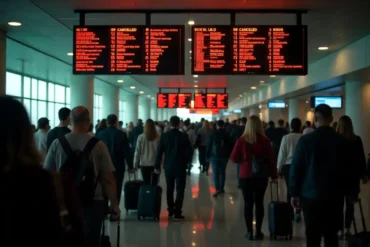
Delta, American, and Southwest Airlines faced parallel chaos. Flights destined for or departing from San Francisco (SFO), Seattle-Tacoma (SEA), and Los Angeles (LAX) were abruptly grounded or delayed. Rebooking counters were flooded as travelers scrambled to adjust their itineraries amid a rapidly evolving situation. Airports braced for further disruptions as news of tsunami wave arrival times created uncertainty hour by hour.
Japan on High Alert as Waves Reach Coastal Zones
Japan, deeply entrenched within the Pacific Ring of Fire, activated its extensive disaster response protocols. Tsunami waves generated from the Kamchatka quake reached northern Japan, with Hokkaido facing the brunt of the impact. Authorities issued evacuation advisories, and Sendai Airport, situated in tsunami-vulnerable Miyagi Prefecture, suspended all operations.
Japan Airlines (JAL) and All Nippon Airways (ANA) halted flights to and from northern Japan, particularly in regions facing imminent tsunami activity. This included suspensions of flights to Taiwan and other destinations that would cross the potentially unstable airspace.
Importantly, nuclear facilities across Japan, including those in Fukushima, were swiftly assessed. Tokyo Electric Power Company (TEPCO) confirmed no signs of damage, reassuring the public that critical infrastructure had remained intact despite the proximity to the seismic event. Japan’s nuclear systems, fortified since the 2011 Tōhoku earthquake, demonstrated their resilience once again.
U.S. West Coast: Ports Close and Airports Disrupted
As the tsunami waves reached California, Oregon, and Washington, the National Weather Service issued advisories for dangerous rip currents and abnormal tides. Waves began hitting San Francisco Bay and Seattle’s coastal zones just hours after the initial tremor. In response, beach closures were enforced and fishing and recreational boating operations were halted across several ports.
San Francisco, Los Angeles, and Seattle ports temporarily ceased cargo operations, triggering ripple effects in the shipping sector. These closures also impacted adjacent airports, which already struggled with flight backlogs and anxious travelers awaiting updates. Local emergency teams patrolled beaches and harbors to enforce safety regulations.
Coordinated Airline and Government Responses
Airlines implemented emergency customer service protocols, including:
- Waived change and cancellation fees for affected flights.
- Rebooking flexibility, including changes to alternate dates or destinations.
- Accommodations and meal vouchers for stranded passengers.
- Use of AI-powered notification systems to update customers in real time.
Meanwhile, transportation authorities in the U.S., Japan, and Russia coordinated real-time monitoring of tsunami waves, airspace stability, and port operations. The Federal Aviation Administration (FAA) maintained continuous contact with airline operation centers, while Japan’s Meteorological Agency provided hourly updates on wave intensity and direction.
Technology Behind Tsunami Detection and Response
The success in averting a major aviation disaster was largely credited to advanced tsunami monitoring systems. The Pacific Tsunami Warning Center relies on deep-ocean assessment and reporting of tsunamis (DART) buoys, satellite imaging, and underwater seismic sensors. These tools allowed authorities to track wave propagation, predict landfall, and alert aviation controllers well ahead of the threat zone’s saturation.
Although a full-scale tsunami didn’t materialize, experts stress that the energy released by an 8.8-magnitude quake remains inherently dangerous. Even modest water surges can destabilize aircraft during takeoff and landing, flood airport runways, and disrupt ground operations. Pilots and ATC teams relied on risk modeling and live oceanographic data to determine when it was safe to resume operations.
Travelers Face Uncertainty Amid Rebooking Chaos
As of midday on July 30, thousands of passengers remain displaced across international terminals, especially in Hawaii, where Honolulu International Airport became a focal point of confusion. Airport authorities set up crisis management booths, helping passengers navigate delays, hotel bookings, and flight status updates.
Mobile applications such as FlightAware, TripIt, and airline-specific apps saw a surge in usage as travelers sought real-time rerouting options. Many passengers took to social media to express frustration, though most acknowledged the necessity of safety-first decisions made by the airlines.
Airline customer service teams, especially those at Delta, Hawaiian Airlines, and Southwest, worked overtime to communicate policy exceptions and refund pathways, a move that helped reduce panic and maintain operational order.
A Wake-Up Call for Global Aviation and Emergency Preparedness
This earthquake has reignited conversations about the vulnerability of global air travel to natural disasters. Despite the absence of widespread structural damage, the chain reaction of delays, reroutes, and airport closures demonstrated how even non-catastrophic tsunami events can paralyze major aviation corridors.
The episode reinforces the urgency of:
- Investing in early warning systems at all major airports in seismically active zones.
- Regular seismic drills for airline and airport personnel.
- Real-time data sharing protocols between international aviation and geological agencies.
- Disaster contingency planning integrated with airline customer service platforms.
Conclusion: The Cost of Caution, The Value of Vigilance
The Kamchatka earthquake may not have caused towering tsunami waves or mass casualties, but its effect on the global aviation ecosystem has been profound. Airlines that halted flights in the name of passenger safety demonstrated operational maturity, while national governments mobilized resources to manage the evolving threat.
For travelers and industry professionals alike, this event is a critical reminder of the fragile equilibrium between nature and modern infrastructure. As seismic activity continues to be a persistent threat in the Pacific, readiness and adaptability will remain the twin pillars of air travel resilience in the face of environmental volatility.