Türkiye has crossed a historic threshold in naval engineering by officially commencing the MUGEM-class aircraft carrier program in early 2025. Built entirely within Istanbul Naval Shipyard, this groundbreaking project catapults Türkiye into a select group of nations capable of designing and constructing a full-scale aircraft carrier domestically. The development marks a strategic shift in the balance of maritime power, as Türkiye redefines its role not only as a regional naval leader but as a rising global force in defense manufacturing.
The Rise of the MUGEM-Class: Indigenous Power and Purpose
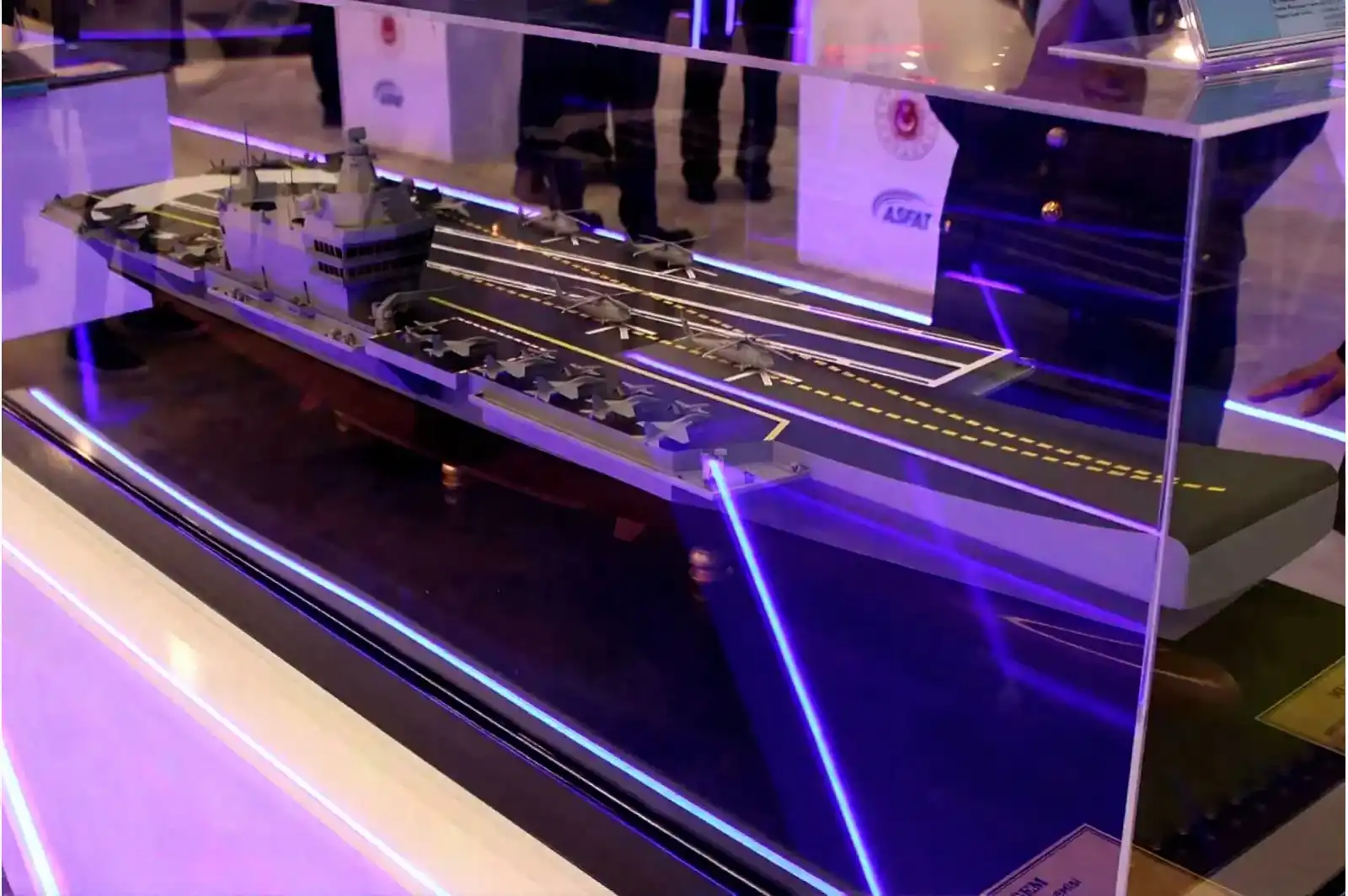
The MUGEM-class is not merely a ship; it is the embodiment of Türkiye’s evolving naval doctrine, self-reliant industrial capability, and ambition to project power far beyond its shores. The carrier, with a planned displacement of 60,000 tons and a length of 285 meters, will be the largest warship ever constructed in Türkiye. It reflects a monumental evolution in the country’s MILGEM national warship program, moving beyond corvettes and frigates into the capital ship category.
Constructed with a STOBAR configuration (Short Take-Off But Arrested Recovery), the MUGEM’s flight deck includes a 12-degree ski-jump ramp and a homegrown arrestor system, enabling it to launch and recover various aircraft types. These will range from the Bayraktar TB3 UCAV, the stealth-capable Kızılelma drone, and the HÜRJET light combat jet, to potential naval variants of the TF-Kaan fifth-generation stealth fighter.
Capable of carrying 30 aircraft in its hangar and 20 more on deck, the MUGEM is engineered to support continuous air operations. This hybrid model reflects not just flexibility in mission types—air defense, strike, surveillance—but also Türkiye’s drive to integrate manned and unmanned platforms within a cohesive air wing.
Technological Integration: National Capabilities at Work
Unlike traditional carrier programs built through international consortiums, MUGEM is an all-Turkish initiative. Core systems are being developed by domestic defense giants such as HAVELSAN, ASELSAN, and STM. The carrier’s combat systems, radar and sensor suite, electronic warfare architecture, and command infrastructure are being fully designed, tested, and integrated within Türkiye’s borders.
At its core, the ship will feature a COGAG (Combined Gas and Gas) propulsion setup, ensuring speeds exceeding 25 knots and operational endurance over 10,000 nautical miles. This gives the Turkish Navy extended reach across its strategic zones, from the Aegean and Eastern Mediterranean to the Indian Ocean.
This achievement demonstrates the effectiveness of Türkiye’s vertically integrated defense ecosystem—a streamlined model that rivals the complexity and industrial mass of programs in the U.S., China, and France, but operates with greater domestic concentration and control.
Global Benchmarks: How MUGEM Stands Against the Giants
To understand the significance of the MUGEM-class, one must compare it with global counterparts.
United States: Gerald R. Ford-Class Supercarriers
The U.S. Navy remains the standard bearer of aircraft carrier warfare. The Gerald R. Ford-class, displacing over 100,000 tons, features EMALS (Electromagnetic Aircraft Launch Systems), Advanced Arresting Gear, and the cutting-edge AN/SPY-6 radar. With a wing of 75+ aircraft, including F-35Cs, the Ford-class represents the culmination of over a century of naval aviation.
China: Type 003 Fujian-Class Carrier
China’s Fujian-class (Type 003), launched in 2022, marks its leap into electromagnetic launch technology. Displacing 80,000+ tons, the ship uses EMALS and is undergoing trials ahead of an expected late 2025 commissioning. China is also reportedly designing a nuclear-powered fourth carrier.
France: PANG Next-Generation Carrier
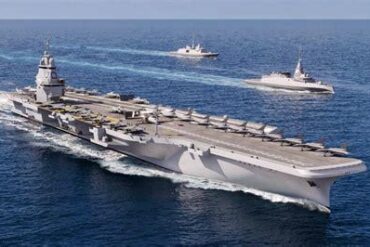
The PANG (Porte-Avions de Nouvelle Génération) will replace Charles de Gaulle in the 2030s. Built by Naval Group, this 75,000-ton carrier will run on K22 nuclear reactors, integrate EMALS, and serve as the launch platform for the FCAS aircraft developed with Germany and Spain.
In comparison, Türkiye has produced a technically competitive design with significantly faster timelines, greater cost efficiency, and complete industrial sovereignty. The MUGEM-class does not rely on foreign design inputs, making it one of the few fully nationalized aircraft carrier projects in the modern era.
Strategic Doctrine: Mavi Vatan and Power Projection
The MUGEM-class fits squarely into Türkiye’s expansive maritime vision known as “Mavi Vatan” (Blue Homeland). This doctrine calls for extended naval presence across the Mediterranean, Aegean, Black Sea, and beyond. As a command-and-control center, the MUGEM will provide:
- Full-spectrum air superiority at sea
- Maritime domain awareness
- Unmanned warfare capabilities
- Electronic and cyber warfare resilience
- Rapid humanitarian and combat deployment flexibility
Its strategic value extends to humanitarian relief, NATO missions, and joint operations, offering Türkiye a mobile base of operations untethered from regional constraints or foreign dependence.
From Anadolu to MUGEM: Building a National Strike Group
The MUGEM-class is not emerging in isolation. It follows the path paved by the TCG Anadolu, an amphibious assault ship modeled partially on Spain’s Juan Carlos I. Lessons from Anadolu’s construction and systems integration are being applied and scaled for MUGEM.
Additionally, platforms like the Ada-class corvettes, I-class frigates, and the future TF-2000 destroyers form the escort group that will support carrier operations. Türkiye is also progressing with its MILDEN-class submarine project, aiming for a balanced, multi-dimensional naval task force, all constructed under a unified national framework.
Together, these ships will form Türkiye’s first indigenously built carrier strike group, enabling coordinated maritime operations across diverse theaters. This holistic approach mirrors American and Chinese strategies but is distinguished by its consolidated national control and localized industrial efficiency.
Geopolitical Implications: Signaling Global Capability
The unveiling of the MUGEM-class has sent ripples through global naval circles. For NATO, it presents an opportunity to enhance regional force projection and reduce reliance on U.S. carriers for Eastern Mediterranean operations. For Türkiye’s competitors, particularly in the Eastern Mediterranean and beyond, it marks a sharp escalation in naval deterrence.
The ship’s development coincides with Türkiye’s rising defense exports, active diplomacy in Africa, Central Asia, and the Middle East, and a broader assertive foreign policy. As global naval architecture leans increasingly toward autonomous systems, multi-role carriers, and unmanned integration, MUGEM places Türkiye among the countries shaping that future—not just following it.
Conclusion: A Maritime Power Reimagined
The MUGEM-class aircraft carrier is the clearest signal yet that Türkiye has fully emerged as a carrier-capable nation with the industrial base, technical expertise, and strategic vision to rival traditional naval powers. More than a platform of steel and circuits, it is the culmination of decades of planning, investment, and technological advancement.
By choosing to build an entirely indigenous carrier, Türkiye has not only joined an elite club but has redefined the criteria for entry. This warship is both a tool of modern warfare and a symbol of national ambition, ready to patrol the blue waters of the future with confidence, independence, and strength.