Few moments in American sports capture spectacle, patriotism, and pure logistical daring the way a college basketball game played on a US aircraft carrier deck does. The idea sounds almost cinematic — sneakers squeaking on polished wood laid over steel, floodlights instead of scoreboards, the Pacific breeze instead of HVAC ventilation. Yet it happened more than once, transforming naval engineering into sporting theatre. We explore how a floating airbase evolved into a basketball court, why universities embraced the experiment, and how the spectacle returned in 2022 after a decade-long pause.
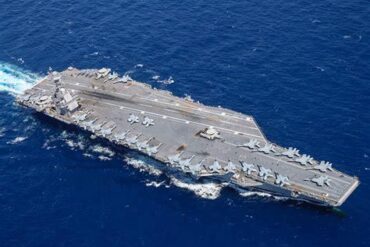
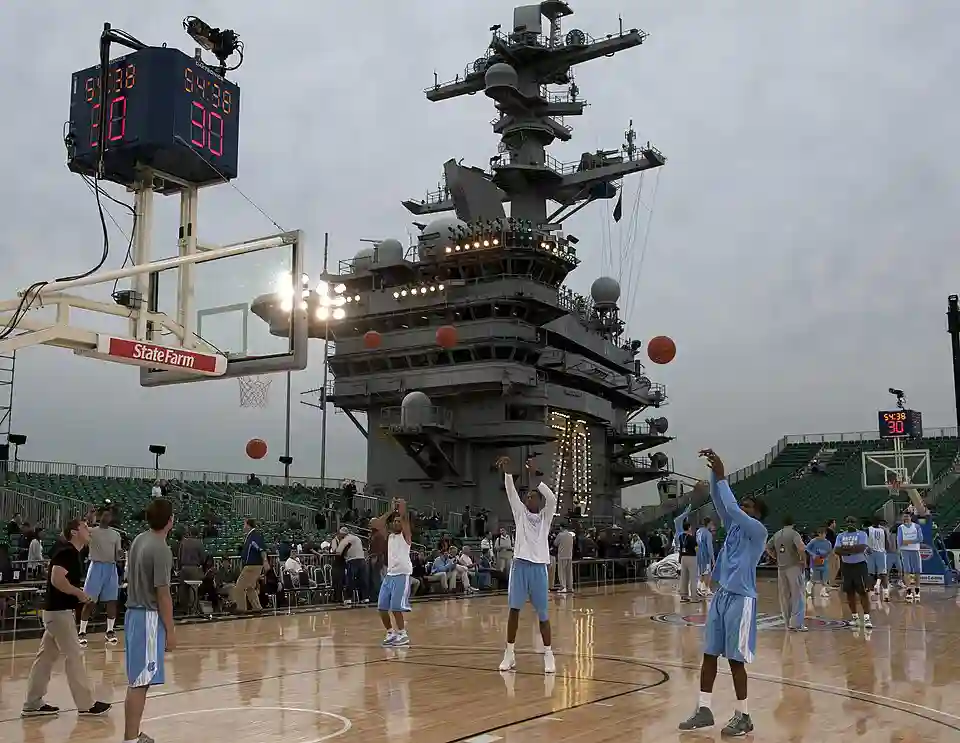
College basketball thrives inside packed arenas — climate-controlled, acoustically tuned, predictable. A US aircraft carrier is the opposite in every possible way. The USS Carl Vinson, USS Midway, USS Bataan, USS Yorktown, and later the USS Abraham Lincoln, anchored not just ships but entire crowds, athletes, media networks, and national attention. Temporary courts rose where F/A-18s usually sat. Bleachers stretched across flight decks where catapults launched jets.
Weather, not referees, became the most unpredictable influence. Sunshine meant perfect play. Moisture meant danger. Enthusiasm alone could not tame the Pacific breeze. Yet the symbolism was powerful — athletes competing over open ocean, honoring service members not with speeches but with sport.
Veterans Day 2011 — The Breakthrough Event
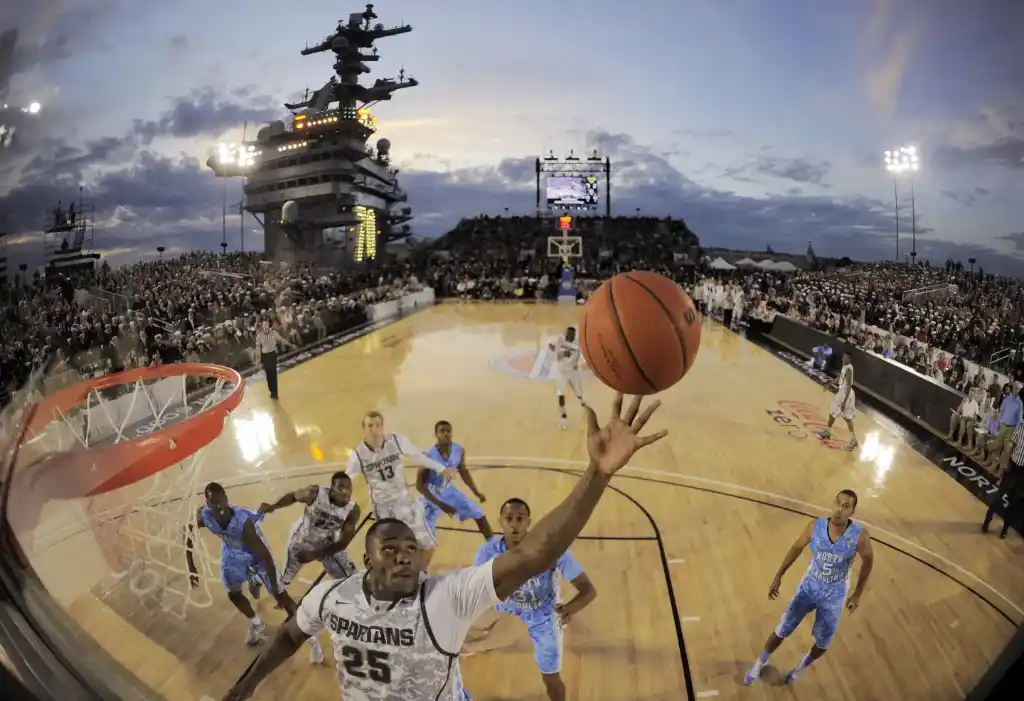
The breakthrough came Veterans Day 2011, when North Carolina and Michigan State squared off aboard USS Carl Vinson in San Diego. Over 8,000 fans, most of them uniformed service members, packed the deck. President Barack Obama and First Lady Michelle Obama took front-row seats under calm California sky. The court glowed under spotlights, wooden planks gleaming against battleship gray. The wind was gentle, the floor dry, and the atmosphere electric.
It wasn’t simply basketball — it was ceremony, tribute, and innovation woven together. The success ignited ambition. Planners wanted bigger, louder, more widespread.
The Carrier Classic Expands — And Problems Surface
Momentum carried into 2012, when four carrier games were scheduled: USS Bataan in Jacksonville, USS Yorktown in South Carolina, USS Midway in San Diego, and another slated exhibition. Expectations soared, but nature pushed back.
Condensation turned freshly installed hardwood into a hazard. A second game on USS Yorktown was cancelled mid-event. The USS Bataan game halted at halftime. Even the USS Midway, normally kissed by gentle coastal winds, saw its matchup between Syracuse and Ohio State delayed two full days due to rain. When action resumed, swirling gusts bent shots off-line like invisible defenders.
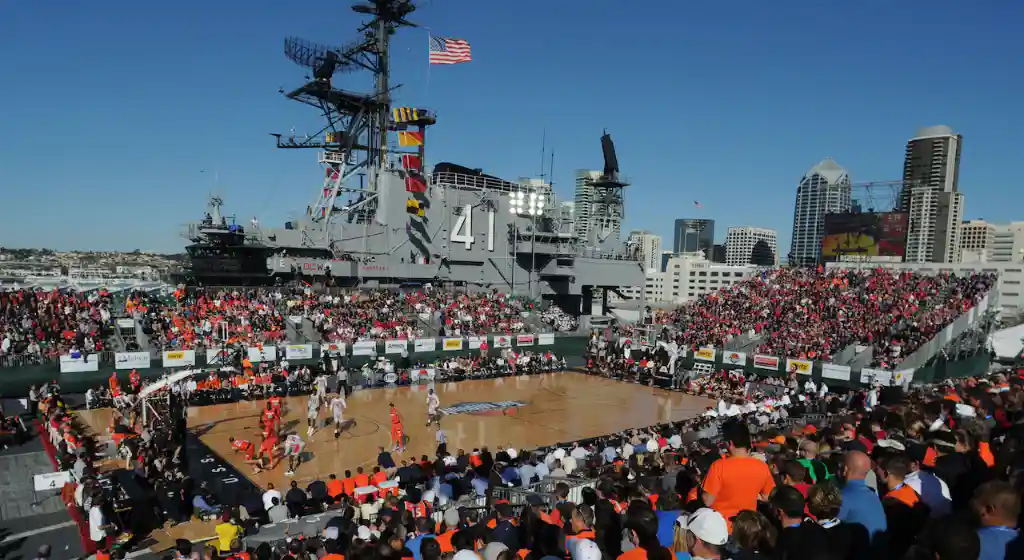
Slip hazards weren’t atmospheric footnotes — they were game-breaking safety threats. Unlike football, where mud and rain enhance drama, basketball requires traction, balance, and precision. On carriers, weather was not a backdrop but a participant.
The vision paused. For ten years no carrier hosted another tip-off. Engineers, athletic departments, and Navy planners stored the blueprint like a classified file — waiting for timing, confidence, and technology to align.
A Triumphant Return — USS Abraham Lincoln, 2022
One decade later, the concept resurfaced with striking resilience. On Veterans Day 2022, Michigan State and Gonzaga met aboard USS Abraham Lincoln as part of the Armed Forces Classic. Lessons from 2012 shaped every decision — improved moisture controls, refined court materials, more conservative scheduling. This time, winds cooperated and the deck stayed dry.
With 3,000 spectators gathered beneath open sky, the event balanced respect and spectacle. Helicopters hovered in the distance. Red-white-blue paint reflected sunset. Every shot and defensive rotation unfolded against the vastness of the Pacific, reminding viewers that this court existed only temporarily — a hardwood island on steel.
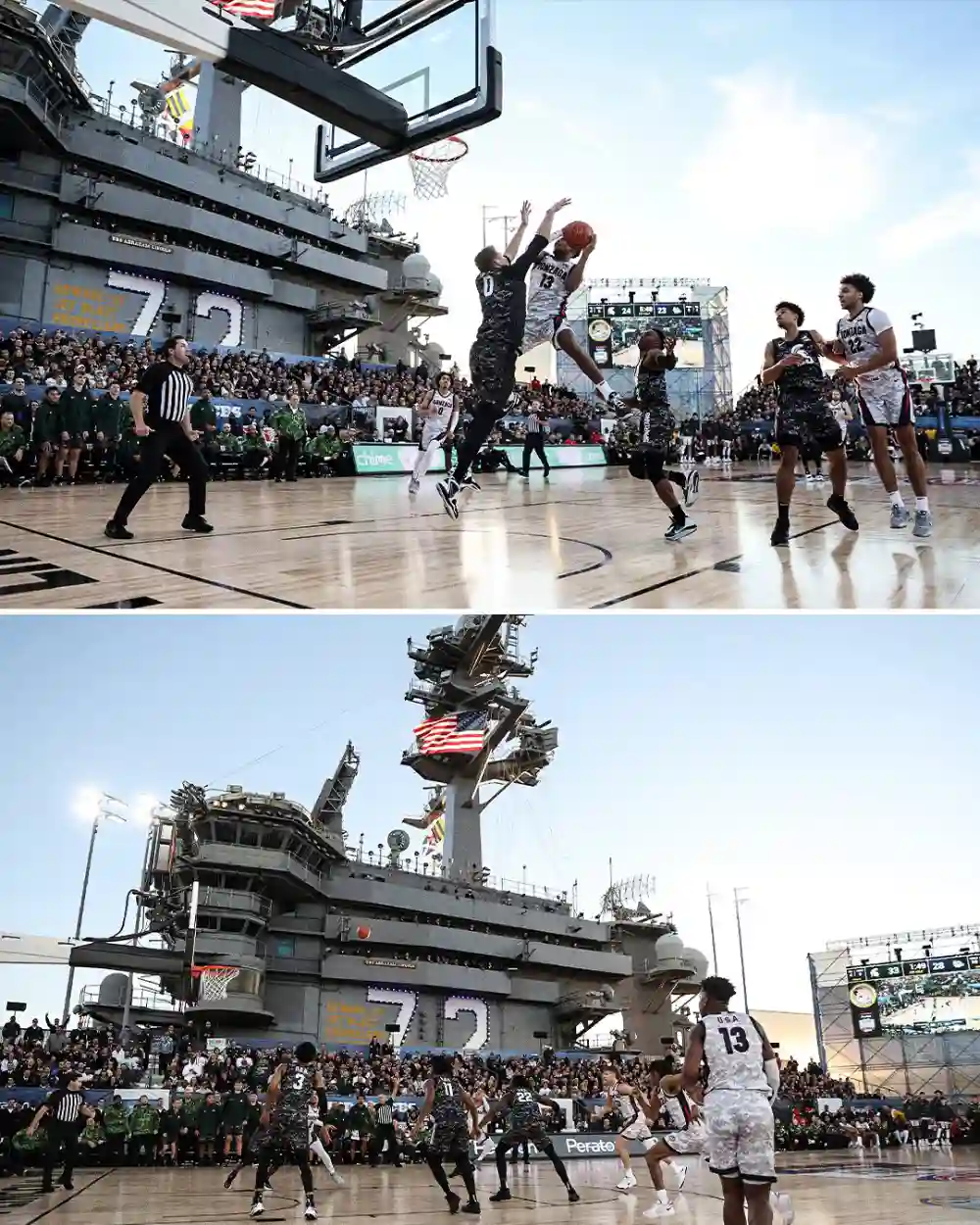
The success hinted that carrier games may return again. Nothing in sports matches the surreal experience of a three-pointer arcing between radar towers and jet blast deflectors. The Navy later embraced the visual power of carriers again when NASCAR announced a 2026 San Diego street race featuring carriers as dramatic backdrop — proof that this union of military steel and athletic spectacle still resonates.
Why It Mattered — Beyond Entertainment
These games never existed merely to entertain. They honored service members with front-row access to something normally confined to arenas hundreds of miles inland. They pushed the NCAA into new creative territory, testing the limits of broadcasting, logistics, climate management, and event design.
A court on a carrier represents American scale, mixing technology, culture, and gratitude into one moment. Hardwood laid atop steel. Sneakers where fighter jets slept. The national anthem floating across an open ocean rather than bouncing off concrete walls.
Whether future games return depends on risk, sponsorship, and military coordination — but the blueprint exists, proven twice now across decades of trial. There may be another night when fog gives way, winds calm, and college players step out where pilots once waited for catapult launch.
Until then, the memory remains solid as hull plating. A reminder that innovation in sport doesn’t require new rules — only a bold location, a willing Navy, and a deck big enough to build a court of dreams at sea.