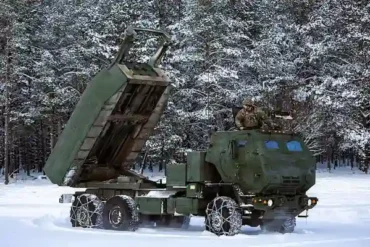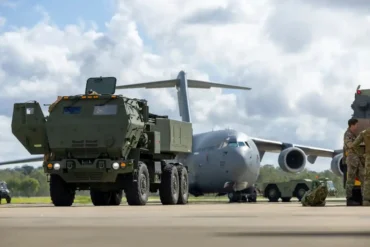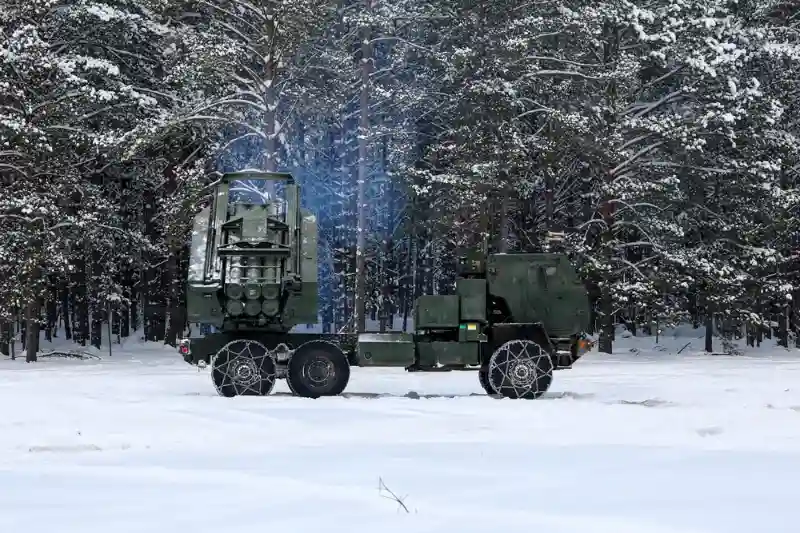
The deployment of U.S. Army rocket artillery units to eastern Lithuania for joint M142 HIMARS training with the Lithuanian Armed Forces marks a deliberate escalation in NATO’s long-range precision fires readiness along one of its most strategically sensitive borders. Conducted at the Pabradė training area, just kilometers from Belarus, the exercise demonstrates how allied forces are translating political commitments into concrete battlefield capabilities through hands-on cooperation, shared procedures, and synchronized command-and-control systems.
This training event was not designed as a symbolic show of presence. Instead, it reflected a methodical approach to interoperability, focusing on the practical mechanics that determine whether long-range fires can be employed rapidly and effectively in a real crisis. For Lithuania, which is preparing to field its own HIMARS capability, the exercise offered invaluable exposure to operational realities that cannot be replicated through classroom instruction or simulations alone.
The location itself carries strategic weight. Eastern Lithuania sits at the crossroads of NATO’s northeastern flank, bordered by Belarus and influenced by the broader military balance involving Russia’s Kaliningrad enclave. Training long-range precision fires in this environment sends a clear signal that allied forces are not only present, but fully integrated and prepared to operate under real-world geographic and political constraints.
Joint HIMARS Training at Pabradė: From Procedures to Precision
The joint activity took place on January 13, 2026, at the General Silvestras Žukauskas Training Area near Pabradė, involving U.S. Army soldiers from Bravo Battery, 1st Battalion, 14th Field Artillery Regiment, assigned to Task Force Pergale under the 41st Field Artillery Brigade. Lithuanian artillery personnel worked directly alongside their American counterparts, participating in launcher drills and mission-essential tasks that underpin the HIMARS system’s effectiveness.
Rather than focusing on live missile launches, the training concentrated on core launcher operations. Crews rehearsed pre-mission inspections, maintenance routines, digital fire mission processing, radio communications, and precise launcher positioning. These steps are critical for a system designed to deliver time-sensitive precision strikes while minimizing exposure to enemy counter-battery fire. In modern high-threat environments, survivability depends as much on speed and coordination as on the weapon’s range.
For Lithuanian forces, this exposure provided insight into the tempo and discipline required to operate a highly mobile rocket artillery system. Observing and participating in U.S. procedures allows future Lithuanian HIMARS units to align their own doctrine with NATO standards from the outset, reducing friction once national systems are delivered and declared operational.
Why HIMARS Matters on NATO’s Northeastern Flank
The M142 High Mobility Artillery Rocket System has become a cornerstone of U.S. and allied long-range fires doctrine due to its unique blend of mobility, precision, and modularity. Mounted on a wheeled chassis, HIMARS can deploy rapidly via road networks, execute a firing mission, and relocate within minutes. This “shoot-and-scoot” capability is essential in regions saturated with surveillance drones, counter-battery radars, and long-range strike assets.
Unlike heavier tracked systems, HIMARS requires a relatively small logistical footprint, allowing it to operate flexibly across dispersed firing points. Its modular launch pod design enables the same launcher to fire a range of munitions, adapting to mission requirements without changing the base platform. This adaptability is particularly valuable for smaller nations like Lithuania, where maximizing combat power per system is a strategic necessity.
The system’s relevance is amplified by its munitions ecosystem. Guided Multiple Launch Rocket System (GMLRS) rockets already provide precision engagement at ranges exceeding 70 kilometers. Extended-range variants push that envelope further, while the emerging Precision Strike Missile (PrSM) promises reach well beyond 400 kilometers. For NATO planners, this means a single HIMARS battery can influence a vast operational area, supporting deterrence by holding critical targets at risk deep beyond the frontline.
Accelerating Lithuania’s Path to Long-Range Precision Fires
Lithuania’s decision to acquire HIMARS reflects a broader shift among NATO’s eastern members toward credible long-range strike capabilities. Rather than relying solely on forward-deployed allied forces, countries on the Alliance’s periphery are investing in systems that allow them to contribute directly to collective deterrence. HIMARS fits this model by offering strategic impact without the manpower and infrastructure demands of larger missile forces.
Training alongside U.S. units before national fielding shortens the learning curve significantly. Lithuanian officers and non-commissioned officers gain firsthand experience in fire mission planning, digital command integration, and crew coordination. These are the intangible skills that determine whether a system performs as advertised when political leaders need military options that are both effective and proportionate.
This approach also builds confidence at the political and strategic levels. Demonstrated interoperability reassures NATO allies that Lithuania’s future HIMARS units will plug seamlessly into Alliance fire support networks, capable of receiving and executing missions under multinational command structures.
Part of a Broader Pattern of Allied Readiness
The HIMARS exercise at Pabradė did not occur in isolation. In the same training area, U.S. armored units recently conducted winter live-fire drills with M2 Bradley Fighting Vehicles, focusing on cold-weather operations and combined-arms integration. Together, these activities illustrate a deliberate pattern: maneuver forces and long-range fires units training side by side in the same terrain they would be expected to defend.
Thiss pattern reflects NATO’s evolving approach to deterrence in the Baltic region. Rather than relying on static defenses, the Alliance is emphasizing mobility, dispersion, and rapid integration across national forces. Rocket artillery, armored maneuver, and digital command systems are being woven into a cohesive framework designed to respond quickly to any escalation along the eastern flank.
From a tactical standpoint, HIMARS complements maneuver units by providing deep fires that shape the battlefield before contact. From a strategic perspective, its presence complicates adversary planning by introducing uncertainty about which targets can be struck, when, and from where.
Strategic Signaling Near the Belarusian Border
Conducting HIMARS training near Belarus carries unavoidable strategic symbolism, but its primary value lies in substance rather than messaging. The exercise reinforces that NATO’s deterrence posture is grounded in capability, not rhetoric. Precision rocket artillery systems capable of rapid deployment and long-range engagement fundamentally alter the cost-benefit calculus for any potential aggressor.
For the United States, the deployment underscores its role as an enabler of allied capability development, not merely a provider of security guarantees. By embedding U.S. artillery units within partner training cycles, Washington reinforces a model of shared responsibility where frontline allies are empowered to defend themselves while contributing to collective defense.
For Lithuania, the benefits extend beyond the technical. Repeated joint training builds institutional familiarity, trust, and confidence that cannot be generated through occasional exercises. It signals to domestic audiences and allies alike that the country is investing seriously in its defense and integrating deeply into NATO’s operational fabric.
Building Deterrence Through Practical Cooperation
The HIMARS rocket artillery training conducted by U.S. and Lithuanian forces at Pabradė illustrates how modern deterrence is constructed incrementally through repeated, realistic, and technically focused cooperation. By emphasizing interoperability at the crew level, aligning procedures, and rehearsing the unglamorous but decisive details of launcher operations, NATO is ensuring that long-range precision fires are not an abstract capability but a ready and credible tool.
As Lithuania moves closer to fielding its own HIMARS systems, such exercises reduce the gap between acquisition and operational effectiveness. More broadly, they contribute to a NATO posture in which speed, precision, and integration define defense along the Alliance’s most exposed borders. In an era of persistent tension and rapid escalation risks, that readiness may prove as important as the missiles themselves.