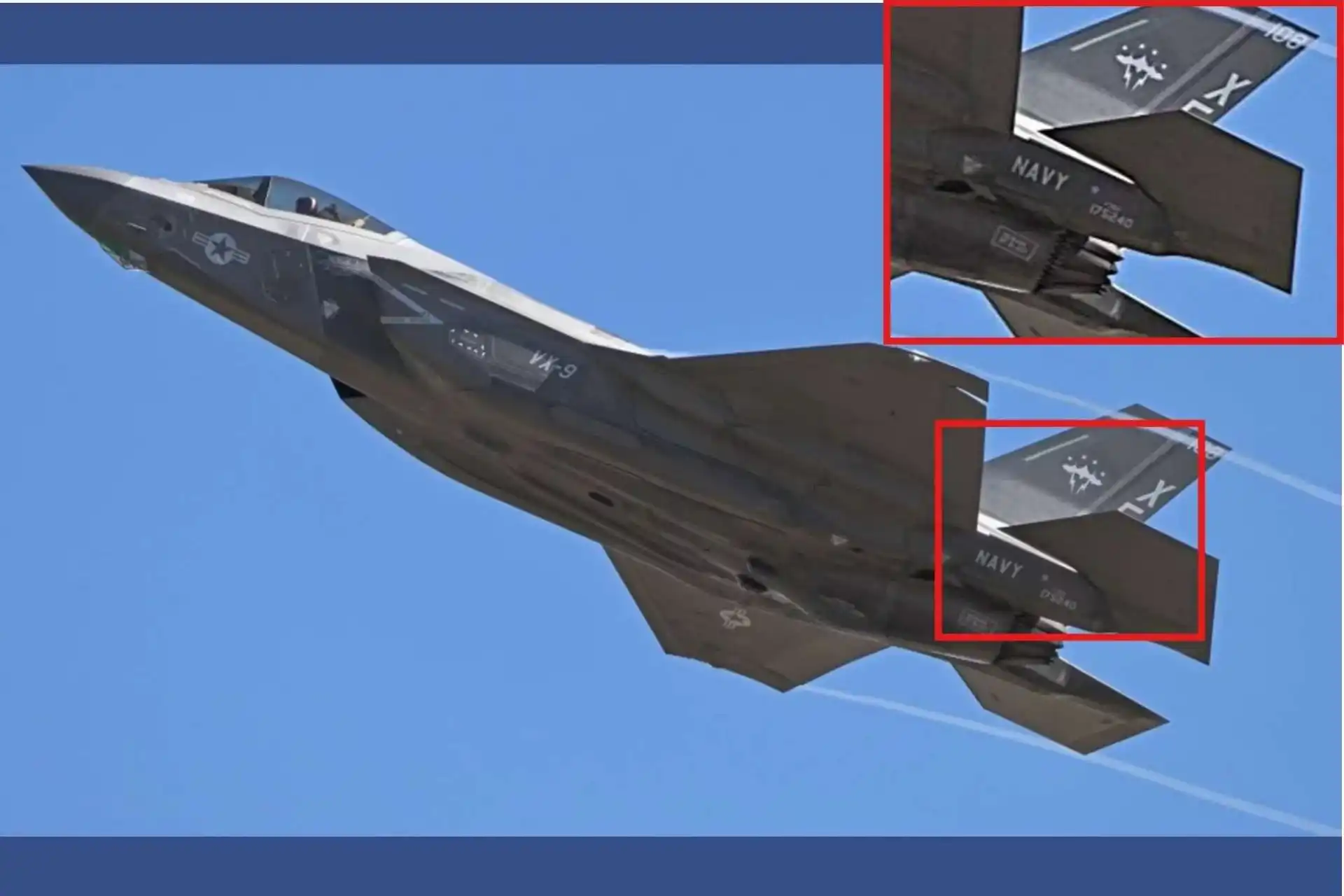
The sight of a U.S. Navy aircraft operating a U.S. Air Force–exclusive fighter variant is rare enough to turn heads even in the deeply interconnected world of American military aviation. That is precisely what happened when observers documented Air Test and Evaluation Squadron Nine, better known as VX-9, flying the F-35A Lightning II during test activity in California. The episode offers a revealing snapshot of how joint experimentation is quietly reshaping the future of fifth-generation airpower.
VX-9, based at Naval Air Weapons Station China Lake, sits at the center of the Navy’s tactical aviation testing ecosystem. The squadron is responsible for pushing combat aircraft, sensors, weapons, and software to their operational limits long before fleet squadrons ever see them. While VX-9 routinely works with Navy and Marine Corps platforms, the appearance of an Air Force–configured F-35A under Navy control marked an unexpected but telling departure from tradition.
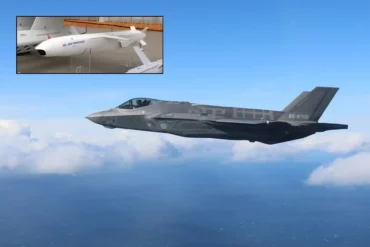
The aircraft was observed conducting a low approach at Mojave Air and Space Port, a hub known for flight testing, experimental aviation, and developmental programs. Images published on January 23, 2026, by aviation photographer @Task_Force23 quickly circulated among defense watchers, triggering immediate scrutiny. The jet was unmistakably an F-35A, yet it carried NAVY markings and VX-9’s distinctive bat insignia, visually collapsing long-standing service boundaries into a single airframe.
The F-35A involved was identified as tail number 17-5240, an aircraft previously assigned to the U.S. Air Force’s 422nd Test and Evaluation Squadron at Nellis Air Force Base. That unit plays a central role in validating combat capabilities for frontline fighters, making the jet a seasoned participant in high-end testing before its reassignment. Its presence with VX-9 represents the first publicly documented instance of an F-35A being flown operationally by a U.S. Navy test squadron.
This transfer was made possible through an established inter-service loan framework managed by the F-35 Joint Program Office. The mechanism allows aircraft to move temporarily between services for specific test and evaluation objectives. While such arrangements exist on paper, they are rarely visible in practice, especially when they cross the sharp variant lines that define the F-35 family. The Navy has historically focused on the carrier-capable F-35C, making the decision to operate an A-model particularly noteworthy.
Technically, the F-35A and F-35C share a common mission system architecture, advanced sensor fusion, and a largely unified software baseline. Yet the differences between them are far from cosmetic. The F-35A is optimized for conventional takeoff and landing, making it lighter and more aerodynamically agile, with a certified 9G maneuvering limit. The F-35C, designed for catapult launches and arrested recoveries, features a larger wing, reinforced landing gear, and a tailhook, trading some agility for carrier survivability and range with a 7.5G limit.
By bringing an F-35A into the VX-9 test ecosystem, the Navy gains access to a larger and more mature pool of aircraft without drawing down its comparatively limited F-35C inventory. More than 550 F-35As have already been delivered to the Air Force, while total planned production of the F-35C for the Navy and Marine Corps remains under 300 aircraft, with deliveries stretching well into the next decade. From a test management perspective, the logic is difficult to ignore.
Much of modern combat aviation development is no longer dominated by airframe-specific changes. Instead, it revolves around software updates, electronic warfare enhancements, sensor integration, and weapons certification. These elements often apply across all F-35 variants with minimal physical differences. Using an F-35A allows VX-9 to conduct risk reduction, data collection, and system validation at a faster tempo, especially when the test objectives are not dependent on carrier-specific features.
There is also a broader operational context shaping this decision. The U.S. military’s evolving focus on distributed operations, particularly in the Indo-Pacific, increasingly values flexibility across land- and sea-based aviation. Testing systems on a land-based F-35 variant can generate insights relevant to scenarios where carrier access is limited, delayed, or actively contested. In such environments, interoperability and shared tactics between services become operational necessities rather than doctrinal ideals.
Symbolically, the Navy-operated F-35A underscores a subtle but significant cultural shift. Fifth-generation airpower is becoming less about service ownership and more about shared capability. As platforms grow more software-defined and network-centric, the practical distinctions between who flies what are softening at the margins, especially in the test and development phase where speed and data matter more than tradition.
Whether VX-9’s use of the F-35A remains a one-off experiment or evolves into a recurring practice, its implications are clear. The image of a Navy test squadron flying an Air Force Lightning II variant captures a moment where institutional boundaries bend in service of efficiency and readiness. In the quiet airspace over California, the future of joint air combat is already being rehearsed, one borrowed aircraft at a time.