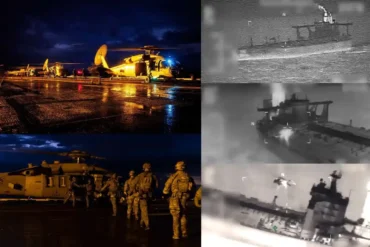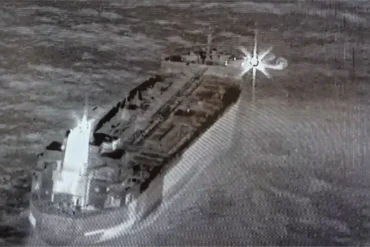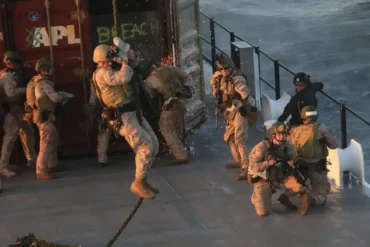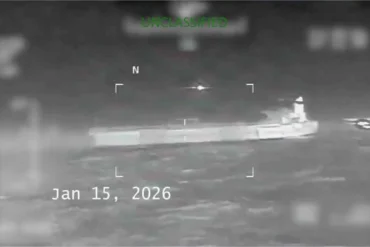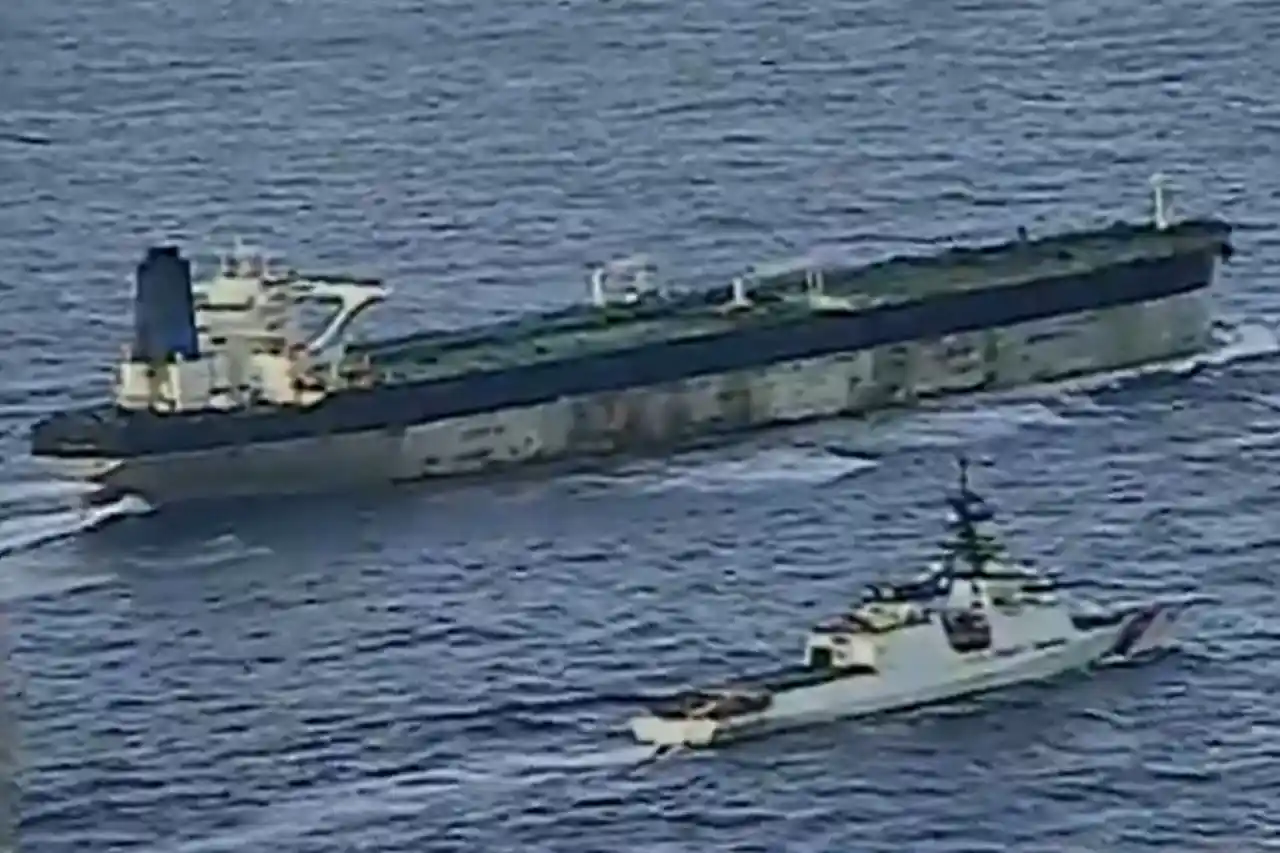
On January 7, 2026, the UK Ministry of Defence officially acknowledged that Britain played a pivotal intelligence and logistical role in supporting a U.S. special forces operation to seize the Russian-linked tanker BELLA 1 in the North Atlantic Ocean. While no UK personnel were directly involved in the physical boarding of the vessel, the United Kingdom provided critical operational infrastructure, surveillance, and intelligence capabilities that enabled the U.S. mission to succeed. The episode highlights deep Anglo-American defense cooperation and signals a united front against sanctions evasion tied to Iran and Russia.
The Shadow Fleet and the Target: Tanker BELLA 1
The BELLA 1 has long operated on the margins of legality, skirting global enforcement efforts through a network of alias identities, false flags, and covert routes. Initially sanctioned in 2024 by the U.S. Treasury for transporting Iranian crude oil, the vessel had become emblematic of a wider “shadow fleet” used to circumvent international sanctions. In December 2025, the tanker was tracked moving across the Atlantic under a falsified Guyanese flag, only to later adopt the name “Marinera” and register under the Russian flag as U.S. forces closed in.
UK officials confirmed that by the time the vessel was seized, it was effectively stateless—a status that under international maritime law permits interception and seizure without the consent of a flag state. The legal framework provided the justification for the bold operation carried out by U.S. special forces and U.S. Coast Guard units northwest of Britain and Ireland.
British Infrastructure Enabled the U.S. Strike
Though the high-risk boarding was carried out exclusively by American forces, British territory and assets were indispensable to the mission’s success. British airbases, including RAF Mildenhall and RAF Fairford, provided basing access, airspace support, and rapid mobility platforms to U.S. units. Notably:
- RAF Mildenhall supported maritime surveillance and special operations aviation.
- RAF Fairford hosted C-17 Globemaster III aircraft critical for fast deployment of U.S. special forces and equipment.
These forward bases enabled sustained operational tempo and quick reaction capability, essential in the unpredictable conditions of the North Atlantic winter.
Intelligence Sharing: The Eyes in the Sky
The Royal Air Force’s RC-135W Rivet Joint, operated by No. 51 Squadron, played a vital role in intelligence gathering. As a signals intelligence (SIGINT) platform, the Rivet Joint intercepted, located, and analyzed a broad spectrum of communications and electronic emissions. This real-time data was seamlessly integrated with U.S. assets like the P-8 Poseidon maritime patrol aircraft, creating a comprehensive situational awareness grid that tracked BELLA 1’s movements across thousands of nautical miles.
This coordination enabled command centers in both nations to:
- Monitor changes in crew behavior.
- Detect false flag re-registration maneuvers.
- Adapt to deteriorating weather and shifting maritime conditions.

RFA Tideforce: The Lifeline at Sea
The Royal Navy’s logistical support came through the deployment of the RFA Tideforce, a Tide-class fleet tanker with advanced refueling and resupply capabilities. With a displacement exceeding 39,000 tonnes and capacity for 19,000 cubic metres of fuel, Tideforce enabled U.S. naval assets to:
- Stay on station without returning to port.
- Replenish aviation fuel and operational supplies mid-sea.
- Support embarked helicopter operations despite adverse weather.
This seamless logistics support was essential in sustaining the pressure on BELLA 1 and ensuring operational success over prolonged tracking periods.
Coordinated Surveillance and Maritime Awareness
Beyond physical platforms, the UK contributed through advanced maritime domain awareness systems, combining:
- Radar feeds.
- Automatic Identification System (AIS) tracking.
- Military-grade sensor networks.
These systems enabled a shared operational picture that coordinated the actions of U.S. and UK air and naval assets across the congested air and sea lanes near Britain and Ireland.
A Politically Backed Operation
British involvement was not ad hoc. Defence Secretary John Healey authorized support following a formal request from Washington. In a statement before the House of Commons, Healey emphasized the United Kingdom’s strategic commitment to enforcing international norms. He laid out three clear objectives behind the UK’s participation:
- Disrupt Iranian oil revenue: BELLA 1 had transported over 7.3 million barrels of sanctioned Iranian crude, financing activities deemed destabilizing by the UK and allies.
- Counter Russian shadow fleets: These vessels increasingly act as proxies for circumventing sanctions, including those tied to the Ukraine conflict.
- Protect UK national security: By combating espionage, cyber threats, and aggressive maritime actions linked to Iran and Russia.
Healey praised the “professionalism and courage” of U.S. forces and reaffirmed that while no UK personnel boarded the vessel, British support was integral to the mission’s execution.
A Blueprint for Future Joint Enforcement
The seizure of BELLA 1 exemplifies the evolving nature of modern maritime enforcement, which increasingly relies on integrated multinational capabilities rather than unilateral action. The UK’s role—strategic but indirect—illustrates a model of hybrid support, combining:
- Technical intelligence assets (like Rivet Joint and ground sensors).
- Strategic basing and logistics (via RAF airfields and Royal Fleet Auxiliary ships).
- Operational coordination in contested environments.
This blueprint signals that London and Washington are prepared to respond together to global sanctions evasion, even in the absence of traditional armed conflict.
Strategic Implications in a New Geopolitical Era
The broader message from the BELLA 1 operation is unmistakable. The UK is positioning itself as a core strategic enabler of American-led enforcement efforts across multiple domains—from maritime interception to cyber intelligence. This posture reflects the shifting defense priorities post-Brexit, in which the UK seeks greater global projection in partnership with NATO and Five Eyes allies.
Moreover, by cracking down on sanctions-evading vessels that operate under murky legal flags, the UK and U.S. send a warning to other rogue actors. “Stateless” vessels can no longer hide behind falsified documentation, especially when persistent ISR (Intelligence, Surveillance, and Reconnaissance) and rapid expeditionary capabilities are brought to bear.
Conclusion
The seizure of BELLA 1 underscores not only the operational depth of U.S.-UK military cooperation but also the strategic resolve to counter sanctions evasion and maritime deception. Through a fusion of intelligence-sharing, logistical support, and political coordination, Britain ensured that the U.S. mission proceeded without a hitch. This landmark operation is likely to serve as a case study in future enforcement actions, particularly as Russia and Iran continue to adapt to global sanctions. In the increasingly complex battlespace of maritime security and hybrid warfare, such partnerships are not only desirable—they are essential.