In the highly regulated and precisely coordinated world of aviation, few visual cues on an airfield hold as much operational significance as the hold short line. These critical ground markings serve as vital safeguards for runway incursions and prevent catastrophic airside incidents. Found where taxiways intersect runways, hold short lines dictate where an aircraft must stop before entering or crossing a runway, based on Air Traffic Control (ATC) clearance. Their function is deceptively simple, but their presence underpins airfield safety protocols in a way few other visual markers do.
What is a Hold Short Line?
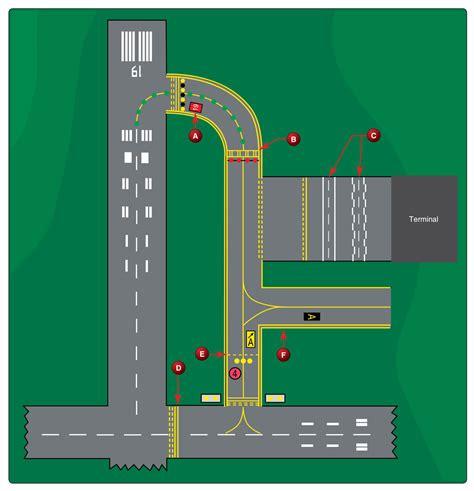
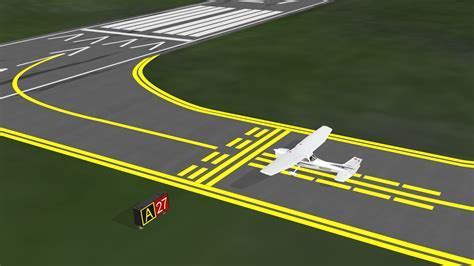
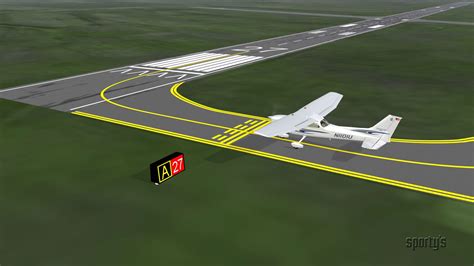
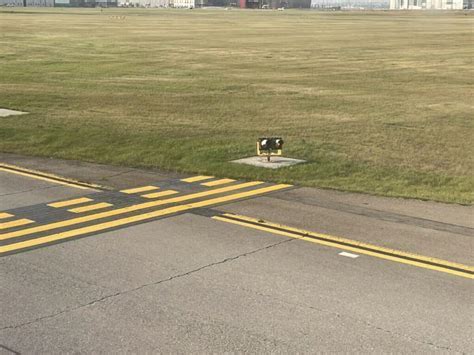
A hold short line is a distinctive pavement marking painted at the intersection where a taxiway meets a runway. It consists of two solid yellow lines and two dashed yellow lines stretching across the taxiway. These markings are always accompanied by a red and white runway holding position sign, indicating the runway number. The convention is clear: aircraft must stop before the solid lines unless specifically cleared to proceed by ATC.
These lines are far more than mere paint. They represent the boundary between ground operations and active flight space. Crossing them without clearance can result in runway incursions, which are among the most dangerous ground incidents in aviation.
Importance of Hold Short Lines in Ground Operations
The primary role of hold short lines is to control movement on taxiways and prevent unauthorized access to active runways. As airports continue to expand and modernize, the density of runway usage grows, especially at major hubs. Every second on an active runway is planned with precision. One unintended breach could cause catastrophic consequences.
These lines are designed to:
-
Maintain separation between aircraft during takeoff and landing
-
Provide ATC with predictability in aircraft ground movement
-
Prevent collisions during low visibility or nighttime operations
Visual Markings and Associated Signs
Hold short lines are not standalone features. They are embedded into a broader system of airfield markings:
Runway Holding Position Markings
These include:
-
Two solid yellow lines (indicating where aircraft must stop)
-
Two dashed yellow lines (showing the direction from which a pilot may proceed with clearance)
Positioned perpendicular to the taxiway centerline, they are engineered to be visible in a variety of weather conditions.
Runway Holding Position Signs
These signs are installed adjacent to the hold short lines. They have white text (e.g., “27L”) on a red background, placed on the left side of the taxiway. Their role is to reinforce the restriction and confirm to the pilot which runway threshold is being approached.
Land and Hold Short Operations (LAHSO)
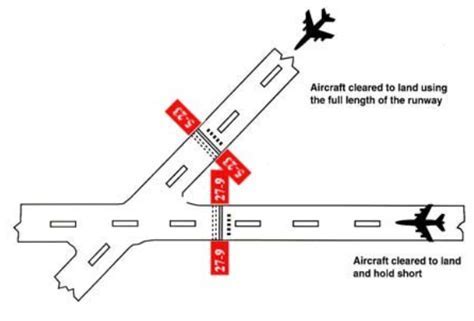
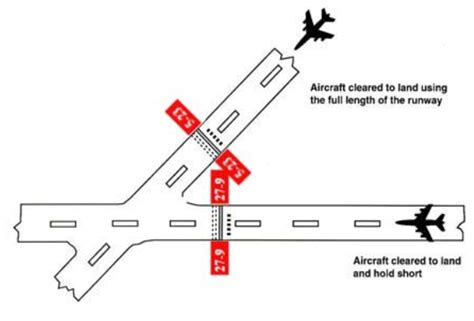
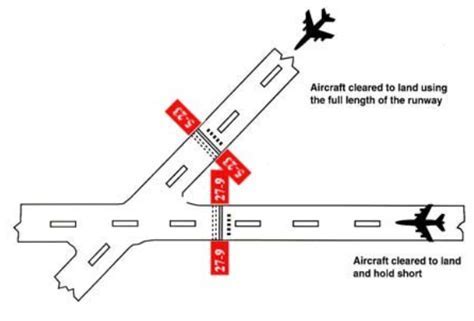
One advanced application of the hold short concept is the Land and Hold Short Operation (LAHSO). This procedure allows aircraft to land on one runway and stop before crossing another intersecting runway or taxiway.
In this case, ATC will issue instructions such as:
“Cleared to land runway 24, hold short of runway 33.”
Only if the pilot accepts this instruction, and if conditions permit safe execution, can the operation proceed. LAHSO enhances runway efficiency, but also demands high situational awareness from the flight crew.
Technical Dimensions and Standards
Hold short line placement and visibility are governed by stringent FAA and ICAO standards. Key specifications include:
-
Line width: Minimum 6 inches (15 cm)
-
Separation: Typically 6 inches between lines
-
Length: Spanning across full taxiway width
-
Distance from runway threshold: Usually 150 feet, extendable up to 300 feet based on aircraft size and airport layout
These dimensions ensure universal recognition, even under low visibility conditions, where reliance on visual cues becomes critical.
Causes of Hold Short Violations
While the concept is clear, violations of hold short lines still occur, with potentially dangerous consequences. These violations are often categorized by their root causes:
1. Airport Configuration Complexity
Airports with intersecting or parallel runways are more prone to incidents due to the sheer number of interactions between taxiways and runways. Complex taxi routes demand vigilant navigation, especially during peak hours.
2. Flight Crew Errors
Even seasoned pilots can experience:
-
Loss of situational awareness
-
Distraction due to workload
-
Misinterpretation of ATC instructions
3. ATC Controller Oversight
Controllers themselves can become distracted or overloaded by traffic volume, leading to communication lapses that might result in simultaneous clearances on intersecting paths.
Hold Short Lines in Adverse Conditions
Hold short lines are engineered for high-visibility environments, but their relevance increases under low-visibility operations (LVO), including fog, rain, or nighttime. At such times, airports rely on:
-
Enhanced taxiway centerline lighting
-
Runway Guard Lights (Wig-Wags)
-
Surface Movement Radar (SMR)
These features are integrated with hold short positions to ensure pilots can safely identify stopping points under Instrument Flight Rules (IFR).
Training and Compliance
Due to the non-negotiable nature of hold short compliance, both pilots and ATC undergo regular training and simulation scenarios. Airline SOPs (Standard Operating Procedures) emphasize hold short adherence during pre-flight briefings, especially when LAHSO is likely to be issued.
Moreover, violation of a hold short instruction is taken very seriously and can result in:
-
FAA investigation and potential penalties
-
Retraining or license suspension for the flight crew
-
Operational reviews for ATC units involved
Conclusion
The hold short line may seem like a minor detail on the massive canvas of an airfield, yet its significance cannot be overstated. It is a physical manifestation of the invisible boundary that separates controlled movement areas from potentially dangerous intersections with airborne operations. Pilots, ground crew, and controllers alike are trained to treat this boundary with reverence and precision.
In a high-stakes environment where timing and coordination mean everything, the hold short line remains a silent sentinel, protecting lives and upholding the integrity of every takeoff and landing.
Frequently Asked Questions (FAQ)
What happens if a pilot crosses a hold short line without clearance?
Crossing a hold short line without explicit ATC clearance constitutes a runway incursion. Depending on the circumstances, this can lead to serious safety violations, operational delays, and FAA investigations. Pilots may face disciplinary action, and the incident is typically reported and analyzed.
Are hold short lines the same at every airport?
While the design and function of hold short lines are standardized globally by ICAO and the FAA, their exact positioning can vary depending on the airport’s layout, aircraft size accommodations, and runway thresholds. Nonetheless, pilots are trained to identify and comply with them universally.
Can a pilot refuse a LAHSO instruction?
Yes. Pilots can decline a Land and Hold Short Operation if they are uncomfortable or unable to comply due to performance limitations, weather, or unfamiliarity. Safety remains paramount, and ATC will provide an alternative clearance without penalty.