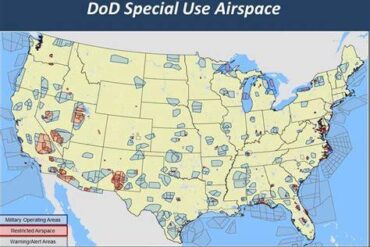
Prohibited Areas are among the most strictly controlled types of airspace within the United States and globally. These areas fall under the category of Special Use Airspace (SUA) and are designated by regulatory bodies to serve critical national interests, including security, safety, and preservation of national landmarks or sensitive operations. Pilots must fully understand the implications of entering these zones, as violations carry severe legal and administrative consequences.
What Are Prohibited Areas?
The Federal Aviation Administration (FAA), in conjunction with other governmental entities, defines a Prohibited Area as “airspace of defined dimensions, identified by an area number, within which the flight of aircraft is prohibited. Such areas are established for security or other reasons associated with the national welfare.” These zones are not optional—they are off-limits, 24/7, without exception, unless explicit prior authorization is granted for a specific operational or governmental purpose.
Unlike other Special Use Airspace types such as Restricted Areas, which may become inactive and allow passage under certain conditions, Prohibited Areas are permanently active unless otherwise noted. Their regulatory status means that violations are not just safety infractions—they’re federal offenses.
Identifying Prohibited Areas on Aeronautical Charts
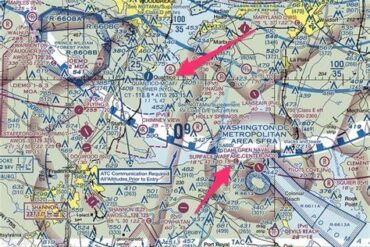
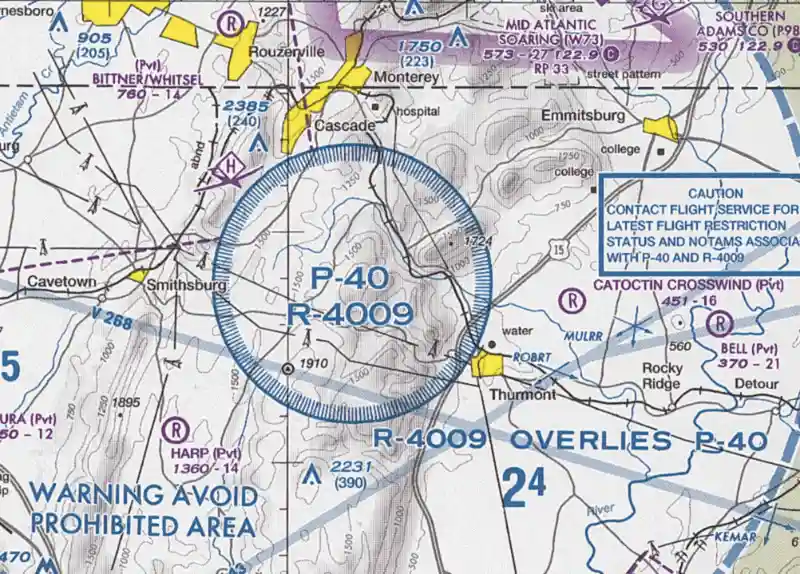
Prohibited Areas are clearly marked on VFR sectional charts with a blue hashed border and labeled with a unique alphanumeric identifier such as P-56 (which denotes the restricted airspace around Washington, D.C.). These designations are critical: each number corresponds to a specific entry in the Special Use Airspace (SUA) table, typically found on the side of the sectional chart.
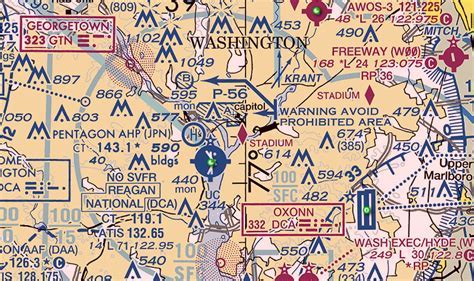
To get more information about the boundaries and vertical limits of any given Prohibited Area, pilots should refer to this table. For example, P-73, located over a naval installation, has a ceiling of 1,500 feet MSL, which means aircraft can legally fly over but not through it.
Examples of Prohibited Areas
While many assume Prohibited Areas exist solely over military installations or nuclear facilities, the reality is more nuanced. These zones include:
- Washington, D.C. (P-56): Encompassing the White House and National Mall.
- Disneyland and Disney World: Surprisingly, these popular attractions are designated Prohibited Areas due to post-9/11 legislation aimed at crowd safety.
- Area 51: The legendary military facility in Nevada.
- Kennedy Space Center (P-50): Due to sensitive aerospace operations.
- Camp David (P-40): The presidential retreat in Maryland.
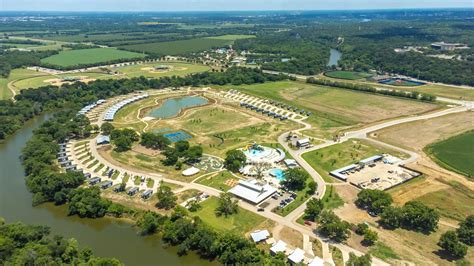
- Boundary Waters Canoe Area (P-204): A rare example of a Prohibited Area for environmental preservation rather than security.
These examples highlight that national security is not the only justification; sometimes, public safety and environmental stewardship are also determining factors.
Legal Ramifications of Violating Prohibited Areas
The airspace within a Prohibited Area is considered a no-fly zone under federal law. Unauthorized entry can result in:
- Immediate interception by military aircraft
- Revocation of pilot certification
- Criminal prosecution
- Heavy civil penalties, often exceeding tens of thousands of dollars
There is no controlling agency listed for Prohibited Areas because no negotiation or clearance is offered. In contrast with Restricted Areas, where contact with an ATC facility might yield conditional access, Prohibited Areas are absolute in their restrictions.
Vertical Limits and Flight Planning
Each Prohibited Area has a clearly defined vertical structure, typically beginning at the surface (0 feet AGL) and extending to a specified altitude, often in the range of 1,500 to 18,000 feet MSL. For high-flying aircraft operating under IFR, this opens the potential to route flights over, but never through, a Prohibited Area.
Pilots must plan accordingly, consulting tools such as SkyVector.com or FAA digital chart repositories. However, one should never assume that higher altitudes inherently grant permission—the vertical limits must be confirmed via official charts.
When Are Prohibited Areas Active?
Almost all Prohibited Areas are permanently active, especially those related to government, military, or sensitive civilian infrastructure. The SUA table will confirm the active hours, though “continuous” is the default setting. The FAA’s Special Use Airspace website offers updates and details on activity statuses, but again, the standing assumption must always be: access is denied unless explicitly permitted.
Who Can Fly Through a Prohibited Area?
The short answer is: no one without explicit federal authorization. That includes:
- Military aircraft on designated missions
- Government aircraft (e.g., Secret Service transport)
- Emergency flights pre-approved by the FAA
- Presidential transport operations (e.g., Marine One into the White House grounds)
General aviation pilots, regardless of purpose, are not eligible for entry under normal circumstances. There are no radio frequencies assigned, no published procedures for entry, and no “cold” or inactive states to exploit.
Comparison With Restricted Areas
It is essential to differentiate Prohibited Areas from Restricted Areas, though both fall under regulatory Special Use Airspace.
Restricted Areas:
- May be inactive during certain times
- Controlled by an ATC facility or military operations center
- Permit entry with clearance when not active
- Often involve dangerous activity, such as missile tests, artillery, or live-fire exercises
Prohibited Areas:
- Always active unless explicitly noted
- No access permitted under normal conditions
- Typically established for non-combat concerns such as national monuments, executive residences, or space launch centers
Consequences of Ignorance or Misnavigation
In aviation, unintentional entry into a Prohibited Area is not a valid defense. The FAA and other oversight agencies operate on the principle that every pilot is fully responsible for their navigation and situational awareness. The consequences are swift and unforgiving:
- Violation reports filed to the FAA Enforcement Division
- Mandatory interviews or certification reviews
- Suspension or permanent loss of pilot privileges
- In extreme cases, national security incidents involving fighter jet interception
In some cases, Temporary Flight Restrictions (TFRs) can temporarily create Prohibited-like conditions, such as during presidential travel or major sporting events. These are published through NOTAMs, and pilots are expected to remain up to date at all times.
How to Stay Compliant
Staying safe—and legal—in the air means maintaining up-to-date information and practicing disciplined pre-flight planning. Here’s how:
- Always use updated sectional charts or electronic navigation tools.
- Check the Special Use Airspace table for each area along your route.
- Utilize FAA NOTAMs and SUA updates before flight.
- Never assume an area is safe to cross without verification.
- If in doubt, reroute well clear of any Prohibited Area.
Final Thoughts
Prohibited Areas represent the most absolute form of restricted airspace, a literal red line drawn in the sky that pilots must never cross. Whether protecting national landmarks, preserving environmental treasures, or safeguarding classified operations, these zones are non-negotiable. There is no ATC clearance to be obtained, no opportunity to request entry, and no leniency for mistakes.
For the safety of all airspace users—and the integrity of sensitive national operations—respect for Prohibited Areas is not optional, it is law.