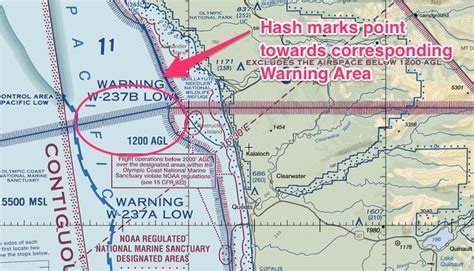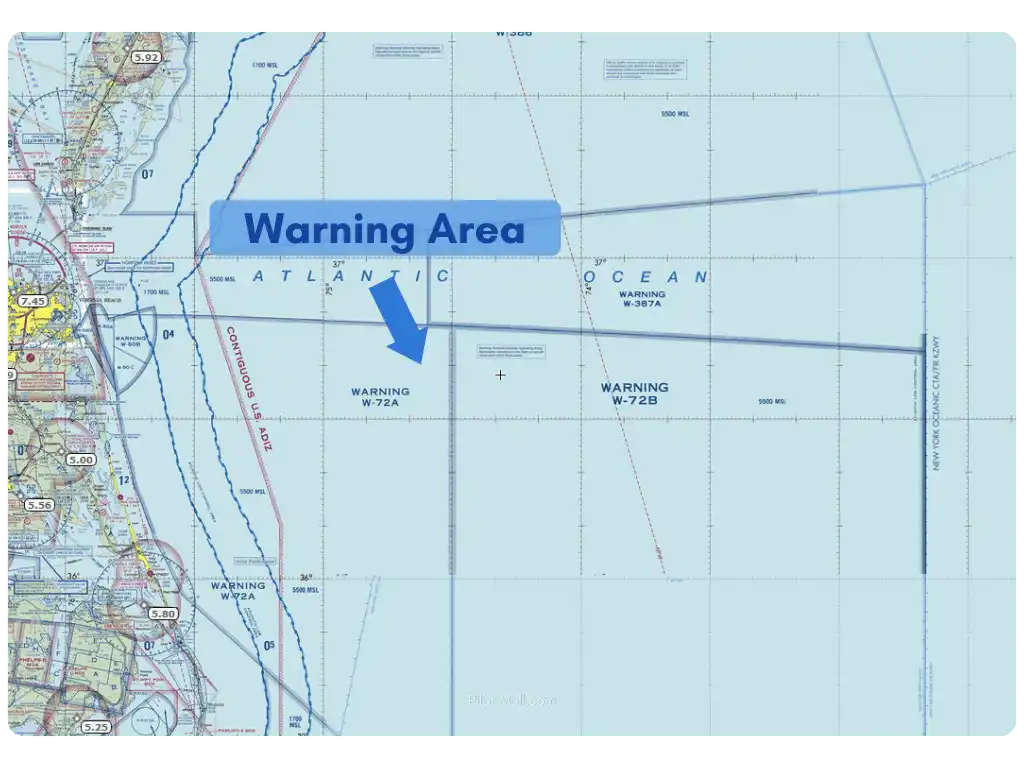
Operational hours of Warning Areas are not always fixed. Some areas operate during specific windows, while others are active on demand. The Notice to Air Missions (NOTAMs) system provides updates on airspace status, but relying solely on NOTAMs is risky.
Some Warning Areas never issue NOTAMs despite being active on a regular schedule. Therefore, the best practice is to always confirm using multiple sources:
- Check your VFR chart’s SUA table.
- Use ForeFlight or similar apps to review NOTAMs associated with the ARTCC controlling the area.
- Visit the FAA Special Use Airspace website.
- Call the Flight Service Station (FSS) to confirm status.

If you do not have access to tools like ForeFlight, you can manually check the NOTAMs online via the FAA website. Click on the ARTCC tab and locate your region using a map reference or the ARTCC identifier.
Remember: The absence of a NOTAM does not mean the Warning Area is inactive.
Strategic Flight Planning: To Enter or Not to Enter
When contemplating a route through a Warning Area, ask yourself the following:
- Is my aircraft capable of safe overwater flight beyond 3 NM from shore?
- Am I flying a Part 91 single-engine aircraft where ditching might be fatal?
- Do I have current data on the Warning Area’s operational status and controlling agency?
If you determine that the Warning Area might be inactive during your planned crossing, you must still verify this by contacting the controlling agency.
To do so:
- Reference the controlling frequency from the SUA table.
- Prior to entering, call the controlling agency on the appropriate frequency.
- Confirm the airspace is cold and request transit clearance.
Do not attempt to enter the Warning Area unless the controlling agency explicitly states it is cold. Even if the NOTAM suggests it is inactive, you could encounter live operations that weren’t published.
Role of Part 121 Operators Versus Part 91 Pilots
Part 121 commercial operations are usually managed through centralized dispatch units. These dispatchers coordinate directly with ATC and plan routes that either avoid Warning Areas or cross them at known safe altitudes and times. In contrast, Part 91 general aviation pilots bear the entire responsibility for checking the airspace and obtaining permission to enter.
Therefore, what may be routine for a commercial airliner is a potential hazard for a small GA pilot without proper preflight diligence.
Summary: Practical Do’s and Don’ts for Flying Near Warning Areas
Navigating around or through Warning Areas doesn’t need to be intimidating—but it does require intentional planning, timely communication, and up-to-date information. Here are some final takeaways:
- Don’t confuse MOAs with Warning Areas—they are structurally and operationally different.
- Always verify airspace status via sectional charts, NOTAMs, and direct agency contact.
- Never enter a Warning Area without confirming it is cold, even if it appears inactive on public resources.
- Avoid unnecessary offshore flying, especially in single-engine GA aircraft with limited overwater range.
- Use multiple tools—apps, FAA sites, ARTCC contacts—to cross-reference data.
By respecting the complexity and risks of Warning Areas, we not only ensure safety but also uphold the integrity of flight operations in shared airspace. With military activity intensifying in various coastal zones, recognizing and navigating these special use airspaces is more essential than ever.