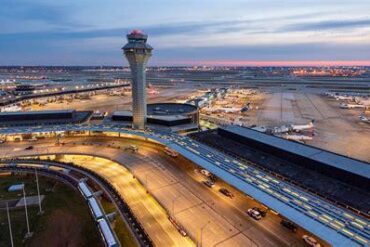
The scale of United Airlines’ summer 2026 network reduction at Chicago O’Hare International Airport (ORD) is nothing short of dramatic. In a sweeping operational shift, the carrier has removed over 18,000 two-way flights between June and August, fundamentally reshaping one of its most critical hubs during peak travel season. The move is not driven by weakening demand or cost-cutting alone, but by a structural intervention from federal regulators aimed at solving a persistent problem: chronic delays at one of the busiest airports in the United States.
At the heart of this decision lies a newly imposed Federal Aviation Administration (FAA) flight cap, which restricts daily movements at O’Hare to 2,708 flights, a notable reduction from the previously scheduled 3,080 daily operations. This recalibration forces airlines—particularly dominant hub operators like United—to make difficult choices about where capacity is deployed and which routes survive the cut.
The result is a leaner, more controlled operation that prioritizes reliability over raw volume. Yet behind the numbers lies a deeper story about congestion, network optimization, and the shifting dynamics of domestic aviation.
Massive Flight Reductions Reshape United’s O’Hare Hub
Between June and August 2026, United will eliminate approximately 18,190 round-trip flights from its Chicago schedule. The monthly breakdown highlights the intensity of the cuts during peak summer:
- June: 7,387 flights removed
- July: 7,112 flights removed
- August: 3,916 flights removed
This translates into roughly 100 fewer daily departures, shrinking United’s operation from about 780 daily flights to approximately 650. While that still represents a formidable presence, the reduction is significant enough to alter connectivity patterns across the Midwest and beyond.
Notably, United has strategically preserved peak-hour departures between 7:00 AM and 8:00 PM, ensuring that its most commercially valuable time slots remain intact. This signals a clear intent: maximize efficiency and revenue during high-demand windows while trimming less profitable or operationally vulnerable flights.
11 Cities Lose All United Service from O’Hare
Among the most striking consequences of this restructuring is the complete suspension of United service to 11 regional destinations. These routes, largely operated by United Express regional affiliates, will see zero connectivity from O’Hare during the summer period.
The affected cities include:
- Kalamazoo, Michigan
- Billings, Montana
- Bloomington–Normal, Illinois
- Champaign–Urbana, Illinois
- Wausau / Mosinee, Wisconsin
- Erie, Pennsylvania
- Lansing, Michigan
- La Crosse, Wisconsin
- Marquette, Michigan
- Rochester, Minnesota
- Bristol / Kingsport / Johnson City, Tennessee–Virginia
These are not major metropolitan markets, but they play a crucial role in feeding traffic into United’s hub network. Their removal underscores a broader industry reality: regional routes are often the first casualties when capacity constraints tighten.
Widespread Capacity Cuts Across 20 Additional Routes
Beyond outright suspensions, United is also reducing capacity by at least 30% on 20 additional routes. This second layer of cuts affects a diverse mix of destinations, ranging from leisure markets to secondary business hubs.
Cities experiencing significant reductions include:
- Albuquerque, New Mexico
- Scranton / Wilkes-Barre, Pennsylvania
- Birmingham, Alabama
- Burlington, Vermont
- Duluth, Minnesota
- Des Moines, Iowa
- Panama City Beach, Florida
- Spokane, Washington
- Grand Rapids, Michigan
- Huntsville, Alabama
- Madison, Wisconsin
- West Palm Beach, Florida
- Providence, Rhode Island
- Portland, Maine
This broad geographic spread highlights how network trimming is not confined to one region or demand segment. Instead, it reflects a systemic recalibration designed to fit within strict operational limits.
FAA Flight Caps: The Real Driver Behind the Cuts
The catalyst for these sweeping changes is the FAA’s decision to impose temporary flight caps at O’Hare from June 2 through October 24, 2026. Originally expected to begin in mid-May, the rollout was delayed to allow airlines time to adjust schedules without causing widespread disruption.
The reasoning is straightforward: O’Hare’s congestion has reached unsustainable levels, with fewer than 60% of flights operating on time last year. Delays ripple through the national airspace system, affecting passengers far beyond Chicago.
By enforcing a lower ceiling on daily operations, regulators aim to:
- Improve on-time performance
- Enhance safety margins
- Reduce cascading delays across the network
This approach effectively forces airlines to prioritize quality over quantity, a shift that could redefine how major hubs operate during peak seasons.

A Strategic Retreat—But Still Year-Over-Year Growth
Despite the headline-grabbing cuts, United’s leadership emphasizes that the airline is still growing at O’Hare compared to summer 2025. According to internal data, the revised schedule represents an 11% increase year-over-year, even after accounting for the reductions.
This seemingly contradictory reality reveals an important nuance: United had initially planned for aggressive expansion, and the FAA caps forced a rollback from those ambitions—not a contraction below historical levels.
Equally notable is the airline’s commitment to maintaining its workforce. United has confirmed that staffing levels—both in the air and on the ground—will remain unchanged, signaling confidence in long-term demand and operational stability.
Operational Efficiency Takes Center Stage
The restructuring of United’s O’Hare hub is less about shrinking and more about refining operational performance. By concentrating flights into peak periods and eliminating lower-yield routes, the airline is positioning itself to deliver:
- Higher schedule reliability
- Improved aircraft utilization
- Better passenger experience through reduced delays
This aligns with a broader industry trend where airlines are increasingly judged not just on network size, but on consistency and punctuality.
What This Means for Travelers
For passengers, the impact will be mixed. Travelers flying between major cities are unlikely to notice significant changes, as core routes and peak-time frequencies remain largely intact. However, those in smaller markets may face:
- Reduced connectivity options
- Longer travel times due to fewer direct flights
- Greater reliance on alternative hubs
At the same time, the FAA’s intervention could deliver a tangible benefit: a smoother, more predictable travel experience. Fewer delays and cancellations may ultimately outweigh the inconvenience of reduced frequency.
A Turning Point for O’Hare’s Future Operations
United Airlines’ decision to cut over 18,000 flights is not an isolated event—it represents a turning point in how capacity-constrained airports are managed. As demand continues to grow and infrastructure struggles to keep pace, regulatory intervention may become more common.
For O’Hare, summer 2026 serves as a real-world experiment in controlled capacity and operational discipline. If successful, it could set a precedent for other congested hubs worldwide.
For United, the challenge is clear: deliver reliability without sacrificing its competitive edge. And in an industry where delays can define reputations, that may be the most important flight plan of all.