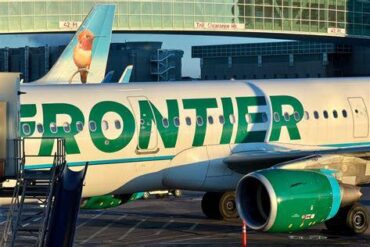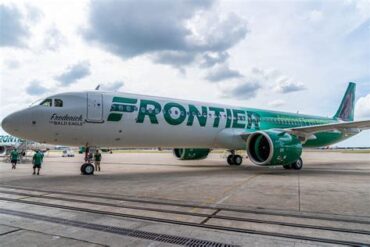
Frontier Airlines has confirmed the suspension of two domestic routes for the peak summer travel season of 2025, a surprising move given the typically high demand during these months. According to data provided by aviation analytics firm Cirium, the ultra-low-cost carrier will halt operations between Chicago Midway International Airport (MDW) and Las Vegas Harry Reid International Airport (LAS), as well as Long Island MacArthur Airport (ISP) and Palm Beach International Airport (PBI). These cuts will take effect across July and August 2025, signaling deeper issues within the airline’s route network planning and financial positioning.
Gradual Frequency Reductions Precede Full Route Suspensions
While the suspension of flights may appear sudden, a closer examination reveals that Frontier had been incrementally reducing flight frequencies on both affected routes for several months prior. This phasing-out strategy suggests that the airline had been testing the financial viability of these corridors before pulling the plug entirely.
Between February and March 2025, Frontier operated the MDW-LAS route five times a week. However, April saw this frequency lowered to four weekly flights. By May and June, the service was reduced to only three weekly operations. This route covers 1,321 nautical miles (2,447 km) and had been serviced by the Airbus A320neo, known for its fuel efficiency—an essential factor for low-cost carriers.
In parallel, the ISP-PBI route also experienced a tapering schedule. Initially flown seven times per week, the frequency was reduced to five in April, four in May, and only three flights per week by June. The shorter 914-nautical-mile (1,693 km) route has been operated by a mix of aircraft, including Airbus A321s, A321neos, and A320neos.

Economic Turbulence and Strategic Cuts
The most plausible rationale behind these cuts, though not officially confirmed by Frontier, revolves around economic headwinds and weakened demand. On May 4, 2025, Frontier publicly acknowledged that it would trim capacity during low-demand days in a bid to regain profitability. This strategy is a continuation of broad network restructuring efforts dating back to late 2024.
Frontier’s financial reports from Q1 2025 further illuminate the pressure points. The airline posted a $43 million net loss, a steep rise from the $26 million loss in Q1 2024. CEO Barry Biffle cited a “demand shock,” exacerbated by volatile trade policies under the Trump administration, which has strained discretionary travel spending—especially among leisure-focused passengers, Frontier’s core demographic.
The airline has responded by trimming excess capacity on historically low-demand travel days: Tuesdays, Wednesdays, and Saturdays. This move was designed to prevent aircraft from flying half-empty—a persistent concern for low-cost business models. Biffle has emphasized the company’s shift toward “value optimization,” underscoring a need to operate only on routes and days that produce adequate returns.

A Broader Pattern of Network Contraction
The July-August route cuts are not isolated actions. They are part of a broader wave of route eliminations that began in late 2024. In December 2024, Frontier revealed it would reduce or remove service on more than 40 domestic routes, affecting several of its primary hubs.
According to data shared by Ishrion Aviation, Frontier’s preliminary schedule through April 21, 2025, confirmed these widespread cuts. The affected airports included major bases such as Hartsfield-Jackson Atlanta (ATL), Dallas/Fort Worth (DFW), Denver (DEN), and Philadelphia (PHL). The scope and geographical spread of these changes suggest a systemic overhaul, not merely seasonal fine-tuning.
Frontier’s route-planning algorithm seems to be favoring short-haul, high-yield corridors and eliminating longer, lower-demand routes that tie up fleet resources. The MDW-LAS and ISP-PBI corridors both require considerable flight time and crew hours—valuable commodities for an airline running on razor-thin margins.
Operational Strategy: The Cost of Ultra-Low-Cost
The challenges faced by Frontier underscore the inherent risks of the ultra-low-cost carrier (ULCC) model, especially during economic turbulence. This model relies heavily on volume, efficiency, and aggressive pricing, which leaves little room for error when passenger numbers decline.
Unlike legacy carriers that benefit from premium cabin sales and loyalty programs, ULCCs depend almost exclusively on leisure travelers—a segment that is often the first to reduce discretionary spending in uncertain times. Additionally, fuel price fluctuations, labor costs, and airport fees weigh heavily on profit margins.
To manage this, Frontier appears to be pivoting toward a leaner, more flexible flight network, better aligned with real-time demand signals. This includes dynamic scheduling, adjusting frequencies not just seasonally but week-by-week, depending on fare yields and forward bookings.
Potential Impacts on Affected Regions
The suspension of these routes may have local economic ripple effects, particularly for airports like Long Island MacArthur (ISP) and Palm Beach International (PBI). These smaller regional airports benefit significantly from each added connection, driving tourism revenue, hotel occupancy, and airport service jobs. Losing a direct route—especially in peak season—can be detrimental to short-term economic performance in those areas.
Chicago and Las Vegas, while being major airport hubs, will likely absorb the loss with minimal disruption, given the availability of alternative carriers and flight options. However, Frontier’s retreat could lead to less competitive fare pricing, particularly on the low-cost segment, where it had been a dominant player.
What Lies Ahead for Frontier
Despite these setbacks, Frontier continues to emphasize its long-term growth strategy, which includes expanding into underserved markets, optimizing existing fleet utilization, and investing in new aircraft to enhance efficiency. The airline’s reliance on the Airbus A320neo family allows for reduced fuel consumption, which may prove advantageous as oil prices remain unpredictable.
Biffle and the executive team appear focused on returning the company to profitability by the end of 2025, driven by “value over volume” and a streamlined operation that emphasizes revenue per available seat mile (RASM) rather than aggressive expansion.

Final Thoughts: A Cautious Summer Strategy
Frontier Airlines’ decision to cut two more routes during the peak summer season speaks volumes about the current fragility of the air travel market—particularly in the leisure sector. The airline’s continued capacity reductions are not merely short-term corrections but appear to be part of a longer-term pivot toward a more disciplined, financially conservative route network.
While some passengers may find fewer travel options this summer, these adjustments may be essential to ensuring Frontier’s survival and profitability in a highly competitive and increasingly unpredictable marketplace. Whether these strategic retrenchments will pay off remains to be seen, but for now, the airline is clearly choosing sustainability over short-lived expansion.
FAQs
What routes is Frontier Airlines cutting this summer?
Frontier is cutting its Chicago Midway (MDW) to Las Vegas (LAS) and Long Island MacArthur (ISP) to Palm Beach (PBI) routes during July and August 2025.
Why is Frontier suspending these specific routes?
Though no official reason has been provided, it is likely due to low demand and poor profitability, based on declining weekly frequencies in recent months.
Will these route cuts affect Frontier’s other operations?
These cuts are part of broader capacity reductions affecting over 40 routes nationwide, especially on low-demand days like Tuesdays and Wednesdays.
Is Frontier in financial trouble?
Frontier posted a $43 million loss in Q1 2025, citing economic uncertainty and demand shocks. The airline is actively restructuring to regain profitability.
Could these routes return in the future?
Possibly. Route reinstatements depend on market demand, cost structure improvements, and macroeconomic conditions improving over time.