United Airlines is facing renewed scrutiny after a passenger was removed from a flight following a confrontation with an off-duty United flight attendant, an incident that has ignited debate over airline authority, employee privilege, and the treatment of passengers with disabilities. A video circulating online captures the tense exchange, offering a rare, unfiltered look at how quickly a routine flight can spiral into a high-stakes standoff at the gate.
Incident Begins With Alleged Rudeness Toward Hearing-Impaired Passenger
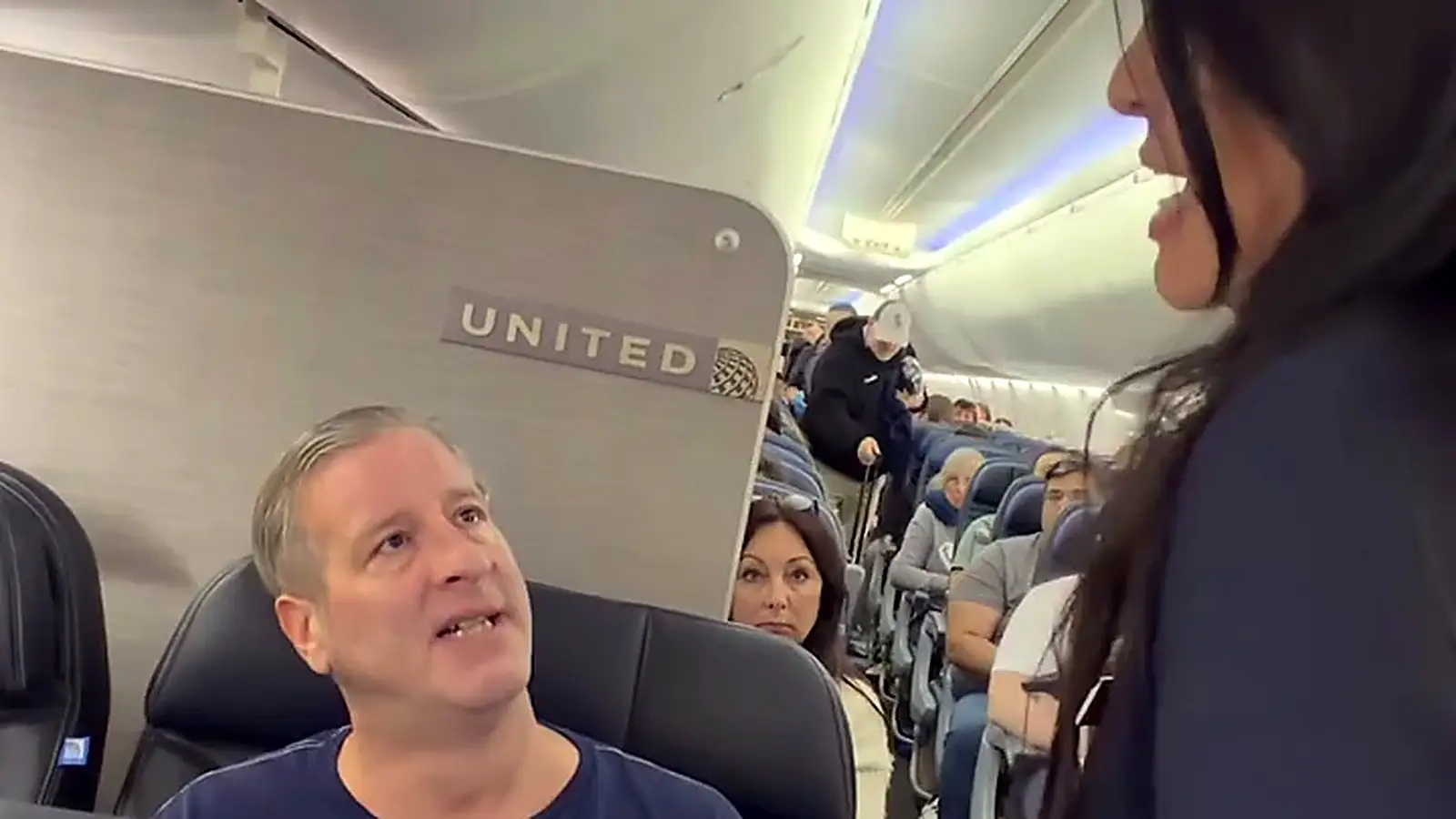
According to accounts shared alongside the video, the situation began in the gate area before boarding. The passenger was traveling in United First Class with his wife, who is hearing impaired. An off-duty United flight attendant, traveling as a regular passenger, reportedly interacted with the woman and spoke to her in a dismissive or rude manner. The central issue, as described by the husband, was that the employee did not realize the woman had a hearing disability and interpreted her lack of response as intentional.
For families accustomed to navigating invisible disabilities, these moments are painfully familiar. What may appear to be indifference is often a physical limitation, and when that distinction is ignored, frustration builds fast. In this case, the perceived lack of empathy became the spark that lit a much larger fire.
Onboard Confrontation Triggers Escalation
Once onboard, the off-duty flight attendant was seated directly behind the couple in Economy Plus, an arrangement that made avoidance impossible. The husband decided to address the earlier interaction and asked the employee to apologize after explaining his wife’s hearing impairment. Rather than de-escalating the situation, the conversation reportedly grew more heated.
What followed was a rapid escalation. Airline staff became involved, and the decision was made to remove the husband from the aircraft. A United gate agent is seen in the video explaining that the removal was due to the use of foul language, a claim the passenger firmly disputes. His recorded statements are calm but firm, emphasizing that his wife’s disability was at the heart of the conflict and questioning why the burden of consequences fell on him rather than the employee whose behavior sparked the incident.
man and wife are asked to leave the plane
by
u/Lazy-School-7580 in
PublicFreakout
Gate Agent Authority and the Question of “Foul Language”
Airlines maintain broad discretion to remove passengers under the banner of safety and order, but the threshold for what constitutes a genuine risk is often opaque. In the video, the passenger’s demeanor appears controlled, measured, and focused on explaining context rather than provoking chaos. Even if profanity had been used, critics argue that language alone, absent threats or aggressive behavior, rarely rises to the level of a safety concern.
This ambiguity is where public trust erodes. When enforcement feels subjective, passengers are left wondering whether rules are being applied evenly or selectively. The gate agent’s authority is real and legally supported, but authority without transparency invites skepticism.
Off-Duty Employees and Perceived Preferential Treatment
One of the most troubling aspects of the incident is the role of the off-duty employee. While not part of the operating crew, airline employees often carry an unspoken institutional weight. The question many viewers are asking is whether the outcome would have been the same if the confrontation had involved two ordinary passengers.
There is a persistent perception among frequent flyers that off-duty airline staff receive de facto credibility in disputes, especially when conflicts arise onboard. If true, this creates a two-tier system of accountability that undermines the customer-airline relationship. Paying passengers expect fairness, not hierarchy, particularly when they are advocating for a disabled family member.
Disability Awareness and Missed Opportunities for De-Escalation
At its core, this incident is not just about airline policy but about disability awareness. Hearing impairment is not always visible, and misunderstandings are common. The husband’s frustration reflects a broader societal failure to normalize patience and curiosity over assumption.
An apology, or even a brief acknowledgment of misunderstanding, could likely have defused the situation entirely. Instead, each step compounded the conflict, transforming a personal grievance into a public spectacle and ultimately into a removal that now lives permanently online.
A Pattern of Escalation in U.S. Airline Culture
Observers have noted that this kind of rapid escalation seems particularly prevalent in the United States airline industry, where zero-tolerance policies are often enforced with maximal authority. The intent is safety, but the execution can feel punitive, especially when passengers do not present a clear threat.
The removal raises a fundamental question: Was the flight truly safer without this passenger onboard? Nothing in the footage suggests physical danger or loss of control. What it does suggest is a clash of egos, procedural rigidity, and a failure to prioritize empathy over enforcement.
Brand Image and the Cost of Viral Incidents
United Airlines has worked for years to rehabilitate its public image after past passenger-removal controversies. Incidents like this, even when nuanced, reopen old wounds. The airline’s slogan, “Good Leads The Way,” invites scrutiny when real-world actions appear misaligned with that promise.
In the age of smartphones and social media, every confrontation is a potential reputational crisis. Airlines are no longer judged solely by internal policies but by how humanely those policies are applied under pressure.
Bottom Line
The removal of a United passenger after he confronted an off-duty employee over alleged rudeness toward his hearing-impaired wife presents a deeply uncomfortable picture. While confronting someone onboard is rarely advisable, the available evidence does not support the notion that this passenger posed a safety risk. Instead, the incident highlights unresolved tensions around authority, disability sensitivity, and whether airline employees are implicitly shielded from accountability.
For United, the damage lies less in the decision itself and more in what it appears to represent: a moment where procedure overshadowed compassion, and where escalation replaced understanding.