In the realm of aviation, crosswind landings represent one of the most technically demanding phases of flight, often requiring pilots to execute refined control inputs to ensure a safe touchdown. Two distinct techniques dominate these scenarios—crabbed landings and de-crab landings. Though both aim to neutralize lateral drift caused by crosswinds, the timing and method of aligning the aircraft with the runway differ significantly between the two.
Understanding Crosswind Forces and the Need for Correction
Crosswinds occur when the wind direction is not aligned with the runway orientation, creating lateral drift during approach and landing. Left uncorrected, this drift can result in runway excursion, gear stress, or asymmetrical touchdown. Therefore, pilots must maintain the aircraft’s ground track aligned with the runway centerline while counteracting the sideways push of the wind.
To achieve this, pilots use one of two techniques: maintaining a crab angle until touchdown (crabbed landing) or aligning the nose with the runway just before landing (de-crab landing). Each method has specific advantages, risks, and aircraft-dependent considerations.
What is a Crabbed Landing?
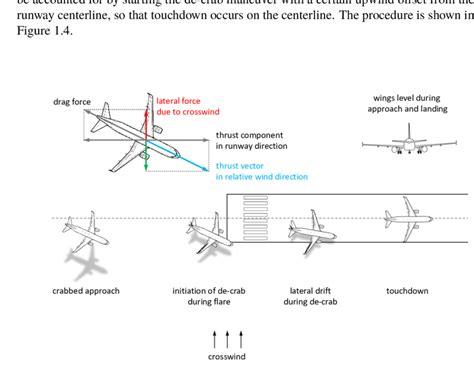
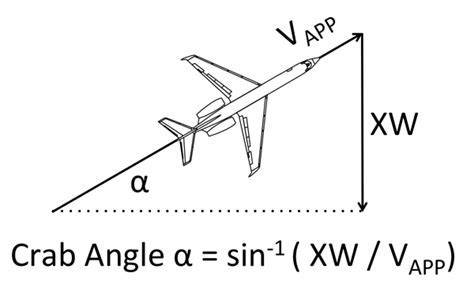
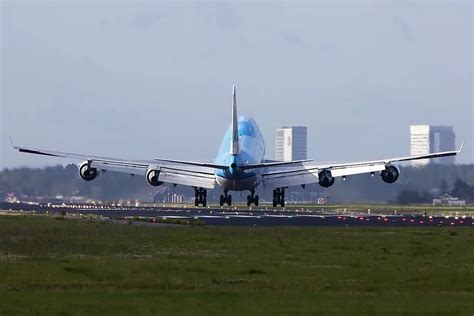
In a crabbed landing, the aircraft maintains a heading into the wind during the final approach, countering lateral drift. This crab angle, which creates a sideways orientation relative to the runway, ensures the aircraft tracks straight along the desired landing path. The pilot touches down while still in this crabbed configuration and relies on the aircraft’s landing gear and aerodynamic forces to realign with the runway post-touchdown.
This technique is particularly favored in large, tricycle-gear jetliners, where the center of gravity lies forward of the main gear. Upon contact with the runway, the yawing moment generated by this configuration tends to self-align the aircraft in the direction of travel, thus reducing the risk of loss of control.
However, crabbed landings pose potential risks:
- Lateral stress on landing gear, especially in strong crosswinds.
- Increased wear on tires and components.
- Danger of wingtip or engine pod contact in aircraft with low-slung engines, such as the Boeing 737, if the crab angle is excessive.
Despite these drawbacks, many carriers operating large aircraft such as the Boeing 747 train and certify their pilots to use this method under controlled crosswind conditions.
What is a De-Crab Landing?
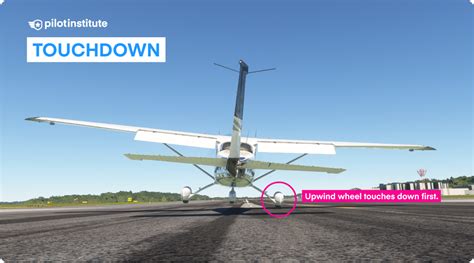
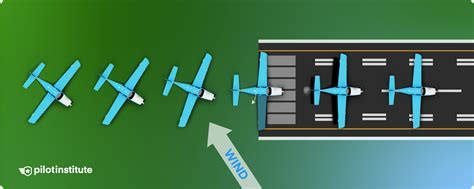
A de-crab landing requires the pilot to remove the crab angle just before touchdown by applying opposite rudder (typically downwind rudder) and often cross-control inputs—such as upwind aileron. The goal is to align the nose of the aircraft with the runway, ensuring the landing gear contacts the surface in a direction parallel to the runway.
This maneuver is often initiated in the flare, the brief moment before touchdown when descent is slowed and the aircraft is prepared for landing. Successful execution requires precise timing, finesse, and a solid understanding of the aircraft’s handling characteristics.
De-crab landings are the preferred technique in:
- Light general aviation aircraft, especially those with tailwheel (conventional) landing gear, where crabbed landings can induce severe yawing moments.
- High crosswind scenarios where side loads can surpass the gear’s structural tolerance.
- Aircraft with low wing configurations, where wingtip clearance during banked corrections may be limited.
Aerodynamic and Mechanical Considerations
The choice between crabbing and de-crabbing isn’t arbitrary. It reflects the aerodynamic design, landing gear configuration, and crosswind certification of the specific aircraft. Aircraft like the Socata TB series—noted for their low wings and robust rudders—allow significant yaw authority for de-crabbing, but require careful rudder-aileron coordination to avoid wingtip strikes or asymmetric landings.
In contrast, heavy jetliners are often designed to tolerate some degree of side load at touchdown. Some are even certified to land in a full crab within specific crosswind limits. This practice avoids last-second yaw corrections that might inadvertently lower the upwind wing, risking a scrape.
Additionally, landing speed influences the required crab angle. A higher touchdown velocity results in a smaller required crab angle for a given crosswind component due to the tangent of the wind correction angle. For instance, a jet approaching at 140 knots in a 20-knot crosswind will require less angular correction than a light aircraft flying at 70 knots.
Pilot Preference and Airline SOPs
Despite theoretical preferences, actual technique often comes down to airline standard operating procedures (SOPs) and individual pilot judgment. Some veteran 747 pilots, for instance, employed a hybrid method—crabbing until short final, followed by a partial de-crab to reduce landing gear strain while maintaining directional control.
This nuanced approach reflects the balancing act between aircraft limitations, safety margins, and personal comfort. A seasoned pilot might lower the upwind wing slightly despite caution from manufacturers, understanding that the first component to contact the ground isn’t the wingtip or engine nacelle, but rather the outboard corner of the wing flap—a factor that subtly informs decision-making.
Tailwheel Aircraft and the Ground Loop Risk
For tailwheel aircraft (often referred to as “taildraggers”), de-crabbing is not just a preference—it is essential. Because the center of gravity is behind the main landing gear, any yaw angle at touchdown can induce a ground loop, a dangerous, uncontrolled turn that can damage the aircraft.
As such, tailwheel pilots are trained to align the aircraft’s nose with the runway precisely before touchdown using coordinated rudder and aileron inputs. In strong crosswinds, this may mean touching down on one main wheel, holding the upwind wing down to maintain roll control and mitigate drift.
Aircraft such as the T-6 or P-51, known for their demanding tailwheel configurations, often use this technique to great effect, combining engine power modulation and precise de-crabbing to arrest descent and touch down cleanly.
Why Crabbing Feels Counterintuitive to Some Pilots
Pilots trained primarily in general aviation frequently express discomfort with crabbed landings. The visual sensation of approaching the runway with the aircraft nose pointed away from the centerline can be disorienting. Moreover, decades of instruction in aligning with the runway before touchdown make the idea of landing “sideways” seem unnatural.
Nevertheless, in large aircraft, the landing gear design, inertia, and pilot assist systems like yaw dampers help absorb and realign the aircraft during a crabbed touchdown. In most cases, runway excursion risks are minimal if crosswind limits are observed and the touchdown is executed within aircraft handling parameters.
Aircraft Type Determines Best Practice
The final determinant in choosing between crabbed and de-crabbed landings is aircraft-specific engineering. For instance:
- The Boeing 737 requires caution with de-crabbing, as its engine nacelles sit low and can contact the runway if banked excessively.
- The Airbus A320 family, with its higher engine placement and computer-assisted flight control systems, permits greater flexibility in choosing technique based on wind conditions.
- Military trainers and warbirds with tailwheel designs demand textbook de-crabbing to avoid directional instability.
Conclusion: A Matter of Technique, Aircraft, and Conditions
The distinction between crabbed and de-crab landings lies in the timing and method of nose alignment with the runway. In crabbed landings, correction occurs after touchdown, making them suitable for tricycle gear jets under controlled crosswinds. De-crab landings, by contrast, align the aircraft before touchdown and are vital for tailwheel and light aircraft.
Ultimately, the choice reflects a balance of aircraft design, environmental conditions, and pilot expertise. Regardless of technique, the goal remains the same: a safe, controlled landing that respects both aerodynamic principles and mechanical limitations.