
Understanding the White Appearance of Clouds
When we gaze skyward on a clear day, the fluffy white clouds floating against the blue expanse seem like a work of art. But this natural beauty is not just a visual spectacle—it is deeply rooted in the physics of light scattering, electromagnetic wavelengths, and atmospheric composition.
The Sun emits white light, a mixture of all visible wavelengths in the electromagnetic spectrum, ranging from violet (about 400 nm) to red (about 700 nm). As this white light interacts with different atmospheric elements, the size and type of particles determine how light is scattered, ultimately influencing how we perceive color in the sky.
In the open atmosphere, tiny air molecules scatter shorter wavelengths, particularly blue light, much more effectively than the longer red wavelengths. This selective scattering—known as Rayleigh scattering—is what gives the sky its deep blue color. However, this principle shifts dramatically when sunlight encounters clouds.

How Cloud Droplets Scatter Light Differently
Unlike atmospheric gas molecules, the water droplets within clouds are significantly larger, typically ranging from 5 to 50 micrometers. Due to their size, these droplets do not discriminate between wavelengths. They scatter all visible wavelengths almost equally, a phenomenon known as Mie scattering.
As millions of these droplets suspend together, they create a dense environment where incoming sunlight is bounced and scattered in multiple directions. Since all colors are scattered equally, their recombination results in the white appearance of clouds. This process is fundamentally different from the blue sky, where unequal scattering skews the visible color.
The Role of Sunlight and Cloud Thickness
While clouds may seem like ethereal formations, their structure and behavior are complex. Sunlight entering a cloud is partially absorbed, partially scattered upward, and partially passed through. The result of this interaction depends significantly on cloud thickness, density, and angle of sunlight.
-
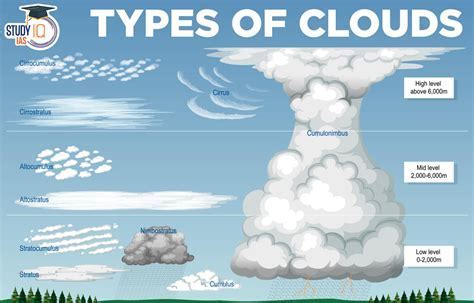
Thin clouds, like cirrus clouds, often appear brilliant white because sunlight passes through them with little absorption.
-
Thicker clouds, such as cumulonimbus formations, may appear gray or even dark at the base. This is because less sunlight penetrates the lower regions, and much of it is scattered upward or sideways before reaching the base.
Why Cloud Tops Appear Whiter
When viewed from above, such as from an airplane, cloud tops always appear white and radiant. This occurs because the top of the cloud is directly illuminated by sunlight without interference. There are no layers of condensed vapor above to obstruct or absorb the light, allowing a pure reflection of white light.
In contrast, from the ground level, we often see the underside of clouds, where light has already been diffused or absorbed, especially in storm clouds where droplets grow larger and further reduce transmitted light. The bottom of such clouds often appears gray or even black, signaling imminent rainfall.
The Influence of Wavelength and Electromagnetic Spectrum
To appreciate why clouds are white, it’s vital to understand how the electromagnetic spectrum affects visibility. Visible light, though only a tiny fraction of the spectrum, contains wavelengths each perceived as distinct colors. Here’s how light interacts depending on its wavelength:
-
Shorter wavelengths (blue/violet): Scattered more by small particles (Rayleigh scattering)
-
Longer wavelengths (red/orange): Scattered less, more likely to pass through the atmosphere
-
Mid-to-large particles (water droplets): Scatter all wavelengths equally (Mie scattering)
This unified scattering across the full visible spectrum is the reason clouds retain the original white light from the Sun, unlike atmospheric gases that selectively scatter.
The Gray and Black Undersides of Storm Clouds
The ominous gray or black hues seen in rain clouds result not from a lack of color, but from optical thickness and depth. In these clouds, water droplets are abundant and large, significantly scattering incoming sunlight upward and laterally. This prevents light from reaching the lower layers, leaving the base dim and shadowed.
Furthermore, these clouds often span several kilometers in height, and their optical density blocks even more light as the cloud thickens, producing a darkened base—a visual cue for approaching storms.

Cloud Colors During Sunrise and Sunset
Clouds take on dramatic hues of red, orange, and gold during sunrise and sunset. This transformation occurs because the Sun’s angle relative to the Earth forces its light to travel through more of the atmosphere. During this extended path:
-
Shorter blue wavelengths are scattered out before the light reaches the observer
-
Longer red and orange wavelengths dominate due to reduced scattering
-
Cloud droplets reflect the prevailing wavelengths, causing the red and orange coloration
The result is a visually rich atmosphere, especially when clouds are present to catch and reflect the remaining warm light.
Rare Phenomena: Iridescence and Pearlescence in Clouds
On rare occasions, clouds display iridescent or pearlescent colors—a delicate spectrum that includes greens, purples, and pinks. These are produced by optical diffraction, where tiny droplets or ice crystals cause light waves to interfere with each other.
This effect usually appears near the edges of thin clouds and is often mistaken for a rainbow. Unlike traditional refraction-based rainbows, cloud iridescence results from wave interference, making it a less frequent but dazzling phenomenon.

In Summary: A Complex Interplay of Light and Matter
The whiteness of clouds is not a simple result of sunlight but rather a precise interaction of light physics and atmospheric microstructure. While the blue sky owes its color to Rayleigh scattering, clouds maintain their white tone through Mie scattering, enabled by larger water droplets that treat all wavelengths of light equally.
From the whiteness of cloud tops to the gray bases of storm clouds, and the fiery hues of dawn and dusk, clouds are ever-changing canvases shaped by the fundamentals of electromagnetic theory, fluid dynamics, and solar radiation.
FAQs
Why are clouds white but the sky is blue?
Clouds are white because water droplets scatter all wavelengths of light equally, which combines to form white light. In contrast, the sky appears blue due to selective scattering of shorter blue wavelengths by air molecules.
Why do clouds turn gray or black before rain?
As clouds thicken and the water droplets grow, they scatter more light away from the base, allowing less sunlight to penetrate. This leads to a darker appearance, often signaling rain.
Can clouds appear in colors other than white or gray?
Yes. During sunrise or sunset, clouds can appear red, orange, or pink due to the longer travel path of sunlight, which filters out blue light. Rare iridescence may also occur under specific atmospheric conditions.