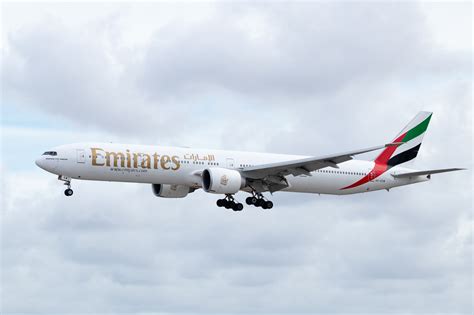
Emirates’ decision to operate the Miami–Bogotá sector as part of its wider Dubai–Miami–Bogotá service is rooted in a careful blend of network strategy, aircraft performance requirements, and commercial opportunity. The flight has drawn global attention, particularly among aviation enthusiasts who track unusual or high-yield routings. This service is a classic example of a fifth-freedom flight, a niche but powerful tool that allows an airline to carry passengers and cargo between two foreign nations before continuing to its home country.
The operation begins in Dubai (DXB), continues to Miami (MIA), and then proceeds to Bogotá (BOG). This structure is neither an accident nor an indulgence. It is the product of geography, aerodynamics, and market economics. The airline uses the highly capable Boeing 777-300ER, and while it can reach Bogotá from Dubai with a technical stop, it cannot depart Bogotá fully loaded and immediately fly to the Middle East due to altitude restrictions. These constraints open a window of opportunity for an intermediate stop such as Miami, transforming operational necessity into revenue potential.
How Fifth Freedom Rights Shape the Route’s Viability
The foundation of this operation lies in fifth-freedom traffic rights, an internationally recognized aviation privilege that allows an airline from Country A to operate services between Country B and Country C. In this case, Emirates—registered in the United Arab Emirates—can carry commercial passengers and cargo between the United States and Colombia as part of its extended route.
These rights serve multiple purposes. They help airlines offset operational costs on long-haul routes, allow countries to stimulate competition and connectivity, and give travelers more choices. Fifth-freedom flights often attract attention because they frequently offer internationally configured widebody aircraft on short segments. In the Miami–Bogotá case, passengers gain access to a full-service long-haul cabin product at pricing that competitively undercuts local carriers. One flightradar24 observer even noted that flying BOG–MIA on Emirates can be cheaper than flying the same route on Avianca.

The Altitude Challenge: Why Bogotá’s Elevation Matters
Bogotá’s El Dorado International Airport sits at an elevation of roughly 8,360 feet (2,548 meters), making it one of the highest major international airports in the world. Aircraft performance changes dramatically at altitude, especially for heavy widebodies like the 777-300ER. At high elevations, thinner air reduces lift and engine performance during takeoff, forcing airlines to impose payload penalties. In lay terms, an aircraft cannot take off with the same amount of fuel, cargo, or passengers that it could carry at sea level.
This terrain challenge is precisely why Emirates cannot operate BOG–DXB nonstop without severe restrictions. A departure from Bogotá to Dubai would require carrying enough fuel for a 7,700-mile journey, which is incompatible with the airport’s altitude-imposed limits for fully loaded widebodies. Miami provides a favorable alternative: a sea-level departure point with long runways, allowing the aircraft to refuel, reload, and relaunch toward the Middle East without weight restrictions.

Cargo Demand: One of the Route’s Hidden Powerhouses
While passenger demand certainly matters, the cargo market is the engine that powers much of this route’s success. Industry insiders and aviation analysts have frequently highlighted the enormous volume of Colombian export cargo, especially flowers, which dominate the export markets into Miami. The Emirates 777-300ER carries substantial belly cargo capacity, and on the short Miami–Bogotá leg, its performance profile allows it to move large quantities of freight at optimal cost.
Miami is one of the world’s largest gateways for perishable goods headed to the United States and beyond. By integrating the Bogotá leg into its Dubai-bound network, Emirates taps into a global cargo flow that seamlessly links South America with the Middle East, Europe, and Asia. The aircraft that may risk leaving Bogotá underloaded now departs Miami at full capability, making the route economically stronger than a simple passenger itinerary might suggest.
Competitive Positioning and Pricing Advantages
The Miami–Bogotá market is dominated by several carriers, particularly Avianca and American Airlines. Emirates enters this market not as a local competitor but as a premium international carrier offering long-haul amenities on a regional route. These advantages often result in surprisingly competitive fares. Travelers have shared accounts of finding Emirates pricing lower than Avianca, while enjoying services typically reserved for intercontinental flights: full meal service, expansive in-flight entertainment, and in some cases lounge access.
Competitors operating narrowbody aircraft on the same route cannot match the onboard comfort offered by the Emirates 777-300ER. The passenger experience becomes a selling point in itself, encouraging travelers to choose Emirates for a short-haul hop that feels like a long-haul experience.
How Miami Becomes a Strategic Bridge in Emirates’ Global Network
Miami sits in an opportune position between the Middle East and South America, functioning as both a commercial hub and a geographic midpoint. Emirates uses the city not simply as a transit point but as a strategic gateway. The MIA stop enhances operational reliability, solves the Bogotá altitude limitation, and opens an additional high-yield market segment.
For Miami, this added connectivity strengthens the city’s position as an intercontinental hub. For Bogotá, it creates an additional bridge to the Middle East and onward destinations. For Emirates, it turns a technical necessity into a commercially vibrant opportunity.
The Historical Context of Fifth-Freedom Operations
Fifth-freedom flights are not new, nor are they unique to Emirates. Airlines across Europe and Asia once relied heavily on these rights to extend their reach across continents. The mention of Jet Airways’ Gatwick–Amsterdam operation reflects how airlines have used such rights to fill aircraft on routes where direct demand fluctuates. Passengers have long benefited from these opportunities, often accessing luxury service at unusually low fares.
Emirates has embraced these freedoms as part of a broader global strategy. Routes such as Dubai–Athens–New York, Dubai–Milan–New York, and Dubai–Sydney–Christchurch exemplify the airline’s ability to combine geography, market gaps, and logistical constraints into commercially appealing services.
The Miami–Bogotá Leg as a Showcase of Widebody Regional Operations
Seeing a 777-300ER at Bogotá is a rare sight, and planespotters have celebrated its arrival with enthusiasm. Widebody aircraft on short regional routes create unique operational dynamics. They move significant cargo volumes, offer premium passenger experiences, and capture niche demand that might be underserved by other carriers.
This particular service illustrates how a widebody aircraft can outperform narrowbody competitors on certain routes when backed by the right market dynamics. Bogotá’s elevation forces airlines to make tough choices; Emirates’ choice turned an obstacle into a marketing advantage.
The Broader Implications for Global Aviation
The Emirates Miami–Bogotá service highlights how international aviation thrives at the intersection of diplomacy, engineering, and economics. Fifth-freedom rights, aircraft performance limitations, and global trade patterns all shape the route’s existence. This flight also underscores how premium carriers can disrupt regional markets in ways that benefit passengers and shippers alike.
As long as Bogotá’s altitude remains a defining constraint and Miami remains a powerful regional gateway, Emirates’ fifth-freedom strategy will continue to be both practical and profitable. The route stands as a reminder that the world of aviation is rarely simple: sometimes the most unusual flights are the most logical ones once every layer is revealed.