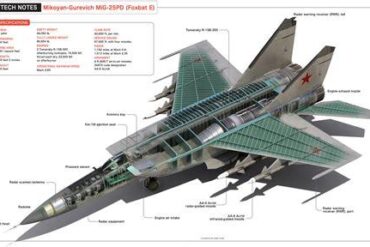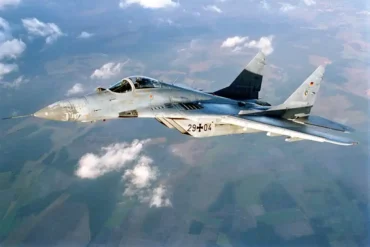
The Mikoyan-Gurevich MiG-25 “Foxbat” was one of the most formidable high-speed interceptors and reconnaissance aircraft developed during the Cold War. Designed to counter the Lockheed SR-71 Blackbird and high-altitude American bombers, the MiG-25 was among the fastest combat aircraft ever built. However, despite its remarkable speed and altitude capabilities, it was retired from active service due to a combination of technological limitations, operational challenges, and shifting geopolitical strategies. This article delves into the key reasons behind its retirement.
Technological Obsolescence
Outdated Avionics and Electronics
The MiG-25 was designed in the 1960s, incorporating technology that became outdated as military aviation advanced. Its vacuum tube-based radar and electronics, while resilient to electromagnetic pulses, were vastly inferior to the solid-state systems found in contemporary Western aircraft like the F-15 Eagle and F-16 Fighting Falcon. These Western fighters benefited from advanced pulse-Doppler radars, digital avionics, and superior fire control systems, making the MiG-25’s targeting and tracking capabilities significantly less effective in modern combat scenarios.

Structural Limitations
The MiG-25’s stainless steel airframe, while enabling high-speed flight at Mach 2.8+, came with significant drawbacks. Unlike aircraft constructed from lightweight aluminum or composites, the steel airframe made the MiG-25 heavier and less maneuverable. This design prioritized speed over agility, making it unsuitable for modern dogfighting and multirole combat. Furthermore, the high temperatures generated at maximum speed often caused structural stress, necessitating frequent maintenance.

Operational and Maintenance Challenges
Engine Wear and Performance Constraints
The Tumansky R-15 turbojet engines, while powerful, had severe limitations. Operating at sustained speeds above Mach 2.8 led to rapid engine degradation, limiting their practical lifespan. As a result, pilots were often restricted to suboptimal speeds, rendering the aircraft unable to fully exploit its designed performance envelope. Engine replacements were costly and time-consuming, making the MiG-25 a logistical burden for air forces.
High Maintenance Costs
The specialized welding techniques and materials required for its stainless steel construction made repairs and upgrades expensive. Unlike modern aircraft, which utilized more cost-efficient aluminum and composite materials, the MiG-25 required frequent, labor-intensive maintenance cycles. Post-Soviet air forces, struggling with budget constraints, found it increasingly unsustainable to operate such a high-maintenance platform.

Geopolitical and Security Factors
The 1976 Defection Incident
One of the most damaging events in the MiG-25’s history was the defection of Soviet pilot Viktor Belenko. On September 6, 1976, Belenko flew his MiG-25 to Hakodate, Japan, where it was thoroughly examined by Western intelligence agencies. This incident exposed previously classified aspects of the aircraft’s design, including its vacuum tube-based radar and limited avionics capabilities. The revelations forced the USSR to revamp its radar and identification systems, increasing costs and reducing confidence in the aircraft’s operational security.

The Rise of Stealth Technology
By the 1980s and 1990s, air combat doctrine shifted towards stealth and beyond-visual-range engagements. The introduction of stealth aircraft like the F-117 Nighthawk, B-2 Spirit, and later the F-22 Raptor rendered high-speed interceptors like the MiG-25 less relevant. Modern air defense networks emphasized radar-evading technology and advanced missile systems, reducing the strategic necessity of high-speed interceptors.
Performance in Modern Conflicts
Challenges in the Gulf War
During Operation Desert Storm (1991), the MiG-25 saw limited combat engagements. While it was capable of outrunning U.S. fighters like the F-15, it suffered from inferior avionics, outdated weaponry, and limited maneuverability. Most MiG-25s relied on older, semi-active radar-guided missiles, making them vulnerable to modern beyond-visual-range missiles like the AIM-120 AMRAAM.
One notable engagement occurred when an Iraqi MiG-25 successfully shot down a U.S. Navy F/A-18 Hornet, but overall, its combat record was unimpressive. The aircraft’s inability to integrate into modern air combat environments further justified its eventual retirement.
Replacement by the MiG-31
The MiG-31 “Foxhound”, introduced in the 1980s, directly addressed many of the MiG-25’s shortcomings. Featuring a phased-array radar, longer-range missiles, improved avionics, and better maneuverability, the MiG-31 became the Soviet Union’s primary long-range interceptor. Unlike its predecessor, the MiG-31 could track multiple targets simultaneously and effectively counter stealth aircraft and cruise missiles. This superior performance led to the gradual phase-out of the MiG-25.
Strategic Shifts in Air Warfare

Emphasis on Multirole Capability
By the late 20th century, most air forces prioritized multirole aircraft capable of performing both air superiority and ground attack missions. The MiG-25, designed purely as an interceptor and reconnaissance platform, lacked versatility. Modern aircraft like the Su-27, F-15E Strike Eagle, and Eurofighter Typhoon offered superior mission adaptability, reducing the demand for single-role interceptors.
Cost-Effectiveness and Economic Considerations
Following the collapse of the Soviet Union (1991), post-Soviet states faced budgetary constraints that made operating a specialized fleet of MiG-25s economically unfeasible. Countries like Russia, Ukraine, and Kazakhstan opted to retire the aircraft in favor of more cost-effective and versatile platforms. The limited availability of spare parts and aging infrastructure further accelerated its withdrawal from service.
Conclusion
The retirement of the MiG-25 “Foxbat” was driven by a combination of technological obsolescence, operational inefficiencies, and shifting military strategies. While it remains one of the fastest and highest-flying combat aircraft ever built, its outdated avionics, high maintenance costs, and lack of versatility made it unsuitable for modern air warfare. The rise of stealth technology, beyond-visual-range missile engagements, and multirole aircraft further diminished its strategic value.
Although retired from frontline service, the MiG-25’s legacy endures as a testament to Soviet engineering ingenuity, influencing subsequent designs like the MiG-31 Foxhound. It remains a Cold War icon, remembered for its unmatched speed, high-altitude performance, and historic role in global air combat history.