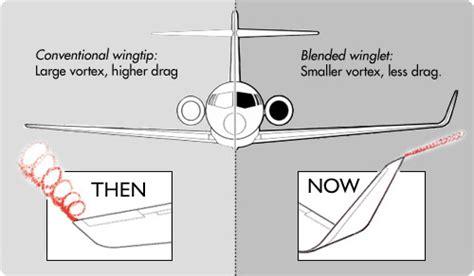
Wing tip drag reduction devices are essential for improving the efficiency of fixed-wing aircraft. Their primary goal is to reduce induced drag caused by lift-induced wing tip vortices. By smoothing the airflow over the wings, these devices enhance lift at the wing tips, leading to lower total drag, better takeoff and climb performance, and reduced fuel consumption.
Additionally, they help diminish the strength of wingtip vortices that can pose a risk to nearby aircraft. Induced drag arises naturally from lift production. As air moves over a wing, it tends to flow inward due to lower pressure above the wing compared to the higher pressure beyond the wing tip. Conversely, air beneath the wing flows outward because the pressure below is greater than that outside the wing tip. This pressure difference creates a continuous upward flow of air around the wing tip, known as the “tip effect” or “end effect.” While wing tip devices do not completely eliminate this effect, they significantly reduce it.
There are several configurations of wing tip devices, including winglets, blended winglets, wing tip fences, and raked wing tips. Each design has unique advantages, with some excelling during cruise and others enhancing takeoff and climb performance. When selecting a design for a specific aircraft, engineers aim for the best fit based on the aircraft’s typical flight profile. For instance, long-range aircraft often use designs that optimize cruise efficiency. Examples of these devices include the Diamond HK36 winglet, Airbus A319 wing tip fence, Boeing 787 raked wing tip, and Boeing 737 blended winglet.