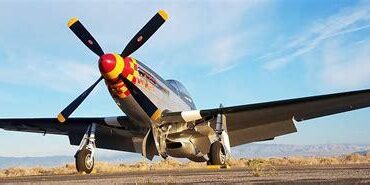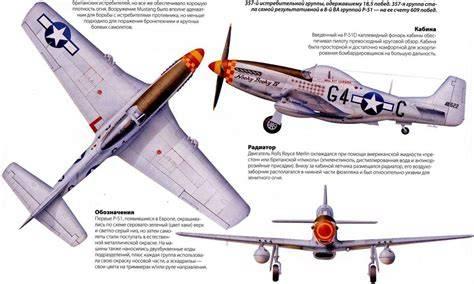
The North American P-51 Mustang is often remembered as one of the defining aircraft of World War II, but its legendary reputation was not created by a single breakthrough. The Mustang became exceptional because several carefully integrated design decisions solved problems that had limited earlier fighters. Long-range fuel capacity, a low-drag wing, an innovative radiator installation, the Merlin engine, and advanced aiming technology transformed the aircraft from a promising fighter into one of the most effective escort fighters of the war.
The importance of that transformation becomes clearer when we consider the air war over Europe. Allied heavy bombers could carry the war deep into German territory, but bombers alone were vulnerable to determined fighter interception. Early Allied escorts could not remain with formations throughout the longest missions. This created a dangerous gap over enemy territory, where German fighters could attack formations after the escorts had turned back. The Mustang eventually closed that gap with a combination of range, speed, altitude performance, and combat efficiency.
The P-51 did not initially possess all of these qualities. Its early Allison-powered versions performed well at lower and medium altitudes but lost much of their advantage higher in the atmosphere. The decisive change came when North American Aviation combined its efficient airframe with the Rolls-Royce Merlin, an engine later produced in the United States by Packard. The resulting P-51B and subsequent variants demonstrated what could happen when aerodynamic efficiency and high-altitude engine performance were designed to complement one another rather than operate as separate improvements.
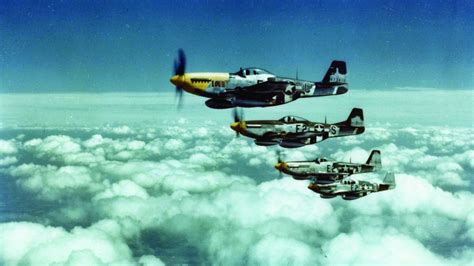
1. Massive Fuel Capacity Turned the Mustang Into a Long-Range Escort Fighter
One of the most consequential Mustang design decisions was not related to speed or armament at all. It was the decision to give the aircraft enough fuel to stay with bomber formations deep into enemy territory. This solved one of the most serious operational problems facing the Allied air campaign.
Partway through P-51B production, North American incorporated an additional 85-gallon fuselage fuel tank behind the pilot. That substantially increased internal fuel capacity and extended the aircraft’s useful combat radius. The Mustang could also carry external drop tanks, allowing it to travel extraordinary distances for a single-engine fighter. Later P-51D configurations could carry even greater quantities of fuel when equipped with external tanks.
The strategic value was enormous. A fighter did not necessarily have to destroy every German interceptor it encountered to protect a bomber formation. Its presence alone could complicate the enemy’s attack plan. German pilots approaching a formation now had to contend with escort fighters that could remain in the area rather than disappear once the bombers reached a certain distance from their bases.
This changed the economics of the air war. Allied bomber crews had previously faced extended periods in which they were exposed to German fighters without effective fighter protection. Once the Mustang could accompany them over much greater distances, the Luftwaffe had to fight through an increasingly capable defensive screen.
The Mustang’s long range therefore represented more than a specification-sheet advantage. It was a strategic weapon. Range allowed the aircraft to convert its excellent performance into sustained operational pressure over Germany. A very fast fighter that could not reach the target was of limited value as an escort. The Mustang could reach the target, remain there, fight, and return.
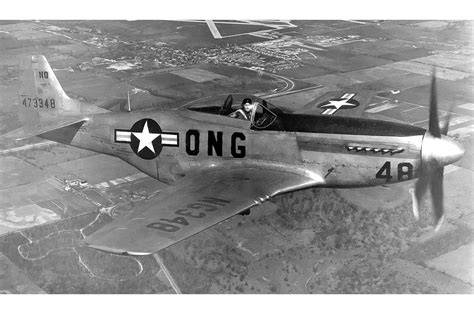
2. The Laminar-Flow Wing Reduced Drag at High Speed
The Mustang’s wing was another crucial part of the formula. North American worked with the National Advisory Committee for Aeronautics, the organization that preceded NASA, to develop an airfoil intended to reduce aerodynamic drag.
Traditional wings were not necessarily optimized for the high-speed regime in which the Mustang would eventually operate. The Mustang’s new airfoil moved the point of maximum thickness farther aft, encouraging a longer region of relatively smooth airflow over the wing. The goal was to reduce skin-friction drag and delay the transition from laminar to turbulent airflow.
That sounds subtle, but at fighter speeds it mattered enormously. Aerodynamic drag rises rapidly with speed, meaning that even modest reductions can produce substantial gains in acceleration, cruising efficiency, and maximum velocity.
Testing demonstrated the effectiveness of the concept. A Merlin-powered P-51B achieved approximately 453 mph at 28,800 feet in testing, demonstrating how efficiently the airframe could exploit the new engine’s power.
The wing’s benefit was not limited to maximum speed. The Mustang became particularly impressive at retaining energy. A fighter that loses speed rapidly after a maneuver can become vulnerable even if its published top speed is excellent. The P-51’s relatively clean aerodynamic design allowed it to preserve speed effectively, especially in high-speed dives and fast repositioning maneuvers.
Maintaining the intended airflow, however, required considerable attention during production and maintenance. North American went to unusual lengths to smooth portions of the wing, including filling and sanding rivet lines and panel joints before applying primer. A smooth wing was part of the aircraft’s performance equation, not merely an aesthetic preference.
The design therefore illustrated an important principle in fighter engineering: performance often comes from reducing losses rather than simply adding power. The Mustang’s wing did not need to create enormous amounts of lift at low speed to be revolutionary. It needed to allow the aircraft to move through the air with as little unnecessary resistance as practical.
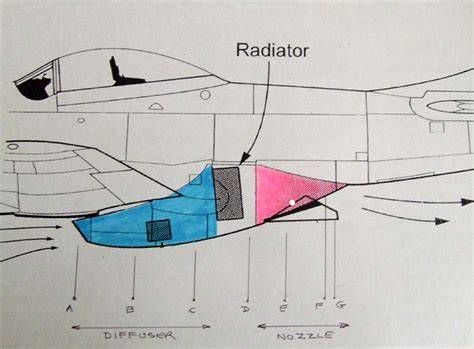
3. The Meredith Radiator Duct Turned Cooling Into an Aerodynamic Asset
Liquid-cooled piston engines created an obvious engineering problem. The engine required a radiator, but the radiator required airflow. Any large opening exposed to the airstream could create cooling drag, reducing the very speed the powerful engine was intended to provide.
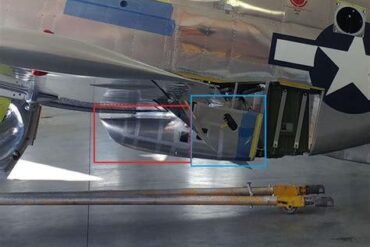
North American’s solution was the Mustang’s distinctive radiator installation beneath the rear fuselage. Its design drew on aerodynamic research associated with British engineer F. W. Meredith, whose work described how heated air passing through a properly designed duct could be accelerated as it exited the aircraft.
The concept became known as the Meredith effect. Air entering the radiator duct was slowed and heated as it passed through the cooling system. The heated air then expanded and accelerated toward the rear. In theory, that accelerated exhaust could generate thrust and recover some of the aerodynamic penalty created by the radiator.
The system did not magically eliminate every source of cooling drag, and claims about precisely how much drag it recovered vary depending on the assumptions used. Nevertheless, the basic concept was highly effective. The radiator could be integrated into a remarkably clean airframe without simply becoming a large aerodynamic liability.
This mattered even more after the Mustang received the Merlin. The new engine was more powerful and more complex than the Allison engine used in early Mustangs. It required effective cooling, and its installation demanded careful management of airflow and temperature.
The radiator duct therefore connected several parts of the aircraft’s design. Engine power, cooling, drag reduction, and high-speed performance became one integrated engineering problem. The solution helped North American install a substantially more capable powerplant without sacrificing the aerodynamic efficiency that made the Mustang special.
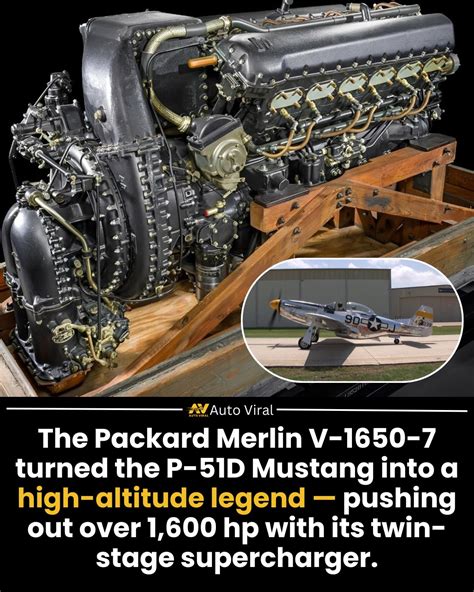
4. The Packard Merlin Gave the Mustang Its High-Altitude Power
The most famous transformation in the Mustang’s development came from replacing the Allison engine with the Rolls-Royce Merlin. The early P-51 was already an efficient aircraft, but its engine did not maintain its best performance at the altitudes where the European strategic bombing campaign increasingly operated.
The Merlin changed that equation. Its sophisticated two-stage, two-speed supercharging system compressed incoming air in stages, allowing the engine to maintain useful power as atmospheric pressure fell at high altitude.
This was essential because piston engines naturally lose performance as altitude increases. There is less oxygen available for combustion, and without effective forced induction, engine power declines. A high-performance fighter could therefore become surprisingly ordinary once it climbed into thinner air.
The Merlin’s supercharger addressed that weakness. In Merlin-powered Mustangs, the engine could continue producing substantial power at altitudes approaching 30,000 feet, where the Allison-powered aircraft had struggled to maintain the same level of performance.
The effect on the Mustang was dramatic. The aircraft’s efficient airframe could now be paired with an engine capable of delivering the power necessary for high-speed flight, strong climb performance, and effective combat at bomber-operating altitudes.
The change also explains why the P-51B deserves particular attention. Although the later P-51D became the most recognizable Mustang because of its improved visibility, armament arrangement, and distinctive bubble canopy, the B model demonstrated the fundamental combination that made the Mustang legendary.
The Merlin was not simply a more powerful engine. It was the missing component that allowed the Mustang’s aerodynamic design to realize its full potential at altitude. The airframe reduced drag; the supercharged Merlin supplied the power; the radiator system managed the heat. These features worked together as a single performance architecture.
5. Advanced Gunsights Made the Mustang’s Firepower More Effective
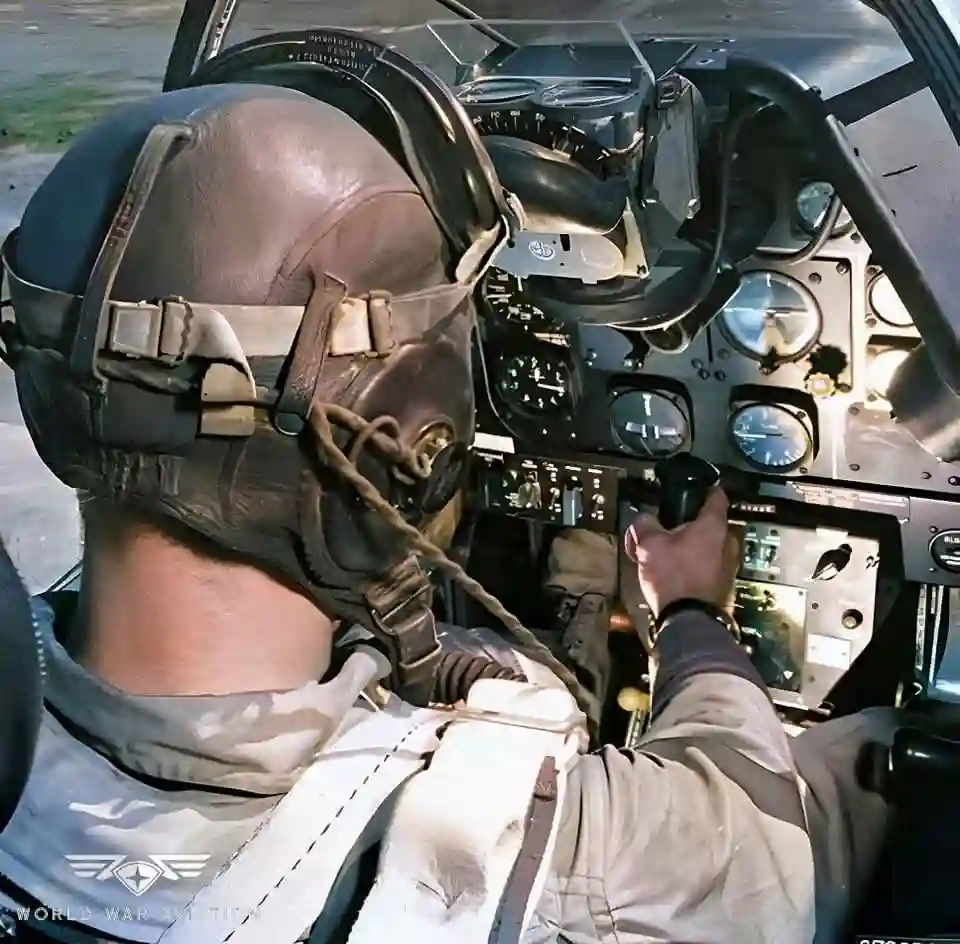
The Mustang’s final advantage was found inside the cockpit. Speed and range could place a fighter in the right location, but the pilot still had to hit a maneuvering target. Dogfights happen quickly, and accurately estimating the necessary lead angle while simultaneously controlling an aircraft under extreme stress is extraordinarily difficult.
The K-14 gyroscopic computing gunsight provided an elegant solution. Instead of requiring the pilot to estimate target lead entirely through experience, the gunsight used mechanical computation to determine the appropriate aiming solution based on target size and relative motion.
The pilot selected an estimated target wingspan, and the gunsight’s moving reticle helped indicate where the aircraft should aim to account for the target’s movement. The technology did not turn an inexperienced pilot into an expert overnight, but it reduced one of the most difficult mental calculations involved in aerial gunnery.
That mattered because the Mustang carried substantial forward-firing armament, and ammunition was finite. A pilot who repeatedly fired ahead of or behind a target could exhaust ammunition without producing meaningful results. Improving aiming accuracy effectively increased the value of every round carried aboard the fighter.
The K-14 also represented a broader shift in fighter design. The aircraft was no longer simply a combination of engine, wings, guns, and armor. Its effectiveness increasingly depended on the interaction between the pilot and the machine.
A powerful fighter that was difficult to aim could waste much of its potential. By providing a mechanical solution to lead-angle estimation, the gunsight helped make the Mustang’s high-speed interception and dogfighting capability more practical in the hands of trained pilots.
How Five Design Choices Created One Exceptional Fighter
The Mustang’s success becomes easier to understand when these five decisions are considered together. Fuel capacity gave it reach. The laminar-flow wing gave it aerodynamic efficiency. The Meredith radiator installation minimized the penalty of cooling a powerful engine. The Merlin supplied high-altitude power. The computing gunsight helped the pilot convert that performance into combat effectiveness.
None of these features alone would have created the aircraft remembered today. A long-range fighter without high-altitude performance would still struggle against enemy interceptors. A powerful engine installed in an aerodynamically inefficient airframe would waste much of its output. An efficient fighter without sufficient fuel could not protect bombers throughout the mission. And a superb aircraft without an effective aiming system could still fail to deliver its firepower.
The Mustang’s brilliance was therefore its integration of multiple engineering solutions into a coherent combat system. North American produced an airframe with unusually low drag, then paired it with an engine whose supercharger preserved performance where the Allies needed it most. The radiator installation helped reconcile cooling requirements with aerodynamic cleanliness, while the enlarged fuel capacity gave the aircraft the endurance necessary to exploit its performance operationally.
That combination had consequences far beyond individual dogfights. Once Mustangs could escort heavy bombers deep into German territory, the Luftwaffe could no longer rely on the same pattern of attacking formations after shorter-range escorts departed. German fighters increasingly had to contend with Allied escorts capable of remaining with the bombers and engaging them over much greater distances.
By 1945, the balance of air power over Europe had shifted dramatically. The Mustang was certainly not solely responsible for the collapse of German air defenses; that outcome resulted from enormous Allied industrial, technological, operational, and numerical advantages. Yet the P-51 became an exceptionally important instrument for exploiting those advantages.
Why the P-51 Mustang Still Matters
The enduring importance of the P-51 Mustang comes from the way its design solved a specific operational problem. The Allies needed a fighter that could travel far, fly high, move quickly, fight effectively, and return home. The Mustang eventually satisfied all of those requirements in one remarkably efficient package.
Its story also demonstrates why aircraft performance cannot be reduced to a single specification. Maximum speed alone did not make the Mustang successful. Neither did horsepower, range, armament, or altitude capability in isolation. Its advantage emerged from the way each element reinforced the others.
The P-51B’s Merlin conversion was the decisive turning point, while the later P-51D refined the concept into the iconic form most people recognize today. Together, these developments created a fighter capable of operating across enormous distances while retaining the performance needed for high-altitude combat.
That is why the Mustang remains one of the most studied piston-engine fighters in aviation history. Its greatest achievement was not simply being fast or powerful. It was being efficient enough to make speed, power, range, and combat capability coexist in one aircraft. In the skies over Europe, that combination helped turn the Mustang from an ambitious American fighter design into a machine capable of changing the strategic character of the air war.