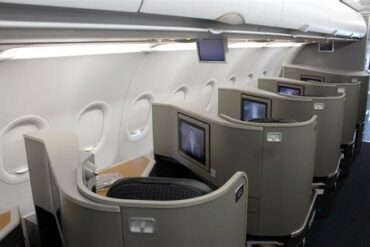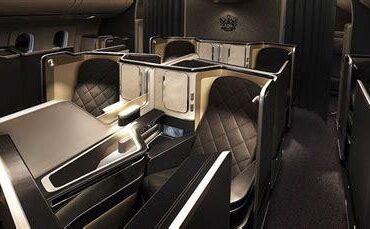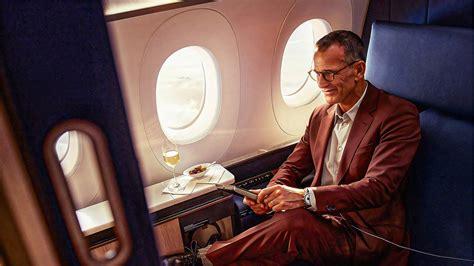
Airlines no longer treat premium cabins as an afterthought politely tucked behind the cockpit. They are now the strategic centerpiece of long-haul profitability, brand identity, and competitive differentiation. In a market where widebody aircraft such as the Airbus A380, Boeing 777-300ER, Boeing 787-9 Dreamliner, and Airbus A350 dominate intercontinental routes, innovation in premium seating has become both a science and a high art.
Space defines the premium experience. Widebody aircraft offer a broader fuselage diameter, enabling airlines to rethink seat geometry, privacy architecture, storage integration, and spatial zoning in ways narrowbody cabins simply cannot accommodate. Yet innovation in aviation is never about extravagance alone. Every design decision must balance weight restrictions, certification requirements, cabin pressurization dynamics, evacuation rules, and operational efficiency.
True innovation in premium seats is not about novelty for novelty’s sake. It is about reengineering how a human body occupies space at 35,000 feet. It is about integrating ergonomics, privacy psychology, and luxury hospitality within strict aerospace constraints. The following five products represent the most innovative widebody premium seats you can book today — each redefining expectations in its own distinctive way.
Air France La Première – Reinventing French Luxury at 35,000 Feet
Air France’s fully redesigned La Première suite aboard the Boeing 777-300ER represents three years of meticulous development and a renewed articulation of French craftsmanship in aviation form. Rather than simply refreshing materials or enlarging partitions, Air France reconceived the entire spatial philosophy of first class.
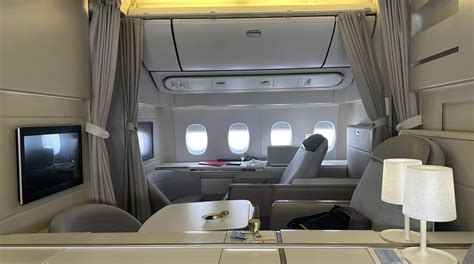
Each suite is manufactured in France by STELIA Aerospace and centers on a sculpted armchair paired with a dedicated chaise longue. Unlike traditional first-class seats that convert into beds, this configuration separates seating and sleeping functions. The chaise longue transforms into a fully flat two-meter bed, enhanced during turndown service with a memory foam mattress topper, plush pillow, and duvet supplied by Dumas Paris.
Overhead bins have been removed entirely from the La Première cabin. This decision dramatically changes the psychological environment. Without bulky compartments above, the suite feels open and residential rather than aeronautical. Storage shifts to floor-level compartments capable of holding two full-size suitcases, along with a dedicated shoe drawer and personal wardrobe.
Privacy is achieved through floor-to-ceiling curtains, creating a fully enclosed cocoon. Central suites feature an electric divider, allowing couples to travel together or independently. Side suites benefit from five windows, amplifying natural light and reinforcing the sense of spatial generosity rarely found in aircraft cabins.
Dining extends the innovation beyond physical architecture. Tableware designed by Jean-Marie Massaud incorporates Bernardaud Limoges porcelain, Christofle cutlery, and metalwork by Degrenne, all subtly engraved with Air France’s winged seahorse emblem. The cabin does not merely transport passengers; it curates a national identity expressed through material culture.
La Première demonstrates that innovation can be subtle yet transformative. By removing overhead bins and separating seating from sleeping, Air France redefined what spatial freedom feels like inside a pressurized aluminum cylinder.
All Nippon Airways “THE Room FX” – Rethinking Ergonomics in Business Class
All Nippon Airways has never been content with incremental upgrades. Its original “THE ROOM” business class on the 777-300ER already disrupted expectations. With THE Room FX aboard the Boeing 787-9 Dreamliner, ANA refined the concept into a more weight-efficient and ergonomically advanced system.
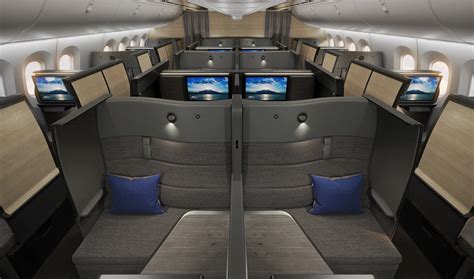
The “FX” stands for Future Experience, and the name is not decorative branding. It reflects a structural reengineering of how a business class seat functions. Manufactured by Safran Seating, THE Room FX integrates two seats into a single structural frame. This reduces weight while increasing seating density without shrinking personal space — a rare feat in aircraft economics.
The most significant innovation lies in its multi-postural architecture. Traditional seats recline backward. THE Room FX avoids that tilt entirely. Instead, the backrest remains fixed while the legrest articulates forward, forming a continuous lie-flat surface. The result is a more natural transition between upright, relaxation, and fully flat modes.
The bed measures approximately 103 inches in length, with a seat width of 27 inches at the waist expanding to 41.5 inches at its widest point. This expansive geometry creates a near first-class sense of openness within a 1-2-1 business configuration.
Rather than focusing solely on privacy doors or visual theatrics, ANA concentrated on biomechanics. How does the spine align during long-haul sleep? How can weight be reduced without compromising rigidity? How can storage be integrated without increasing footprint?
THE Room FX answers these questions through engineering rather than ornamentation. It proves that innovation sometimes means refining the invisible mechanics beneath the upholstery.
Singapore Airlines A380 Suites – The Private Room in the Sky
Singapore Airlines’ Airbus A380 Suites operate in a category beyond conventional seat design. Each suite spans nearly 50 square feet, effectively transforming the upper deck of the A380 into a collection of private hotel rooms.
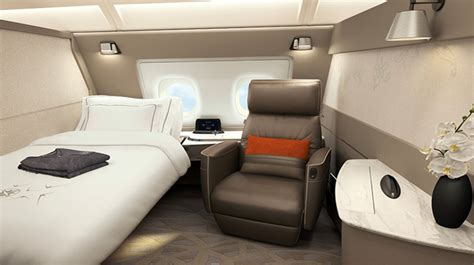
The defining innovation is the separation of bed and chair. Unlike convertible seats, the Suites feature a full-length standalone bed paired with an adjustable leather swivel chair upholstered by Poltrona Frau. This dual-component arrangement allows passengers to dine, work, and sleep without rearranging their environment.
Adjacent suites can combine to create a genuine double bed, forming a private space for couples unmatched in commercial aviation. Sliding doors and electronic window blinds provide full environmental control, while the chair swivels up to 270 degrees, allowing passengers to orient themselves toward the window or 32-inch entertainment screen.
The spatial zoning within each suite distinguishes sleeping, dining, and lounging areas. This separation mimics architectural principles used in boutique hotels rather than aircraft cabins. Integrated mood lighting, touchscreen controls via a wireless tablet, and advanced sound insulation enhance sensory comfort.
The A380’s wide fuselage enables this architectural ambition. Without the aircraft’s generous cross-section, such a layout would be impossible. Singapore Airlines leveraged the aircraft’s structural advantage to create a self-contained living space rather than a modified seat.
In doing so, the airline blurred the boundary between aviation and hospitality. The Suites are not merely premium seats; they are enclosed environments designed around human behavior.
Qatar Airways QSuite – The Business Class That Changed the Industry
When Qatar Airways QSuite launched, it recalibrated global expectations of business class. Installed across much of the airline’s Boeing 777 and Airbus A350 fleets, QSuite introduced flexibility that had rarely been attempted at scale.
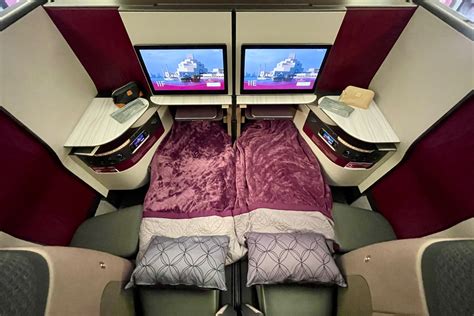
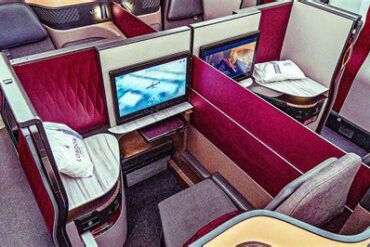
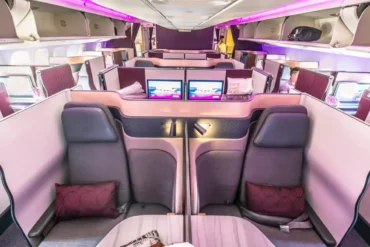
Its most celebrated feature is the double bed in Business Class, achieved by lowering privacy panels between adjacent center seats. This was a radical departure from the prevailing philosophy that prioritized isolation above all else.
The cabin is configured in a 1-2-1 layout with alternating forward- and rear-facing seats. Window seats function as fully enclosed private suites with sliding doors. Meanwhile, the center section allows four seats to convert into a shared “meeting room” layout, complete with movable monitors and a central table.
This reconfigurability introduces a social dimension rarely seen in premium cabins. Business travelers can collaborate mid-flight. Families can dine together. Couples can sleep side by side.
With a 79-inch fully flat bed, generous storage, and high privacy partitions, QSuite balances seclusion with adaptability. Its success lies in its modular thinking. Rather than designing a fixed seat, Qatar Airways designed a flexible micro-environment.
QSuite demonstrated that business class could deliver first-class features without sacrificing density or revenue efficiency. It remains the benchmark for competitive innovation.
Etihad The Residence – A Three-Room Apartment Above the Clouds
At the farthest edge of commercial aviation luxury stands Etihad’s The Residence aboard the Airbus A380. This is not simply a seat or even a suite. It is a 125-square-foot private apartment positioned on the upper deck.
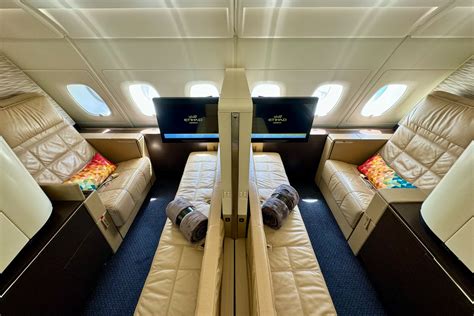
The Residence comprises three separate rooms: a living area, a fully enclosed bedroom, and a private ensuite bathroom with shower. High walls and doors isolate the space from the rest of the cabin, creating an environment closer to private aviation than scheduled airline service.
The living room accommodates dining and relaxation. Beyond a short corridor lies the bedroom, featuring a small double bed fitted with a custom mattress and luxury bedding. The bathroom includes heated floors and a shower — an amenity virtually unheard of in commercial aircraft.
Safety regulations remain intact. A discreet peephole allows crew to verify seatbelt compliance during turbulence. Even in extreme luxury, aerospace safety never yields.
Upgrade pricing varies by route, often reaching several thousand dollars above first class fares. Yet The Residence is not designed for mass appeal. It represents a conceptual boundary test: how much residential comfort can fit inside a pressurized fuselage while remaining commercially viable?
Etihad once explored an even more ambitious two-storey suite concept for the A380. That ambition alone signals the direction of ultra-premium innovation.
The Future of Widebody Premium Seat Innovation
These five products illustrate distinct philosophies of innovation. Air France refined spatial elegance. ANA reengineered ergonomics. Singapore Airlines embraced architectural zoning. Qatar Airways prioritized modular flexibility. Etihad expanded the definition of commercial aviation entirely.
What unites them is disciplined creativity within constraint. Aircraft cabins must meet stringent weight limits, evacuation standards, and certification processes. Every additional kilogram increases fuel burn. Every structural modification demands regulatory scrutiny. Innovation in this environment requires precision.
The next frontier may focus on cabin-centric aircraft design, where interior architecture influences aircraft structure from the earliest engineering stages. Lightweight composite materials, improved sound insulation, and advanced seat articulation mechanisms will continue to reshape long-haul travel.
Virtual windows, immersive lighting systems, and digitally integrated service platforms may evolve further. Yet the most meaningful advancements will likely remain grounded in human factors: sleep quality, posture support, privacy psychology, and spatial perception.
Widebody aircraft provide the canvas. Airlines provide the vision. Engineers supply the constraints. The result is a fascinating interplay between physics, hospitality, and commercial strategy.
Premium aviation is no longer about mere transportation. It is about controlled space, curated privacy, and engineered comfort at altitude. These five innovative widebody premium seats demonstrate how far cabin design has progressed — and how much further it may yet evolve.