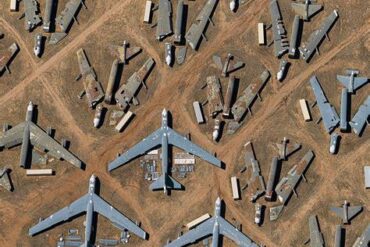
Aircraft graveyards are usually imagined as enormous desert storage yards packed with rows of retired airliners, military transports, and fighter jets slowly being stripped for parts. Places such as the famous American boneyards have become aviation attractions in their own right, but not every aircraft graveyard looks like an organized storage facility. Some are hidden inside active airports, some preserve aircraft because history made them impossible to remove, and others lie beneath tropical water after entire fleets were deliberately discarded.
These unusual sites reveal a different side of aviation history. Instead of simply showing what happens when an aircraft reaches the end of its commercial or military career, they preserve snapshots of particular airlines, wars, technological experiments, and political events. A forgotten jet sitting beside a runway can sometimes tell a far more complicated story than a perfectly restored museum aircraft.
What makes these locations especially fascinating is their variety. One contains an airliner trapped for more than half a century inside a United Nations-controlled airport. Another has become associated with British television and filmmaking. A Russian research facility has accumulated experimental aircraft and Soviet-era machines, while an American dismantling operation inadvertently became a time capsule of Northwest Airlines. Then there is a truly underwater aircraft graveyard in the Pacific, where dozens of World War II aircraft have spent more than 80 years beneath a lagoon.
Nicosia International Airport: The Trident That Never Left
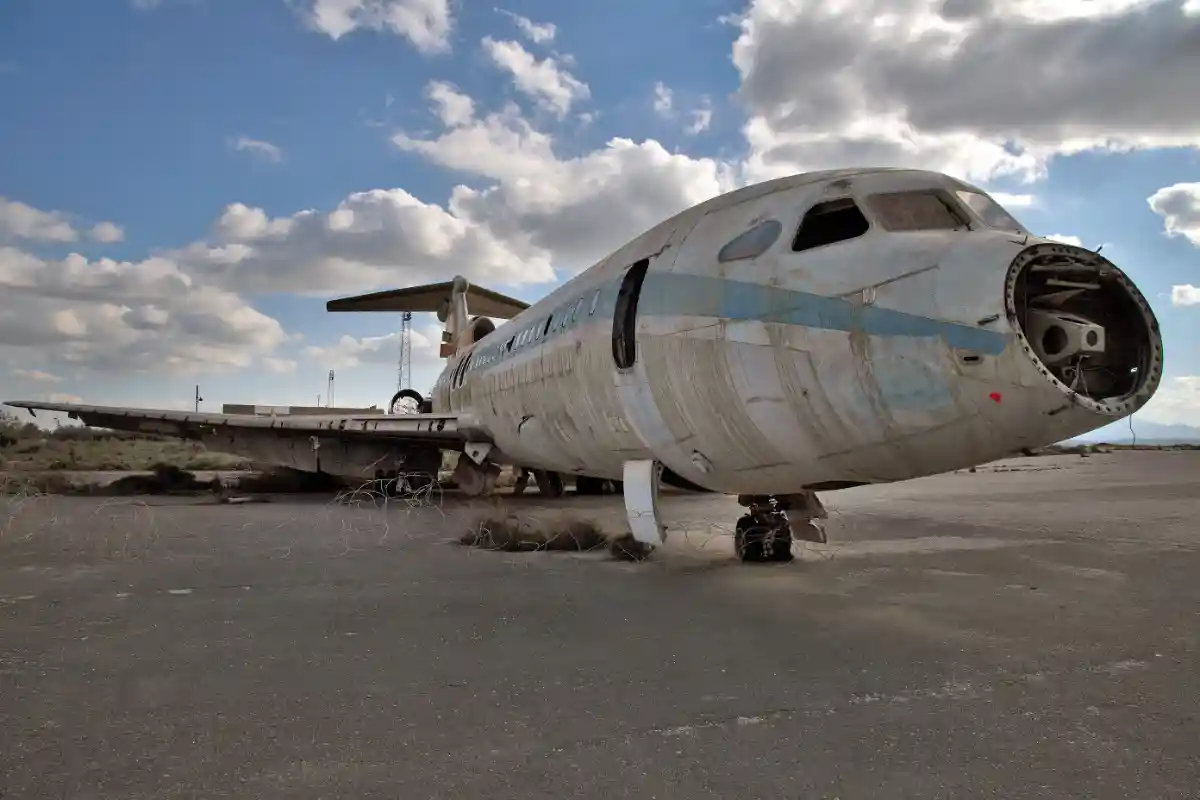
Few aircraft have ended their careers in circumstances as strange as the former Cyprus Airways Hawker Siddeley Trident 2E at Nicosia International Airport. The airport was once the principal international gateway to Cyprus, but that role ended abruptly after the events of 1974, when the airport was heavily damaged during the conflict and subsequently placed inside a United Nations-controlled buffer zone.
Commercial aviation did not simply move elsewhere and leave behind an ordinary abandoned airport. Instead, Nicosia became a frozen piece of aviation history. Aircraft that happened to be at the airport when operations ceased could not simply be collected and flown away. The runway, terminal, and surrounding facilities became inaccessible, leaving the remaining aircraft exposed to the consequences of decades of abandonment.
In 1977, a remarkable attempt was made to recover several stranded aircraft. Under special authorization from the United Nations, engineers associated with British Airways helped retrieve three former Cyprus Airways aircraft and ferry them to London. The operation demonstrated just how unusual the situation had become: aircraft that had been effectively trapped at a closed airport were being extracted years after normal commercial operations had ended.
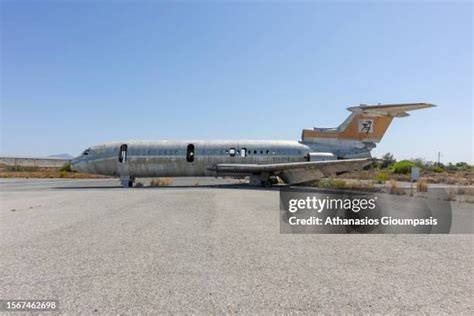
One Trident, however, could not make the journey. The former Cyprus Airways Hawker Siddeley Trident 2E had suffered damage severe enough to prevent it from returning to service. Its fate became even more unusual when its engine was cannibalized to help another Trident escape the airport. Rather than being dismantled and removed afterward, the aircraft itself remained behind.
That means the Trident effectively became a permanent resident of Nicosia. It is not a conventional boneyard containing dozens or hundreds of aircraft, but its story makes the location one of aviation’s strangest graveyards. The aircraft has remained associated with the abandoned airport for more than five decades, surrounded by an environment where ordinary access is impossible.
Nicosia is also unusual because the airport is not simply an abandoned industrial site. The United Nations maintains a buffer zone around the airfield, and helicopters have operated from the location. Ideas have periodically emerged about preserving the airport and terminal as a museum, but turning such a politically and physically restricted site into a conventional aviation attraction is considerably more complicated than restoring an aircraft in a hangar.
Dunsfold Aerodrome: Retired British Airways 747s and a Television Legacy
Dunsfold Aerodrome in Surrey has a completely different atmosphere. Built during World War II by the Canadian Army, the airfield later became associated with the Royal Canadian Air Force, the Royal Air Force, Hawker Aircraft, Hawker Siddeley, and eventually BAE Systems. Its long history as an aviation and engineering site left it with an enormous amount of space, making it useful for purposes far beyond conventional airport operations.
The aircraft that make Dunsfold particularly interesting today are former British Airways Boeing 747s. Three examples became associated with the site, although their individual fates were different. The aircraft included a 747-200 and two 747-400s, providing a remarkably visible reminder of an era when the four-engine jumbo jet was one of the defining aircraft of long-haul passenger travel.
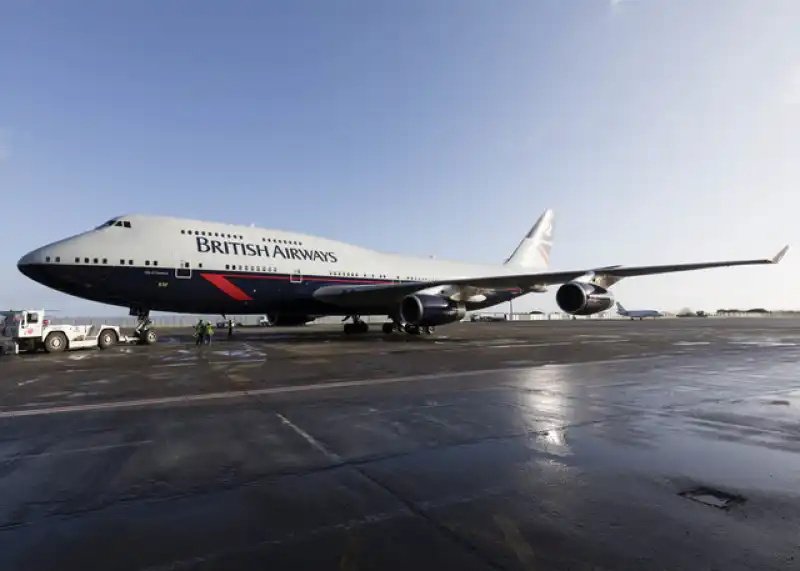
The most famous aircraft at Dunsfold was G-BDXJ, a Boeing 747-236B that first flew in 1980 and spent much of its career with British Airways. It later became a useful prop for film and television productions. Its presence was helped by the enormous open space available at Dunsfold, where production companies could stage scenes involving aircraft without needing to work around a busy commercial airport.
The airfield became even more famous through Top Gear, which used Dunsfold as its home from 2002 until 2020. The program took advantage of the site’s extensive paved areas and relatively unrestricted layout, turning an otherwise obscure aerodrome into one of the most recognizable aviation-related filming locations in British popular culture.
A second former British Airways 747-400, G-CIVW, arrived in 2020 and had also been used in production work before eventually being broken up. A third aircraft, G-BNLY, wore British Airways’ distinctive Landor-era colors and was intended for preservation as a local landmark.
The future of Dunsfold makes the collection particularly poignant. Plans have been approved for redevelopment of the airfield, including extensive housing construction. That means the site is not simply a static aircraft graveyard; it is itself approaching the end of an era. The combination of historic military aviation, British Airways 747s, and decades of television production gives Dunsfold a character that would be difficult to recreate elsewhere.
Zhukovsky International Airport: A Soviet Aircraft Time Capsule
Near Moscow, Zhukovsky International Airport presents one of the most unusual combinations of modern civilian aviation and Soviet aerospace history. The airport is located approximately 22 miles, or 36 kilometers, southeast of central Moscow and occupies what was originally a military aviation site.
The area associated with retired aircraft has historically been connected with the Gromov Flight Research Institute, an organization deeply involved in flight testing and aerospace research. Unlike an ordinary commercial aircraft storage facility, this environment accumulated machines that were interesting not merely because they were old, but because they represented important stages of Soviet aviation development.
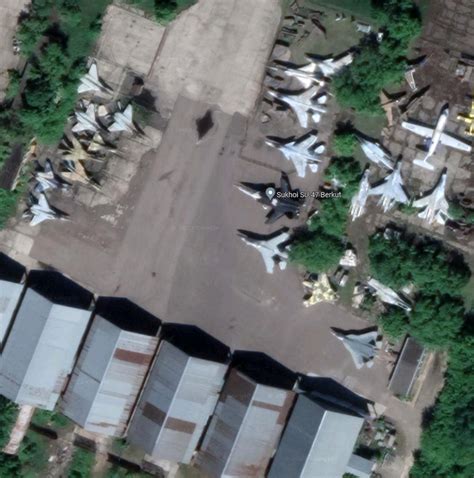
Satellite imagery and photographs taken during periods when visitors were allowed into parts of the facility have revealed an extraordinary collection. Older MiG and Sukhoi fighters, Soviet-era helicopters, experimental aircraft, retired commercial airliners, and other aerospace hardware have appeared at the site over the years. The collection has also included a Tupolev Tu-144, one of the most recognizable symbols of the Soviet Union’s attempt to develop a supersonic passenger aircraft.
Perhaps even more remarkable was the presence of an unfinished Buran orbiter, the Soviet reusable spacecraft program’s counterpart to the American Space Shuttle. Although Buran was a spacecraft rather than an aircraft in the conventional sense, its appearance among abandoned or preserved aerospace hardware illustrates why Zhukovsky is so different from a normal aviation boneyard.
The site’s purpose has never been simply to store obsolete machines. It has also functioned as a secure testing and research environment, meaning that access has historically been limited. Public exposure increased during events such as the MAKS air show, but those opportunities have become less common, particularly since MAKS was last held in 2021.
As a result, much of what can be established about the aircraft collection comes from photographs, historical accounts, and satellite imagery rather than conventional public tours. That relative secrecy makes Zhukovsky especially intriguing. It is less a traditional graveyard than a Soviet aerospace archive scattered across an operating research environment.
Laurinburg-Maxton Airport: The Northwest Airlines Fleet That Time Forgot
Laurinburg-Maxton Airport in North Carolina is much less dramatic than Nicosia or Zhukovsky, but aviation enthusiasts may find its aircraft collection just as fascinating. The relatively quiet general aviation airport is home to a facility operated by Charlotte Aircraft, which specializes in dismantling retired commercial aircraft and recovering their usable components.
The unusual feature is the concentration of former Northwest Airlines aircraft. Northwest was once one of the largest American international airlines, but its merger with Delta Air Lines in the late 2000s ended the Northwest name as a major airline brand. More than a decade later, aircraft wearing Northwest’s colors have become increasingly difficult to encounter.
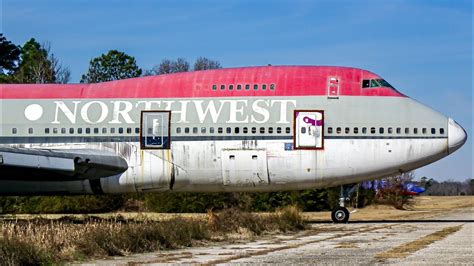
At Laurinburg-Maxton, however, the airline’s visual identity survived in surprising numbers. Former Northwest Boeing 727s, DC-10s, and 747s have passed through the facility, with many carrying the airline’s 1989 “Bowling Shoe” livery. That makes the airport resemble an accidental time capsule from the final decades of the 20th-century airline industry.
The scene is bittersweet because these aircraft are not being preserved as museum pieces. Many have been heavily parted out, with engines, landing gear, avionics, interior components, and other valuable equipment removed for reuse. Their fading paint and incomplete structures show the practical side of aircraft retirement: a commercial jet can have considerable value even after it can no longer economically fly.
The site has also contributed pieces of aviation history to formal museums. The National Air and Space Museum obtained a forward fuselage section from a 747 associated with Northwest’s fleet, illustrating how an aircraft can survive in fragments even after the original airframe disappears.
For enthusiasts interested in classic airline liveries, Laurinburg-Maxton is therefore something unusual. It is not designed as a nostalgia attraction, but the dismantling process has inadvertently preserved a concentrated glimpse of an airline that no longer exists under its original identity.
Kwajalein Atoll: A World War II Aircraft Graveyard Beneath the Lagoon
The strangest aircraft graveyard on this list is also the one that cannot be seen from an airport fence. It lies beneath the waters around Kwajalein Atoll in the Marshall Islands, where dozens of American military aircraft were deliberately discarded after World War II.
During the Pacific campaign, the United States captured and developed positions throughout the Marshall Islands. Kwajalein became an important base for American operations, and the surrounding waters witnessed intense military activity. Aircraft were lost in combat, but many of the machines that eventually ended up underwater were not necessarily destroyed during fighting.
When the war ended in 1945, the United States faced a completely different logistical problem. Hundreds of military aircraft were no longer needed, while shipping capacity was being prioritized for bringing personnel home. Transporting every obsolete aircraft back across the Pacific made little practical sense.
The solution was remarkably simple and brutal: aircraft were loaded onto barges and dumped into the lagoon.
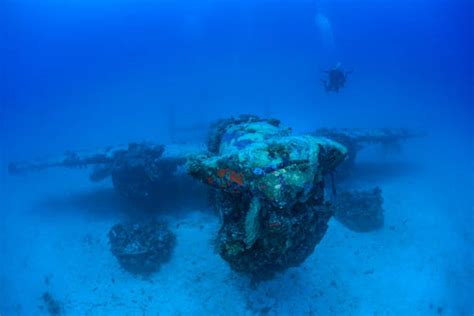
Estimates suggest that roughly 150 aircraft were disposed of in the waters around Kwajalein. More than 80 years later, many remain underwater. Unlike aircraft destroyed in combat, some of these machines entered the lagoon relatively intact, which helps explain why divers can still identify individual aircraft types.
Among the wrecks are aircraft such as Grumman F4F Wildcats, Douglas SBD Dauntlesses, and Curtiss C-46 Commandos. Over the decades, the tropical marine environment has transformed the discarded aircraft. Coral and marine growth have covered parts of the structures, turning what began as wartime surplus into an underwater archaeological landscape.
The site is now of particular interest to experienced scuba divers and underwater photographers. Exploring these aircraft is very different from walking through a conventional boneyard. Instead of seeing faded airline paint beneath an open sky, visitors encounter aircraft frames surrounded by water, coral, and marine life.
Kwajalein also demonstrates how an aircraft graveyard can emerge from circumstances completely unrelated to ordinary retirement. The aircraft were not stored for future use, nor were they intentionally preserved for historical study. They were surplus military equipment at the end of a global war. Their survival is essentially an unintended consequence of being discarded in an environment capable of preserving recognizable remnants for generations.
Why These Aircraft Graveyards Matter
The most interesting aircraft graveyards are not necessarily the largest. Their value comes from the stories attached to the aircraft and the strange circumstances that determined where those machines would spend their final decades. Nicosia preserves the aftermath of a divided airport, Dunsfold preserves pieces of British aviation and television history, Zhukovsky holds remnants of Soviet aerospace experimentation, Laurinburg-Maxton offers an accidental glimpse of Northwest Airlines’ past, and Kwajalein preserves an underwater collection created by the logistical realities of the postwar Pacific.
Together, these sites also show how different aircraft can be afterlife. Some are dismantled for valuable components, some become film props, some remain trapped by geopolitical circumstances, and some become artificial reefs thousands of miles from the factories where they were built.
Modern commercial aviation may be dominated by a relatively small number of aircraft families, but these unusual graveyards reveal the extraordinary diversity that came before them. The Boeing 727, DC-10, 747, Tu-144, Trident, Wildcat, Dauntless, and C-46 each belong to very different chapters of aviation history. Seeing their remains in such unexpected surroundings is a reminder that an aircraft’s final destination can sometimes be just as fascinating as its years in the sky.