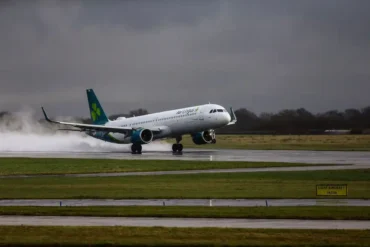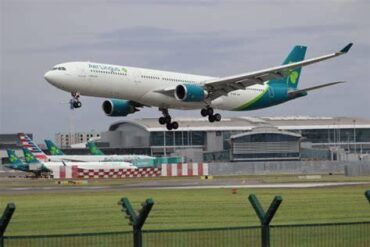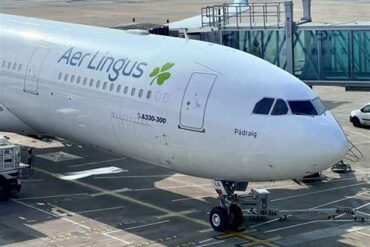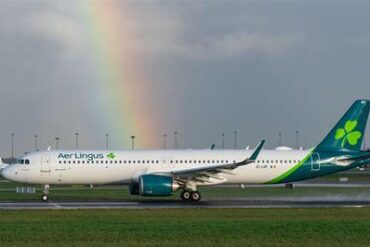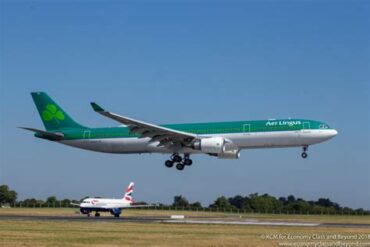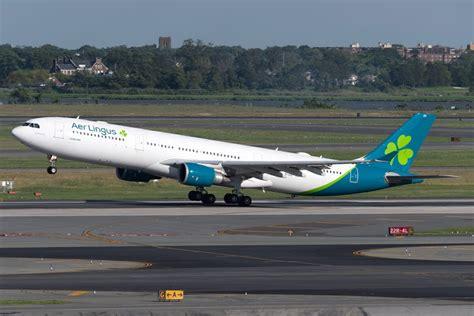
Aer Lingus appears poised to discontinue all transatlantic operations from its Manchester base starting March 31, 2026—a strategic retreat from a bold expansion launched just five years ago. While not officially confirmed as a full cancellation, the airline has halted all future bookings beyond this date, sending a clear signal that the days of long-haul connections from Manchester to New York (JFK), Orlando (MCO), and Bridgetown (BGI) are likely numbered.
The move, wrapped in corporate ambiguity and framed as a “period of uncertainty,” reveals deeper tensions brewing within the Irish flag carrier’s operations outside of Ireland.
Aer Lingus’ Manchester Gamble: A High-Risk Expansion Faltering
In 2021, Aer Lingus launched its transatlantic service out of Manchester with a sense of calculated ambition. The aim was to capitalize on a perceived gap in year-round transatlantic service from the North of England, betting that Manchester’s catchment area could sustain long-haul demand beyond seasonal peaks.
While technically part of the oneworld transatlantic joint venture, despite not being a full alliance member, Aer Lingus leveraged this unique status to push routes that complemented its Dublin hub operations. However, unlike its main base in Ireland—where Aer Lingus enjoys optimized logistics, stronger brand affinity, and preferential scheduling—the Manchester experiment never fully matured into a profitable outpost.
Employee Discontent and Strategic Threats
At the heart of the looming exit is a protracted labor dispute. Aer Lingus has been locked in contentious contract negotiations with the 200-strong cabin crew team based in Manchester, who have staged multiple strikes in recent months. The airline offered a 9% pay increase, but workers dismissed it as insufficient amid the soaring cost of living and demanded more comprehensive improvements in working conditions.
Management’s response? A thinly veiled ultimatum. In a statement that feels more coercive than cautious, Aer Lingus said:
“To minimise customer disruption in the event of a closure of the Manchester base… Aer Lingus is no longer selling transatlantic flights to/from Manchester for travel from 31 March 2026.”
While framed diplomatically, the subtext is undeniable: accept the terms, or face base closure. The question remains whether this tactic is a genuine prelude to abandonment or a high-stakes bargaining chip aimed at undermining the union’s leverage.
Performance Problems and Profit Prioritization
Aer Lingus has cited underwhelming financial returns from the Manchester routes compared to its operations out of Dublin (DUB) and Shannon (SNN). In a post-pandemic world where aircraft utilization must be razor-sharp, Manchester appears to have slipped down the priority list.
The airline’s strategic calculus is now focused on redeploying widebody aircraft to more profitable routes, particularly those anchored in Ireland where logistics, labor, and brand value are more favorable. This isn’t just about labor unrest—it’s about opportunity cost.
Parent company International Airlines Group (IAG) is no stranger to hard-nosed labor tactics. In 2023, IAG reshuffled Airbus A321XLR orders to pressure Aer Lingus pilots during their own negotiations. If history is any guide, corporate muscle-flexing seems to be part of the playbook.
The Timing Raises Eyebrows
Perhaps most baffling is the timeline. Aer Lingus is signaling its probable exit with less than three months’ notice before peak summer travel season planning kicks into full gear. Typically, airlines prefer long-lead route adjustments to manage customer expectations and aircraft schedules. Cutting off bookings this early suggests a level of finality rarely seen in mere strategic posturing.
Would Aer Lingus attempt to relaunch some of these routes out of Dublin in a bid to capture residual demand? That remains to be seen. But with the UK-to-US travel market highly competitive, and low-cost transatlantic models struggling, it’s unclear whether customers will simply migrate to Ireland—or abandon the brand altogether.
A Strategic Retreat or Tactical Sabotage?
The ambiguity in Aer Lingus’ messaging leaves industry watchers and customers in a state of limbo. By pausing ticket sales without making a formal cancellation, the airline avoids triggering compensation obligations or regulatory scrutiny—at least for now. But for frequent flyers, staff, and regional stakeholders, the impact is real and immediate.
Manchester, once a hopeful springboard into new markets, may now be relegated to a cautionary tale of overreach, mismanagement, and labor tension.
Whether this is the beginning of a measured restructuring or simply a cynical negotiating tactic, one thing is certain: Aer Lingus’ Manchester long-haul vision is all but grounded.