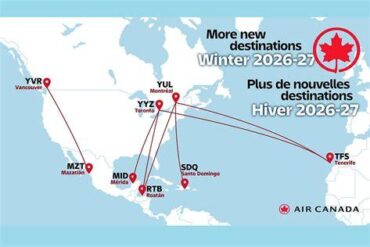
Air Canada has officially opened the door to the Canary Islands, operating its inaugural nonstop flight from Toronto Pearson International Airport (YYZ) to Tenerife South Airport (TFS) with the long-range Airbus A321XLR. The departure marks the first time any carrier has connected Canada directly with the Spanish archipelago, and it positions the Star Alliance airline at the forefront of a new generation of thin-route, long-haul flying made possible by the single-aisle jet. The near nine-hour overnight service now runs twice weekly and will soon be joined by a second Canadian gateway, giving winter sun seekers a genuinely new alternative to the Caribbean.
Toronto to Tenerife South: The A321XLR Schedule Explained
The Toronto operation is the anchor of Air Canada’s Canary Islands strategy. Flight AC954 departs YYZ on Thursdays and Sundays at 8:35 PM, crossing the Atlantic overnight and touching down at Tenerife South at 9:00 AM the following morning, a block time of just under nine hours that effectively converts a full working day into a holiday arrival. The return leg, AC955, leaves Tenerife on Mondays and Fridays at 10:55 AM, landing back in Toronto at 2:50 PM the same afternoon, a schedule that suits both outbound vacationers and returning residents without forcing them into brutal red-eye connections.
The outbound schedule is deliberately engineered. An evening departure from Canada allows passengers to work a normal day, reach the airport after rush hour, and sleep through the Atlantic crossing, arriving in the Canaries in time for a full first day of sunshine. The return timing is equally practical: a late-morning departure from Tenerife means a relaxed hotel checkout rather than a 4 AM alarm, with a mid-afternoon Toronto arrival that leaves room for onward domestic connections across Air Canada’s hub network.
Montréal Follows One Week Later With a Saturday Overnight Service
Québec travelers are not left behind. Air Canada will launch nonstop Montréal-Trudeau International Airport (YUL) to Tenerife South flights beginning Saturday, October 31, operating once weekly. Flight AC956 departs YUL at 9:00 PM on Saturdays, arriving at TFS at 9:00 AM the next morning, while the return AC957 leaves Tenerife at 10:55 AM on Sundays and reaches Montréal at 2:10 PM. Together, the two gateways give Canada’s two largest metropolitan areas a combined three weekly rotations, all flown by the same aircraft type.
The Montréal service mirrors the Toronto design: a Saturday night departure that turns a weekend into a seamless launch pad for a week or two in the sun, followed by a Sunday morning return that preserves the entire weekend for travelers heading back to work. For Air Canada, the French-language market is a natural fit for the Canaries, where Spanish and English sit alongside a deeply European tourism culture, and where package operators have long marketed the islands heavily to Québec travelers.
Why the Airbus A321XLR Unlocks Routes Like Tenerife
The A321XLR is the structural reason this route exists at all. With its extra-capacity rear center tank, the jet can fly roughly 4,700 nautical miles, enough to cover the 3,308-mile great-circle distance between Toronto and Tenerife with margin for headwinds and alternates. Crucially, it does so at narrowbody operating economics, which means Air Canada can profitably serve a seasonal leisure market that would never sustain a widebody 787 or A330 on a year-round basis. The aircraft opens the door to what the industry calls thin routes: destinations with real but moderate demand, precisely the profile of a winter sun market served twice a week rather than daily.
Air Canada has been taking frequent deliveries of the type, and the fleet growth has visibly reshaped its European map. Tenerife is the latest addition to a European network that has expanded rapidly through A321XLR deployments, allowing the carrier to test niche city pairs and seasonal leisure links without cannibalizing widebody capacity needed for trunk routes such as London, Frankfurt, and Paris. The Tenerife service is a textbook demonstration of that strategy, pairing a long sector with a loyal, price-sensitive leisure clientele.

Seasonal Window and the Winter Sun Appeal of the Canaries
Both routes operate seasonally, running through the end of the Northern Hemisphere winter season with final rotations expected in late April. That window aligns perfectly with Canadian demand: travelers escaping subzero temperatures between November and April, and the Canaries delivering reliable warmth when the Caribbean means a longer, costlier journey. Tenerife offers a blend of all-inclusive resorts, boutique hotels, volcanic scenery around Mount Teide, and a distinctly Spanish food and wine culture that appeals to travelers who have already cycled through Mexico and the Dominican Republic.
The route also carries strategic value beyond leisure demand. It gives Air Canada a differentiated product no other Canadian carrier can match this winter, and it strengthens Toronto and Montréal as transatlantic gateways by adding a destination entirely absent from their route maps. For Aeroplan members, the flights create new redemption opportunities in a region previously reachable only through European connections, adding meaningful network depth without adding a single widebody frame.
Air Transat’s Gran Canaria Response Signals a Canaries Battle
Air Canada’s head start will be short-lived. Leisure specialist Air Transat plans to launch its own nonstop Canaries service in December, flying from both Montréal and Toronto to Las Palmas de Gran Canaria (LPA) with its Airbus A321neo. Flight TS456 departs YUL on Saturdays at 7:45 PM from December 12, arriving at 7:35 AM, with TS457 returning on Sundays at 9:05 AM. From Toronto, TS376 leaves YYZ on Sundays at 7:00 PM from December 13, and TS457 departs LPA on Mondays at 8:50 AM, arriving back at 12:55 PM. Gran Canaria becomes Air Transat’s fifth Spanish destination after Madrid, Málaga, Barcelona, and Valencia.
That overlap is significant. Air Canada will enjoy exclusivity on the North America to Canary Islands corridor for only a matter of weeks, and the two carriers will then compete across different islands, schedules, and price points. Air Transat’s stronger leisure packaging model and its established winter sun brand will make it a formidable challenger, while Air Canada counters with loyalty program reach, connecting feed from across its domestic network, and the more premium A321XLR cabin.

What the New Canaries Routes Mean for Canadian Travelers
For consumers, the practical result is choice where none existed. A direct nine-hour flight to Tenerife removes the connection through Madrid, Lisbon, or London that previously added hours and transfer risk, and it makes a two-week Canary Islands holiday realistic for a market that once viewed the archipelago as a distant European add-on. Travelers should book early: twice-weekly capacity on a single-aisle aircraft is finite, and winter sun demand from Canada routinely outstrips supply on established routes to Mexico and the Caribbean.
The bigger signal is structural. The A321XLR era has begun turning marginal destinations into viable nonstop markets, and the Canaries are simply the first proof point of what could follow: more of southern Europe, North Africa, and secondary Atlantic destinations appearing on Canadian route maps without widebody economics. Air Canada’s Tenerife flights are therefore more than a new winter sun option. They are a template for how the airline intends to expand internationally over the next decade, one long, thin, single-aisle route at a time.