The Airbus A220 program is entering a new phase of maturity as Airbus confirms plans to introduce an advanced Runway Overrun Awareness and Alerting System (ROAAS) across the A220-100 and A220-300 fleets starting in 2027. The move closes a long-standing systems gap within Airbus’s single-aisle lineup and aligns the former Bombardier-designed aircraft with modern ICAO safety recommendations that increasingly shape aircraft certification and operational standards worldwide.
For Airbus, this update is not merely about compliance. It reflects a broader effort to fully integrate the A220 into the Airbus ecosystem, technologically and operationally, while reinforcing the aircraft’s safety credentials in a fiercely competitive market dominated by the Embraer E2 family and the Boeing 737 MAX.
Why Runway Overrun Protection Matters More Than Ever
Runway overruns remain one of the most persistent categories of commercial aviation incidents, particularly during wet, contaminated, or short runway operations. While survivability rates are generally high, the operational, financial, and reputational consequences for airlines can be severe. Over the last two decades, regulators and manufacturers have shifted from reactive mitigation to predictive cockpit alerting, aiming to prevent overruns before they occur.
Airbus first introduced its Runway Overrun Protection System (ROPS) on the A380 in 2009, gradually expanding it across the A320, A330, A340, and A350 families. Until now, the A220 stood apart, largely due to its distinct avionics architecture inherited from Bombardier’s CSeries design. With ROAAS, that separation finally narrows.
The A220’s Unique Design Challenge
The A220 avionics suite differs fundamentally from those used on other Airbus aircraft, requiring a bespoke approach rather than a direct software transplant. This explains why the A220 is the last Airbus aircraft to receive a runway overrun alerting system, despite being one of the most modern narrowbodies in service.
Airbus engineers have developed ROAAS specifically for the A220 platform, preserving core Airbus safety logic while adapting it to the aircraft’s flight control laws, performance models, and pilot interface philosophy. The result is a system that enhances situational awareness without introducing unnecessary cockpit complexity.
How the Runway Overrun Awareness and Alerting System Works
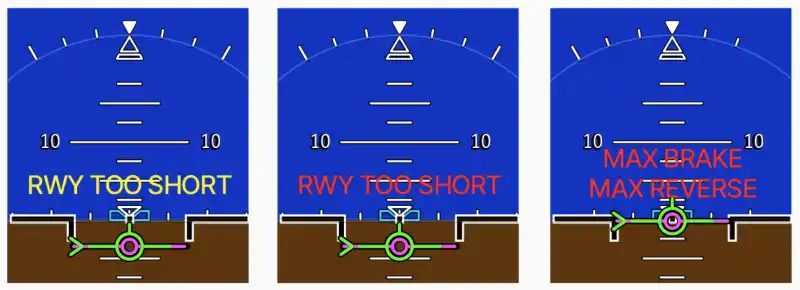
The Runway Overrun Awareness and Alerting System operates across both the approach and landing rollout phases, continuously recalculating stopping performance in real time. During approach, ROAAS evaluates aircraft weight, speed, energy state, runway length, and surface condition. If calculations indicate insufficient stopping distance, pilots receive an aural alert stating “Runway too short”, accompanied by a yellow “RWY TOO SHORT” message on the primary flight display.
Once the aircraft crosses the runway threshold with an unsafe energy margin, the alert escalates. The display message turns red, reinforcing the urgency of the situation. After touchdown, if stopping margins continue to deteriorate, the system commands pilot attention with red “MAX BRAKE” and “MAX REVERSE” alerts, supported by corresponding aural cues. These prompts are designed to drive immediate, decisive action rather than passive awareness.
At entry into service, ROAAS will support dry, wet, and wet grooved runways, with Airbus planning to expand capability to additional surface conditions following certification and in-service data validation.
Safety Compliance and Fleet Commonality Gains
With ROAAS installed, the A220 will meet evolving ICAO runway safety standards, bringing Airbus into full regulatory alignment across its entire commercial aircraft portfolio. For airline operators, this translates into more than regulatory box-ticking. It improves fleet commonality, particularly for carriers operating mixed Airbus fleets, reducing training friction and procedural divergence.
From a safety culture standpoint, ROAAS reinforces Airbus’s long-standing philosophy of layered protection: predict, alert, and assist, rather than relying solely on pilot judgment under high workload conditions.
The A220 in a Competitive Narrowbody Market
The timing of this upgrade is strategic. The A220 occupies a critical niche between regional jets and larger single-aisle aircraft, where margins are thin and performance claims are closely scrutinized. Against the Embraer E195-E2, the A220 already offers strong range and cabin comfort advantages. Enhancing onboard safety systems strengthens its appeal to airlines prioritizing long-term fleet resilience.
Beyond ROAAS, Airbus continues to invest in the A220 program by increasing maximum takeoff weight, improving payload-range flexibility, and preparing the aircraft for HBCplus high-speed connectivity by 2028. These upgrades signal a clear message: Airbus views the A220 as a permanent pillar of its product strategy, not a transitional acquisition.
Sustainability and the Long View
Airbus has also confirmed that the A220 will be fully compatible with 100% Sustainable Aviation Fuel (SAF) by 2030, aligning the aircraft with broader industry decarbonization goals. While safety systems and environmental performance may seem unrelated, airlines increasingly evaluate aircraft holistically, weighing operational risk, regulatory readiness, and sustainability commitments together.
In that context, ROAAS becomes part of a larger narrative: the A220 evolving from an inherited design into a fully Airbus-standard aircraft, both technically and philosophically.
What This Update Signals for the A220’s Future
Despite persistent rumors of a stretched A220-500 or A221, Airbus remains cautious, prioritizing program profitability and operational stability before committing to a multi-billion-dollar development effort. High production costs and reliability challenges have tested the program, but continuous incremental upgrades like ROAAS suggest long-term confidence rather than retreat.
By 2027, the introduction of runway overrun alerts will quietly but decisively elevate the A220’s safety baseline. It is not a headline-grabbing reinvention, but in commercial aviation, the most meaningful progress often arrives through precisely this kind of disciplined, systems-driven evolution.