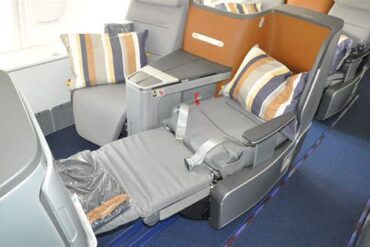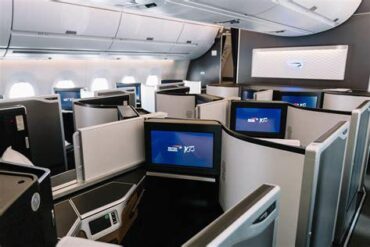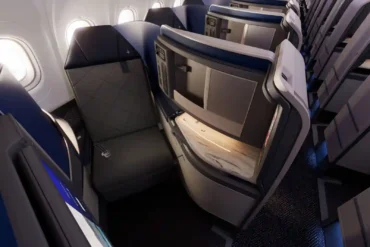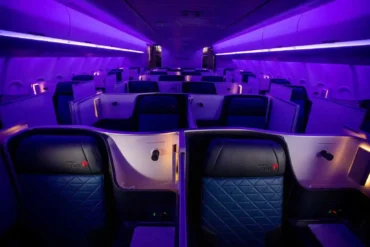
Airbus is exploring a potentially transformative upgrade for its smallest jet family, studying the feasibility of introducing lie-flat business-class seats on the A220. While still in the preliminary stages, the concept could significantly enhance the aircraft’s appeal among airlines increasingly focused on premium revenue and long, thin routes that do not justify larger aircraft.
The move reflects a broader shift across the aviation industry. Airlines are no longer relying exclusively on widebody aircraft to serve premium markets. Instead, advanced narrowbody jets are taking on missions once reserved for twin-aisle aircraft, particularly on transcontinental and medium-haul international routes. If Airbus successfully integrates lie-flat seating into the A220 platform, the aircraft could emerge as one of the industry’s most versatile premium narrowbodies.
Already recognized for its exceptionally quiet cabin, oversized windows, spacious overhead bins, and passenger-friendly five-abreast seating arrangement, the A220 enjoys strong passenger satisfaction scores. A true lie-flat product would elevate the aircraft even further, positioning it as a highly efficient platform capable of generating substantial premium yields.
Airbus Evaluates Lie-Flat Seating as a Factory-Fit Option
According to industry reports, Airbus has begun examining whether lie-flat seats could be offered as a line-fit option directly from the factory. Such an offering would allow airlines to receive aircraft already configured with premium cabins, reducing retrofit costs and simplifying fleet introduction.
Christian Kley, Airbus’ head of single-aisle market development, has described the initiative as being at a very early stage. Nevertheless, Airbus clearly believes the concept could unlock new commercial opportunities, not only among existing A220 operators but also among airlines that have yet to adopt the aircraft.
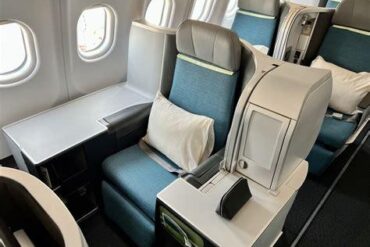
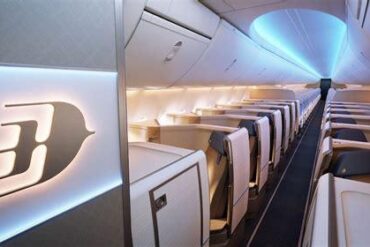
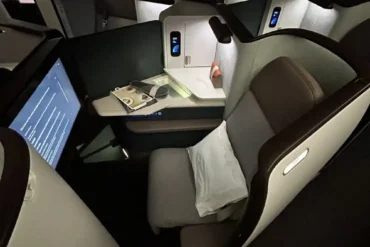
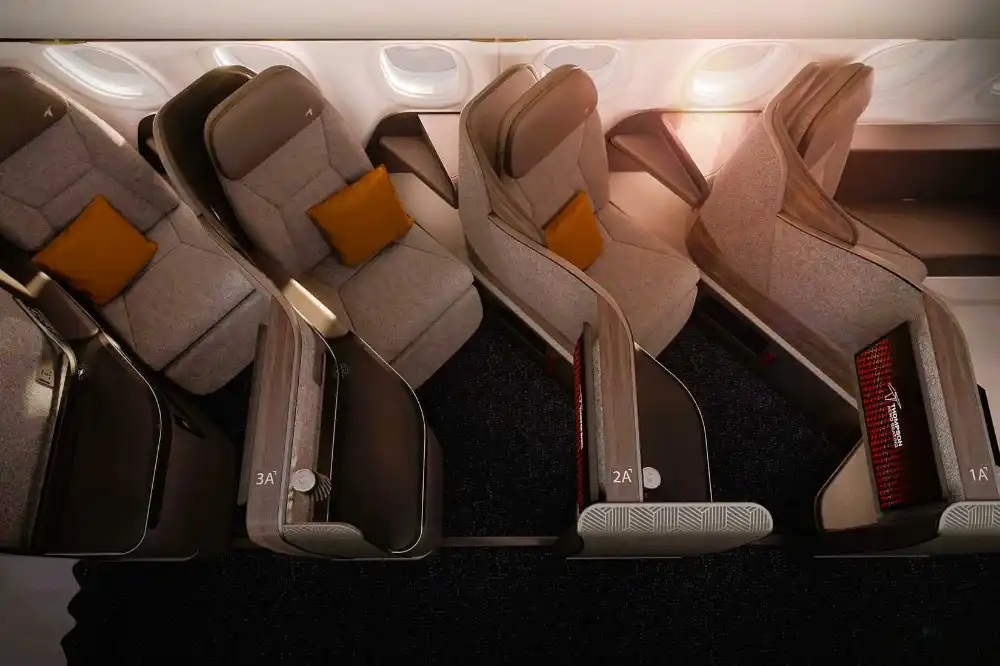
The most realistic configuration under consideration involves a relatively small premium cabin featuring approximately eight to twelve lie-flat seats arranged in a traditional 2-2 layout. This setup would provide airlines with a differentiated premium experience while preserving the majority of economy-class seating capacity.
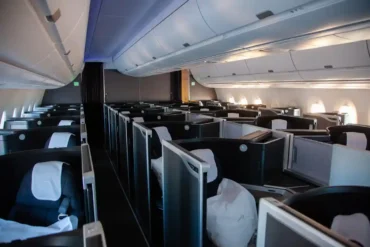
Airbus is also studying a more ambitious concept: an all-premium A220 featuring approximately 38 to 40 lie-flat seats. Although highly specialized, such an aircraft could appeal to niche operators serving lucrative business markets or exclusive premium routes.
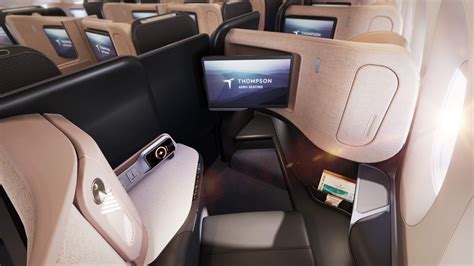
Significantly, Airbus would not be starting from scratch. The manufacturer and seat suppliers have already accumulated extensive experience integrating lie-flat products into aircraft such as the A321LR and A321XLR. Companies including Thompson Aero Seating, particularly with its VantageSOLO seat, have solved many of the industry’s major certification and installation challenges, including weight optimization, monument integration, aisle accessibility, and regulatory compliance.
Adapting these proven technologies to the A220 could substantially reduce development risk while accelerating time to market.
Why Premium Narrowbodies Are Becoming Increasingly Important
The aviation industry has witnessed a dramatic rise in premium narrowbody operations over the past decade. Aircraft such as the Airbus A321LR, A321XLR, and Boeing 737 MAX variants have demonstrated that passengers are willing to pay premium fares on single-aisle aircraft, provided the onboard product meets expectations.
This trend is driven largely by the growth of long-and-thin routes—markets with strong demand but insufficient passenger volumes to justify larger widebody aircraft.
Lie-flat narrowbodies offer airlines several advantages. They enable carriers to:
- Serve premium markets with lower operating costs.
- Increase route frequency while maintaining profitability.
- Open entirely new city pairs.
- Match premium offerings across their fleets.
- Improve aircraft utilization on transcontinental and medium-haul international sectors.
For Airbus, equipping the A220 with lie-flat seats would allow the manufacturer to compete more aggressively in this expanding segment while further differentiating the aircraft from traditional six-abreast narrowbodies.
Existing A220 Operators Could Be Immediate Customers
Several airlines currently operating the A220 stand out as natural candidates for a lie-flat variant.
Among them, Delta Air Lines appears particularly well positioned. As the world’s largest A220 operator, Delta has steadily increased premium seating across its fleet and continues expanding its highly profitable Delta One brand. Introducing lie-flat A220s would allow Delta to deploy premium aircraft on thinner domestic and international markets while maintaining brand consistency.
Similarly, JetBlue Airways could view a premium A220 as a natural extension of its acclaimed Mint product. JetBlue has built a strong reputation around premium narrowbody travel, and a lie-flat A220 could provide additional flexibility on routes where an A321 offers excessive capacity.
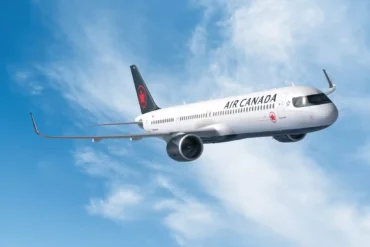
Outside North America, airlines including Air Canada, ITA Airways, and Korean Air already operate lie-flat products on larger narrowbodies. The availability of a premium A220 could enable these carriers to further optimize network planning while extending premium service to smaller markets.

Airbus May Be Targeting Airlines That Do Not Yet Fly the A220
While existing operators represent important prospects, Airbus’ largest opportunity may lie with airlines that currently do not operate the A220.
A lie-flat cabin would provide Airbus with a compelling new sales proposition, particularly among airlines seeking smaller premium aircraft capable of serving high-yield routes where larger narrowbodies are simply too large.
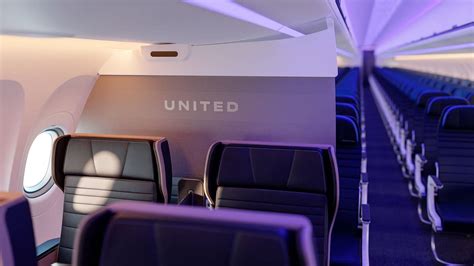
United Airlines stands out as perhaps the most obvious target. The carrier continues operating aging A319s and Boeing 737-700s, while simultaneously investing heavily in premium transcontinental services and future A321XLR operations. A lie-flat A220 could offer United an ideal aircraft for premium-focused routes that require lower capacity.
Copa Airlines also emerges as a fascinating candidate. The Panamanian carrier already operates lie-flat-equipped 737 MAX 9 aircraft and specializes in connecting long, thin markets throughout the Americas. A premium A220 could fit neatly within Copa’s network strategy while eventually replacing older narrowbodies.
Other potential customers include TAP Air Portugal, Etihad Airways, Gulf Air, and boutique all-business carrier La Compagnie, each of which already embraces premium narrowbody operations.
For these airlines, the A220’s economics combined with lie-flat capability could create an entirely new category of aircraft optimized for premium regional and transcontinental missions.
The Proposed A220-500 Could Strengthen the Business Case
The concept becomes even more intriguing when viewed alongside Airbus’ ongoing studies of the proposed A220-500 stretch.
Industry observers expect the stretched variant to accommodate approximately 170 to 180 passengers, placing it closer to the lower end of the A320neo and 737 MAX 8 market.
Additional cabin length would make premium configurations substantially easier to justify economically. On today’s A220-300, installing lie-flat seats removes a meaningful proportion of total seating capacity. A larger A220-500, however, could absorb a premium cabin while retaining a sizeable economy section, preserving overall revenue potential.
As a result, the A220-500 could emerge as the ideal platform for advanced premium development.
However, questions remain regarding range performance. Recent reports suggest Airbus may pursue a relatively straightforward fuselage stretch to minimize development costs and accelerate market entry. Such an approach could potentially reduce range compared with existing A220 variants.
That tradeoff matters because lie-flat cabins deliver their greatest value on longer missions where passengers place a premium on sleep, privacy, and comfort.
Even with somewhat reduced range, though, a premium-configured A220-500 could prove highly attractive on transcontinental sectors and medium-haul international routes where larger aircraft represent excessive capacity.
Airbus Seeks to Create an Entirely New Premium Market Segment
Ultimately, Airbus’ exploration of lie-flat seating for the A220 is about far more than cabin comfort. It represents an effort to redefine what small narrowbody aircraft can accomplish.
The A220 already offers one of the most passenger-friendly experiences in the single-aisle market. By introducing fully flat beds, Airbus could dramatically enhance that advantage while helping airlines capture higher yields and open previously uneconomical routes.
Should Airbus proceed—and particularly if the future A220-500 enters service—the manufacturer could establish an entirely new premium niche between regional jets and larger long-range narrowbodies.
In an industry increasingly defined by flexibility, premium revenue, and network precision, a lie-flat A220 may prove to be exactly the aircraft many airlines never realized they needed.