British Airways occupies a unique position in aviation history. While many airlines claim to have transformed premium travel, few can point to a single innovation that permanently altered the expectations of millions of passengers worldwide. The introduction of lie-flat seating fundamentally changed long-haul business travel, creating a new benchmark for comfort that competitors would spend decades trying to match. More than twenty years after pioneering this revolutionary concept, British Airways is once again investing heavily in the future of luxury aviation, combining advanced cabin design, premium craftsmanship, and next-generation connectivity to create a new era of high-end travel.
For frequent international travelers, the ability to sleep comfortably on a long-haul flight is no longer considered a luxury—it is an expectation. Yet that expectation exists because British Airways challenged conventional aircraft cabin design and proved that premium comfort could coexist with commercial efficiency. Today, the airline’s latest investments suggest that its culture of innovation remains very much alive.
The story of British Airways’ premium transformation is not simply about seats or aircraft. It is about understanding how passenger expectations evolve and how airlines must continuously reinvent their products to stay competitive in an increasingly sophisticated marketplace.
The Revolutionary Birth of Lie-Flat Business Class
In the mid-1990s, premium air travel looked remarkably different from today. Business class passengers enjoyed wider seats, better meals, and improved service, but sleeping onboard remained a compromise. Most premium seats offered deep recline rather than a truly horizontal sleeping surface, leaving travelers struggling to rest comfortably during overnight flights.
British Airways recognized an opportunity to redefine the premium travel experience. In 1995, the airline introduced fully horizontal beds in first class, creating a new standard for luxury air travel. While this innovation attracted significant attention, the greater challenge remained unresolved: how could a fully flat bed be introduced into business class without dramatically reducing the number of revenue-generating seats onboard?
The answer required a radical rethinking of aircraft cabin architecture.
Rather than accepting traditional seat layouts, British Airways partnered with the London-based design firm Tangerine in 1998 to develop an entirely new concept. The resulting solution became one of the most influential cabin designs in aviation history.
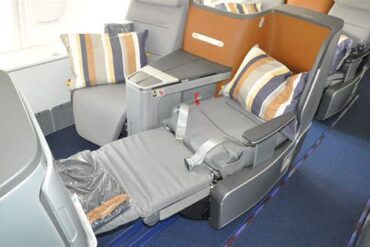
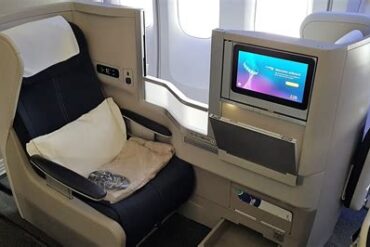
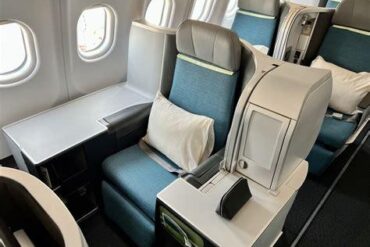
Instead of placing all seats in a forward-facing orientation, the designers created a patented “yin-yang” configuration that alternated forward-facing and rear-facing seats. This unconventional arrangement allowed flat beds to fit within nearly the same footprint previously occupied by reclining seats.
The breakthrough solved the fundamental challenge that had prevented widespread adoption of lie-flat business class. Airlines no longer had to choose between passenger comfort and economic viability.
When the product entered service in March 2000 on flagship London–New York routes, it immediately attracted global attention.
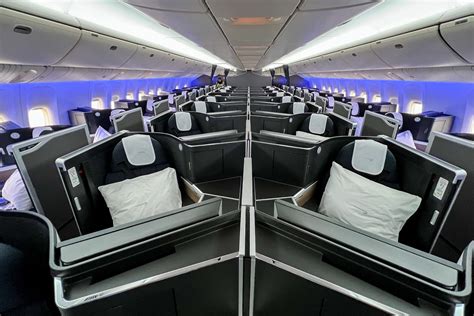
The impact was profound. Competing carriers suddenly faced pressure to develop similar products. What had once been considered an impossible compromise between comfort and profitability quickly became the new industry standard.
The introduction of lie-flat seating transformed business class from a modest upgrade into a genuine premium travel experience. It reshaped passenger expectations, airline investment strategies, and cabin design philosophies across the world.
More importantly, it established British Airways as one of the most influential innovators in modern commercial aviation.
How Passenger Expectations Changed Over Two Decades
The success of lie-flat seating solved one major problem, but it also created new expectations.
As travelers became accustomed to sleeping comfortably in business class, attention shifted toward privacy, workspace functionality, storage, and personal control over the travel environment.
The rise of remote work, global business travel, and increasingly affluent leisure passengers accelerated this trend. Premium travelers no longer wanted simply a bed in the sky. They wanted a personal suite that could function as an office, dining room, entertainment center, and bedroom throughout a long-haul journey.
By the late 2010s, privacy had emerged as one of the most important factors influencing premium cabin satisfaction.
Airlines across the Middle East and Asia began introducing enclosed suites and private cabin concepts that emphasized personal space. British Airways understood that maintaining leadership in premium travel required another major evolution.
The result was the development of the Club Suite.
The Club Suite Marks a New Generation of Luxury
The launch of the Club Suite represented one of the most significant product upgrades in British Airways’ history.
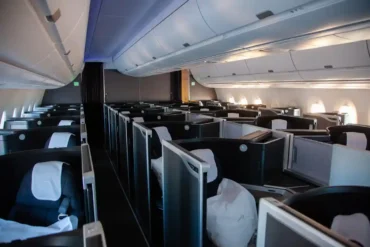
Debuting aboard the Airbus A350-1000, the Club Suite abandoned the airline’s iconic interlocking layout in favor of a highly modern and passenger-focused configuration.
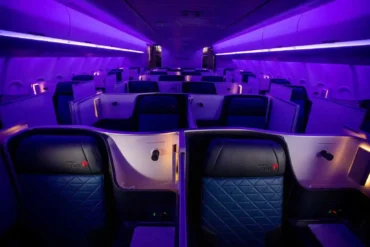
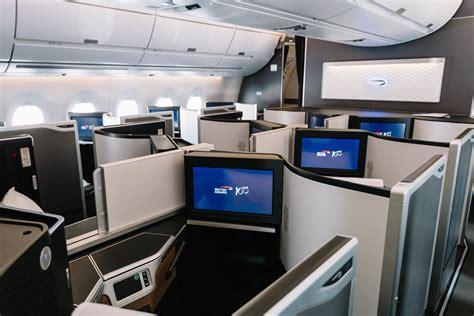
Built around a customized version of the Collins Aerospace Super Diamond platform, the new cabin adopts a 1-2-1 arrangement that guarantees direct aisle access for every traveler.
This may sound simple, but it addresses one of the biggest frustrations in traditional business-class cabins: the need to climb over neighboring passengers during overnight flights.
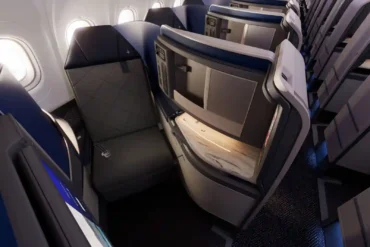
The Club Suite introduces a significantly more sophisticated travel environment. Each suite features a fully flat 79-inch bed, dramatically improved storage capacity, enhanced workspace functionality, and an integrated sliding privacy door.
The addition of the privacy door is particularly significant because it fundamentally changes the passenger experience. Travelers can now create a personal sanctuary insulated from aisle activity and cabin movement.
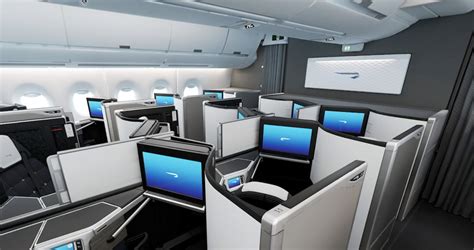
The design reflects broader trends within luxury hospitality, where exclusivity, personal space, and customization increasingly define premium experiences.
Unlike earlier generations of business-class products that focused primarily on sleep comfort, the Club Suite is engineered to support multiple activities throughout a flight. Passengers can work, dine, relax, stream entertainment, or sleep within an environment specifically designed to adapt to changing needs.
This flexibility has become a critical competitive advantage in long-haul aviation.
The Airbus A380 Transformation Strategy
While introducing a new business-class product on recently delivered aircraft is relatively straightforward, retrofitting older aircraft presents a much larger challenge.
British Airways faces exactly this situation with its fleet of Airbus A380 superjumbos.
The double-decker aircraft remains one of the most recognizable passenger jets ever built. Despite industry predictions that the A380 would gradually disappear from commercial service, British Airways has chosen a different path.
Rather than retiring the aircraft, the airline is investing heavily in its modernization.
Beginning in 2026 and continuing through 2028, British Airways plans an extensive refurbishment program covering all active Airbus A380 aircraft in its fleet.
The scale of the project is remarkable.
Every aircraft will receive the latest Club Suite product, replacing older business-class seating with one of the most advanced premium cabins in commercial aviation.
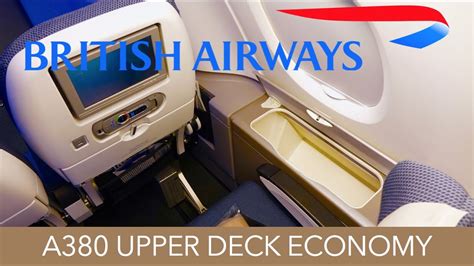
The retrofit expands business-class capacity to approximately 110 suites across both decks, representing a substantial increase in premium seating availability.
At the same time, premium economy capacity will grow significantly, reflecting strong demand from travelers seeking enhanced comfort without the cost of business class.
These modifications reveal a broader strategic shift.
Instead of maximizing total passenger volume, British Airways is increasingly prioritizing premium revenue generation. The airline recognizes that profitability on major long-haul routes often depends more on premium passengers than on sheer seat numbers.
The redesigned A380 demonstrates this philosophy clearly.
Nearly half of the aircraft’s interior space will be dedicated to premium cabins once refurbishment is complete.
Such a substantial allocation of valuable cabin real estate underscores the airline’s confidence in long-term demand for high-end travel experiences.
Reimagining First Class for Modern Luxury Travelers
While business class often receives the most attention, first class remains the ultimate expression of an airline’s brand identity.
British Airways is therefore investing considerable resources into creating an entirely new first-class experience for its flagship aircraft.
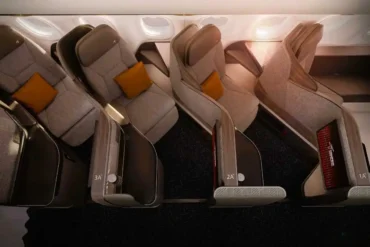
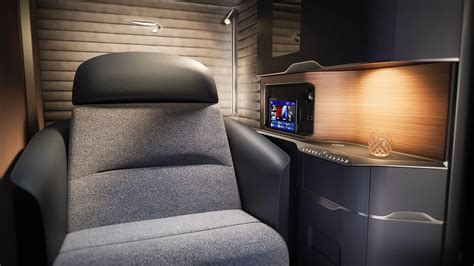
The redesigned cabin draws inspiration from luxury hotels rather than traditional airline interiors. Every element is intended to create a more residential atmosphere that feels warm, private, and sophisticated.
Each suite offers approximately 36.5 inches of width and incorporates a separate 79-inch fully flat bed, delivering a significant increase in personal space.
Technology plays an equally important role.
Passengers enjoy access to a large 32-inch ultra-high-definition 4K entertainment screen, one of the largest displays available in commercial aviation.
The suite’s architecture also prioritizes acoustic comfort.
Specialized sound-dampening materials and advanced privacy structures reduce ambient cabin noise, helping travelers rest more effectively during long flights.
For couples and companions traveling together, selected center suites can be adapted for shared dining experiences, creating a level of flexibility rarely found in traditional first-class products.
The design language incorporates subtle references to Concorde, celebrating one of the most iconic chapters in British aviation history while presenting a distinctly modern interpretation of luxury.
Materials sourced from Britain and Ireland further reinforce the airline’s commitment to craftsmanship and heritage.
Premium leathers, bespoke metal finishes, and custom textiles elevate the tactile quality of the cabin, ensuring that luxury is experienced not only visually but physically.
Why Connectivity Has Become the New Luxury
Comfort alone no longer defines premium travel.
In an increasingly connected world, passengers expect uninterrupted internet access wherever they are, including at 35,000 feet over the Atlantic Ocean.
For corporate travelers, connectivity has become nearly as important as sleep quality.
Missed emails, interrupted video conferences, and unreliable internet service can significantly impact productivity during long-haul journeys.
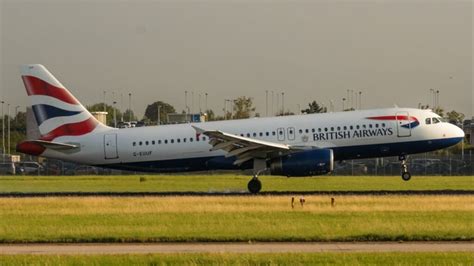
Recognizing this shift, British Airways is introducing fleet-wide complimentary Starlink connectivity beginning in 2026.
Powered by a vast network of low-Earth-orbit satellites, Starlink offers substantial advantages over traditional geostationary satellite systems.
Because the satellites operate much closer to Earth, latency is dramatically reduced, enabling faster and more responsive internet performance.
The practical benefits are considerable.
Passengers can participate in video meetings, stream high-definition content, browse social media, play online games, and access cloud-based applications with performance levels approaching those available at home.
For premium travelers, this development represents a significant enhancement to the overall journey experience.
A private suite loses some of its value if passengers remain disconnected from colleagues, family, or business operations for ten hours.
By combining luxury seating with reliable high-speed internet, British Airways aims to create a truly seamless travel environment where productivity and comfort coexist.
The Economics Behind Premium Cabin Expansion
Luxury travel is often discussed from the perspective of passenger experience, but the financial logic behind these investments is equally important.
Modern airline profitability increasingly depends on premium revenue.
While economy cabins continue to carry the majority of passengers, premium travelers contribute a disproportionately large share of total revenue.
Business travelers, affluent leisure passengers, and frequent flyers are willing to pay significantly higher fares in exchange for comfort, convenience, privacy, and flexibility.
As a result, airlines compete aggressively for premium market share.
British Airways’ decision to dedicate approximately 49 percent of its refurbished A380 cabin space to premium seating reflects a deliberate revenue optimization strategy.
The objective is not simply to offer luxury for luxury’s sake.
The goal is to maximize profitability by allocating cabin space toward products that generate the highest returns.
This strategy is particularly relevant on high-demand international routes linking major financial centers, where premium demand remains strong even during periods of economic uncertainty.
By increasing the availability of business-class suites and premium economy seats, British Airways is positioning itself to capture a larger share of this lucrative market.
Continuing the Legacy of Aviation Innovation
More than a quarter century after introducing lie-flat business-class seating, British Airways continues to influence the evolution of premium travel.
The airline’s journey from pioneering flat beds to deploying private suites, advanced acoustics, luxury craftsmanship, and Starlink connectivity illustrates a consistent willingness to challenge industry norms.
The aviation landscape has changed dramatically since the late 1990s. Passenger expectations have risen, competition has intensified, and technology has transformed nearly every aspect of the travel experience.
Yet the core philosophy that drove British Airways’ original innovation remains unchanged: identify what premium travelers value most and build products that exceed those expectations.
The airline’s ambitious modernization program demonstrates that luxury travel is no longer defined by a single feature. Instead, it emerges from the seamless integration of comfort, privacy, technology, connectivity, and thoughtful design.
As refurbished Airbus A380s enter service, Club Suites expand across the fleet, and next-generation first-class cabins debut, British Airways is positioning itself for another chapter of premium aviation leadership.
The carrier that helped invent the modern lie-flat experience is once again reshaping expectations for what luxury travel can become, proving that innovation remains one of its most enduring competitive advantages.