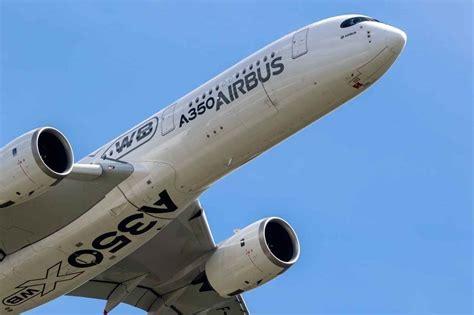
European aerospace giant Airbus has narrowly beaten its revised aircraft delivery goal for 2025, successfully handing over 793 commercial planes by year’s end. This milestone was achieved despite a challenging operating landscape marked by persistent supply chain disruptions, technical setbacks, and mounting pressure from competitors. The final push in December allowed Airbus to edge past its downgraded forecast of 820 deliveries, confirming its position as the world’s largest commercial aircraft manufacturer by volume.
A Grueling Year of Adjustments and Delays
Airbus entered 2025 with bold ambitions, initially targeting the delivery of 820 aircraft. However, a series of unexpected headwinds prompted a mid-year downward revision. Among the most disruptive events was a software upgrade that temporarily grounded segments of the global A320 fleet, halting operations and triggering inspection delays. Compounding the situation, Airbus engineers discovered non-compliant fuselage panels, forcing further quality assurance reviews and slowing production.
These setbacks forced Airbus into a high-stakes scramble to recover lost momentum. Throughout the fourth quarter, internal reports described a company operating at “maximum intensity,” with multiple production sites accelerating output and logistics teams mobilizing expedited delivery plans.
December Surge: 10 Aircraft in a Day
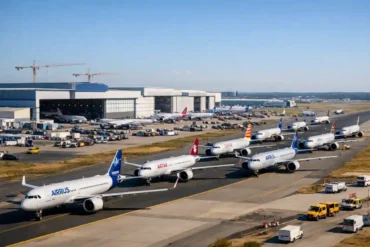
A defining moment in the company’s year-end sprint came on December 19, when Airbus achieved the remarkable feat of delivering ten A321neo aircraft in a single day. This surge showcased not only the resilience of Airbus’s global supply chain but also the strength of its customer relationships. The deliveries included:
- Air China – 3 A321neo
- Wizz Air – 3 A321neo
- IndiGo – 1 A321neo
- Scoot – 1 A321neo
- AirAsia – 1 A321neo
- China Airlines – 1 A321neo
The ability to coordinate such a concentrated delivery schedule was a testament to Airbus’s adaptability and its network of final assembly lines spanning Europe and Asia.
Airbus vs Boeing: Global Delivery Race Heats Up
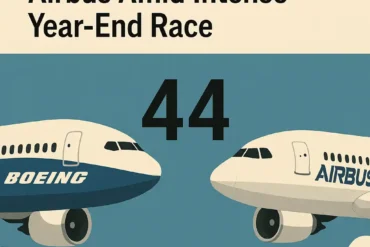
Despite Airbus’s impressive delivery figures, the broader aircraft manufacturing narrative remains dominated by its rivalry with Boeing. While Airbus led the market in total deliveries, Boeing made notable strides in 2025, delivering an estimated 650 aircraft, a substantial recovery from its tumultuous recent years.
Boeing’s portfolio was dominated by the 737 MAX, which accounted for the bulk of its 537 aircraft deliveries through November. However, lingering certification issues and delays surrounding the long-anticipated 777X program meant Boeing remained behind Airbus in the critical deliveries metric. Notably, no 777X units were delivered in 2025, extending its already-delayed timeline.
In total, more than 1,400 aircraft were delivered globally by Airbus and Boeing combined—marking the first return to pre-pandemic delivery levels, a significant indicator of industry stabilization and airline confidence in fleet renewal.
Behind the Numbers: Supply Chain Realities
While Airbus achieved its goal on paper, the underlying story reveals the intense strain on its operations. Persistent supply chain disruptions—particularly in sourcing engines, avionics, and cabin interiors—continued to challenge production stability. In some instances, aircraft reached final assembly stages only to be held back due to missing components, delaying final delivery clearance.
These issues have forced Airbus to develop more agile production strategies, including:
- Increasing on-site parts inventory to mitigate logistics delays
- Diversifying supplier bases across Asia and Europe
- Enhancing final assembly line automation in Toulouse and Hamburg
CEO Guillaume Faury emphasized in recent internal communications that 2025 was a “year of learning and adaptation,” reinforcing the company’s commitment to long-term ramp-up strategies.
The Road Ahead: Ambitious Outlook for 2026
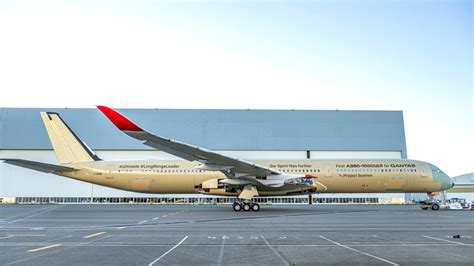
Looking toward 2026, Airbus is entering with a renewed sense of urgency and a slate of high-profile milestones. Among the most anticipated is the Airbus A350-1000ULR—a critical piece in Qantas’s Project Sunrise, which aims to operate non-stop flights from Sydney to New York and London, journeys of up to 22 hours.
The first delivery of this ultra-long-range aircraft is slated for late 2026, representing a landmark in ultra-long-haul travel and Airbus’s commitment to cutting-edge efficiency and passenger comfort.
Additionally, Airbus plans to:
- Ramp up A320neo and A321XLR output to meet surging demand
- Launch operations at a second assembly line in Tianjin, China
- Repurpose the former Airbus A380 line in Toulouse to focus on A321 production
- Complete first flight of the Airbus A350 Freighter (A350F), targeting the cargo market
Guillaume Faury has already dubbed 2026 as “another year of progressive ramp-up,” hinting at even more ambitious targets. While production goals haven’t been officially released, analysts expect Airbus to aim for 850+ aircraft deliveries, depending on supplier alignment.
Airbus’s Market Position: Orders vs Deliveries
Although Airbus maintained its lead in aircraft deliveries, it trailed Boeing in new orders by year’s end. This dynamic raises questions about the balance between volume execution and future demand capture. Boeing’s aggressive push to lock in orders—especially for the 737 MAX—gave it a numerical edge in gross and net orders, though Airbus remains highly competitive in the narrow-body and wide-body segments.
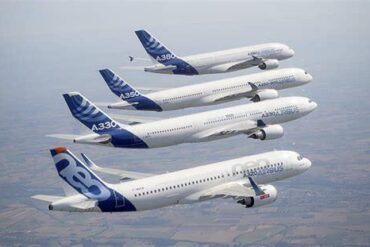
Airbus’s focus on fleet renewal, fuel efficiency, and sustainability goals continues to resonate with global carriers. Its A320neo family remains the backbone of modern fleets, while the A330neo and A350 series are gaining traction for long-haul applications.
Final Thoughts: A Resilient Performance Amid Uncertainty
Airbus’s performance in 2025, culminating in the delivery of 793 aircraft, represents more than just a numerical victory. It reflects a broader narrative of resilience, strategic flexibility, and operational intensity. By adapting swiftly to technical disruptions, managing global logistics constraints, and mobilizing its production teams, Airbus demonstrated why it remains a cornerstone of the global aviation industry.
However, challenges remain. The pressure to maintain supply chain continuity, expand assembly line capacity, and respond to geopolitical uncertainties will define Airbus’s path forward. The delivery success of 2025 is both a capstone of recovery and a springboard for transformation as the aerospace world watches closely what Airbus achieves in 2026 and beyond.