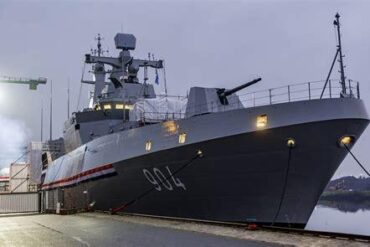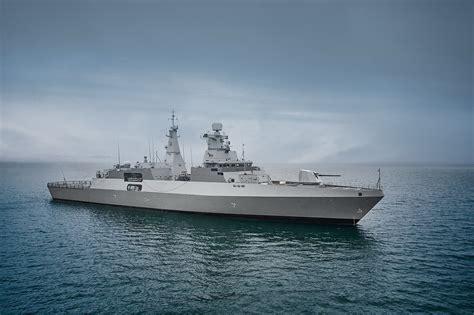
Germany has formally set the course for a critical naval acquisition designed to safeguard fleet readiness as the F-126 Niedersachsen-class frigate program continues to face delays. Under a preliminary agreement signed in February 2026, Thyssenkrupp Marine Systems (TKMS) will begin preparatory work on the first MEKO A-200 DEU frigate, with delivery targeted for 2029. The move represents a calculated industrial and strategic maneuver aimed at preventing operational capability gaps within the German Navy (Deutsche Marine).
The agreement, valued at up to €50 million, authorizes early-stage procurement and steelwork ahead of a final construction contract. While not yet a binding build agreement, it unlocks immediate industrial actions that directly support the 2029 delivery objective. The signing ceremony in Koblenz between TKMS and Germany’s Federal Office of Bundeswehr Equipment marked the official launch of the project’s preparatory phase, underscoring Berlin’s urgency in stabilizing its surface combatant roadmap.
This accelerated pathway reflects mounting concerns over schedule slippage in the F-126 program, which originally envisioned six advanced frigates. With delays now affecting long-term fleet planning, Germany is preparing to procure at least three MEKO A-200 DEU frigates under an alternative acquisition strategy. Budget frameworks allow expansion to as many as eight vessels should the F-126 program face further disruption or cancellation.
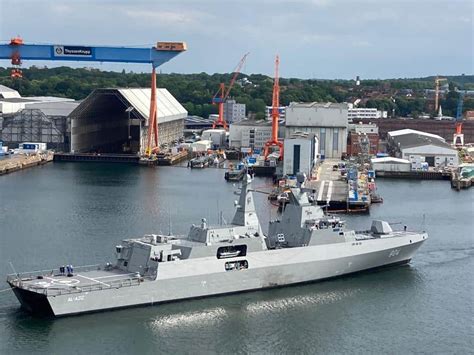
Strategic Response to F-126 Niedersachsen-Class Delays
The decision to initiate early industrial work on the MEKO A-200 DEU is not a symbolic gesture. It is a structural hedge against readiness shortfalls. Modern navies operate on tightly sequenced shipbuilding cycles, and even modest schedule overruns can cascade into capability gaps that persist for years. Germany’s leadership appears determined to avoid precisely that scenario.
Planning estimates place the unit cost of each MEKO A-200 DEU at approximately €1 billion, bringing a three-ship package close to €3 billion. A broader financial framework of €7.8 billion, approved in 2025, provides long-term funding flexibility. Allocations include €724.7 million in 2026, €878.2 million in commitment authority for 2027, and roughly €6.2 billion from 2028 onward, with expenditures projected through 2033. These figures demonstrate that Berlin is not merely improvising but constructing a financially structured alternative pathway.
The preliminary agreement secures long-lead components, reserves shipyard capacity, and initiates steel cutting. Shipbuilding timelines hinge on early material procurement; propulsion systems, combat electronics, and specialized steel sections often require years of advance planning. By beginning this process before the final contract signature, Germany reduces schedule risk and preserves its 2029 operational target.
MEKO A-200 DEU: Design Dimensions and Core Specifications
The MEKO A-200 DEU frigate belongs to the proven MEKO modular family, yet it introduces a configuration tailored to German operational requirements. The vessel measures approximately 121 meters in length, with a beam of 16.4 meters and a design draught of around 4.4 meters. Full-load displacement ranges between 3,700 and 3,950 tonnes, placing it firmly within the medium frigate category.
Crew planning indicates a core complement of 120 to 150 personnel, with accommodation capacity expandable to approximately 180–200 personnel, depending on mission configuration. That flexibility reflects the modular philosophy embedded within the MEKO concept, allowing rapid adaptation to anti-submarine warfare, maritime security, or surface combat roles.
At the heart of the platform lies a CODAG-WARP propulsion architecture. This Combined Diesel and Gas system integrates two diesel propulsion chains rated at roughly 6 MW each with a powerful 20 MW gas turbine driving a centerline waterjet. The result is a ship capable of exceeding 29 knots, while sustaining an operational range of more than 6,500 nautical miles at 16 knots. That endurance profile supports extended deployments across the North Atlantic, Mediterranean, and beyond.
Aviation Facilities and Multirole Capability
The MEKO A-200 DEU is engineered for modern maritime missions where flexibility is paramount. Its hangar and flight deck are dimensioned to accommodate either two 6-ton class helicopters or a single 11-ton helicopter such as the NH90, alongside up to two unmanned aerial vehicles. This aviation capacity significantly enhances anti-submarine warfare, over-the-horizon targeting, and maritime surveillance functions.
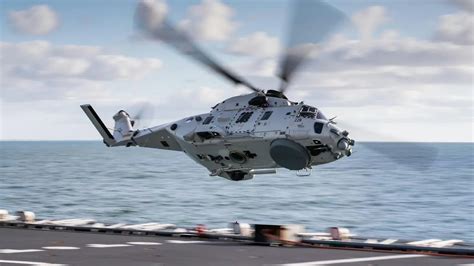
Two rigid-hulled inflatable boats, each up to eight meters in length, are deployed via side-mounted launch systems. These craft support boarding operations, special forces insertion, and maritime interdiction tasks. Operational design standards permit helicopter and small-boat activities in sea states up to level six, underscoring the vessel’s resilience in harsh maritime environments.
The German configuration is expected to integrate national and European sensors, weapons, and combat management systems. While final details remain undisclosed, emphasis is anticipated on advanced anti-submarine warfare (ASW) capabilities, reflecting NATO’s renewed focus on undersea domain awareness in response to evolving security dynamics.
Survivability, Signature Reduction, and Modular Engineering
A defining characteristic of the MEKO A-200 lineage is its advanced signature management. The frigate’s distinctive X-form hull geometry minimizes radar cross-section by eliminating conventional right-angle surfaces. The absence of a traditional funnel further reduces infrared visibility, as exhaust gases are cooled and discharged horizontally or below the waterline.
Acoustic stealth is achieved through machinery isolation, optimized propellers, and the integration of a waterjet system. A tri-axial degaussing system reduces magnetic signature, lowering susceptibility to naval mines. Internally, the high-tensile steel hull is divided into multiple watertight compartments with independent control, firefighting, and power systems, enhancing damage control resilience.
These measures position the MEKO A-200 DEU as a platform engineered for survivability in contested environments. Modern naval combat increasingly involves multi-domain threats—from anti-ship missiles to submarines and unmanned systems—making reduced signature profiles a strategic necessity rather than a luxury.
Industrial Footprint and German Defense Ecosystem
The MEKO A-200 DEU program extends beyond ship delivery timelines. It reinforces Germany’s domestic industrial base. Key industrial participants include Ostseestahl GmbH in Stralsund, Renk AG in Augsburg, Stahlbau Nord in Bremerhaven, and Noske-Kaeser in Hamburg. This distributed participation spreads economic impact while strengthening national maritime engineering capabilities.
By initiating steelwork and procurement early, TKMS ensures production continuity within German shipyards. Naval shipbuilding is not an industry that tolerates idle capacity without consequence. Skilled labor, specialized tooling, and supplier networks require sustained activity to remain viable. The preliminary agreement therefore functions as both a naval readiness measure and an industrial stabilization mechanism.
The MEKO concept itself traces back to the 1980s under Blohm + Voss, built around the principle of Mehrzweck-Kombination, or multipurpose combination. Across the MEKO 200 family, 34 vessels have been completed, with the A-200 variant currently in service with South Africa, Algeria, and Egypt. Germany’s adoption of the A-200 DEU configuration brings the design full circle, integrating export-proven architecture into domestic fleet planning.
Fleet Readiness and Delivery Sequencing
The projected delivery sequence anticipates the first MEKO A-200 DEU in 2029, followed by subsequent hulls at intervals of less than twelve months. Such tempo reflects confidence in modular construction methodologies and established industrial workflows.
Germany’s requirement is explicit: new frigates must enter service from 2029 onward to prevent readiness gaps. Surface combatants serve as the backbone of maritime deterrence, participating in NATO task groups, maritime security patrols, and collective defense operations. Even a temporary shortfall would ripple across alliance commitments.
The MEKO A-200 DEU thus emerges not merely as a substitute platform but as a strategic bridge—maintaining operational continuity while long-term fleet modernization evolves. With financial frameworks secured, industrial work initiated, and delivery targets defined, Germany has positioned itself to navigate procurement turbulence without sacrificing maritime capability.
In a period marked by renewed great-power competition and heightened naval activity in European waters, the decision to advance the MEKO A-200 DEU underscores a clear message: strategic agility and industrial readiness remain central pillars of German defense planning.