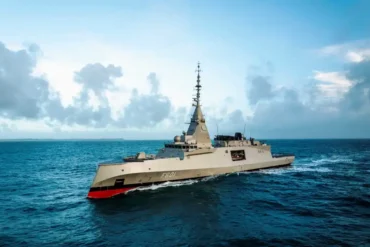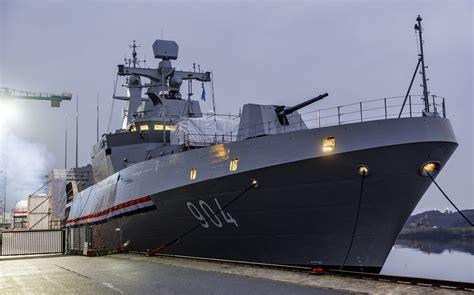
Germany is preparing to take a decisive step to safeguard its naval capabilities by pursuing the acquisition of three MEKO A-200 frigates, a move driven by mounting delays in the F-126 Niedersachsen-class frigate program. The decision reflects a growing urgency within Berlin to prevent a looming capability gap in the German Navy as aging surface combatants approach the limits of their service lives. Rather than waiting for uncertainties to resolve, Germany is signaling a pragmatic willingness to rely on a proven design that can be delivered on a predictable timeline.
The proposed procurement is not framed as a cancellation of the F-126 program but as a parallel insurance policy. German defense planners are keenly aware that surface combatants are not assets that can be conjured quickly once shortages appear. Shipbuilding timelines stretch across years, sometimes decades, and every missed delivery date compounds operational risk. Against this backdrop, the MEKO A-200 emerges as a ready-made answer to an increasingly uncomfortable question: what happens if F-126 slips further to the right?
The approach also underscores a broader shift in German defense thinking since 2022, with fleet availability and deployability now prioritized alongside long-term modernization ambitions. The message is clear—industrial ambition cannot come at the expense of near-term readiness.
F-126 Program Delays and the Risk to Fleet Availability
The F-126 program was originally envisioned as the backbone of Germany’s future surface fleet, with six large, multi-mission frigates designed for sustained global deployments. However, persistent industrial and contractual challenges have pushed timelines further into uncertainty. Each delay erodes confidence that the first hulls will arrive in time to replace older platforms scheduled for retirement.
For the German Navy, this is not an abstract budgeting problem. Frigates underpin Germany’s ability to contribute meaningfully to NATO maritime task groups, conduct maritime security patrols, and maintain a presence in distant theaters. Without sufficient hulls, commitments become harder to sustain, crews are overworked, and maintenance cycles tighten to uncomfortable levels. The risk is not just fewer ships, but fewer ships actually available for operations.
This is why Germany’s parliamentary budget committee approved €7.8 billion in 2025 for an alternative procurement path. That funding does not cancel the F-126 effort, but it creates a pressure valve. If delays persist, the MEKO A-200 option can be activated rapidly, ensuring that new frigates begin entering service from 2029 onward, the critical threshold identified by naval planners.
The Strategic Rationale for Choosing MEKO A-200
The MEKO A-200 was not selected by accident. It represents a mature, combat-proven design that can be adapted to national requirements without the development risks associated with clean-sheet projects. For Germany, this balance—customization without reinvention—is especially attractive under tight timelines.
Thyssenkrupp Marine Systems (TKMS) would act as the prime contractor, leveraging existing production lines and supplier networks. Indicative pricing places each ship at around €1 billion, a figure that reflects both modern combat system integration and the realities of European naval shipbuilding costs. Importantly, deliveries are projected at intervals of less than twelve months, a tempo that aligns with Germany’s urgency to stabilize fleet numbers.
The selection also reinforces domestic industrial capacity. German shipyards and suppliers would remain deeply involved, ensuring that the procurement supports national defense-industrial resilience rather than outsourcing capability abroad.
Industrial Acceleration and Budgetary Commitments
To compress timelines, Germany plans to employ a preliminary contract mechanism. An initial allocation of roughly €50 million would allow TKMS and its partners to reserve shipyard slots, order long-lead items, and begin detailed design adaptation. This early investment is designed to eliminate the dead time that often plagues naval programs between political approval and physical construction.
If the main contract is delayed beyond March 31, 2026, provisions exist to extend preliminary work into April, potentially unlocking an additional €100 million. Medium-term funding lines are already mapped out, with €724.7 million planned for 2026, followed by €878.2 million in 2027, and approximately €6.2 billion allocated from 2028 through 2033.
The industrial ecosystem supporting the program spans multiple German firms, including Ostseestahl GmbH, Renk AG, Stahlbau Nord, and Noske-Kaeser. This distributed approach spreads economic benefits while reducing single-point industrial risks.
MEKO A-200 Design: Size, Propulsion, and Endurance
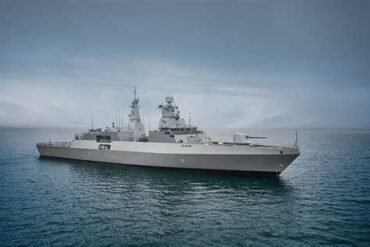
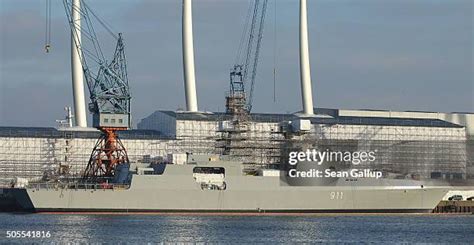
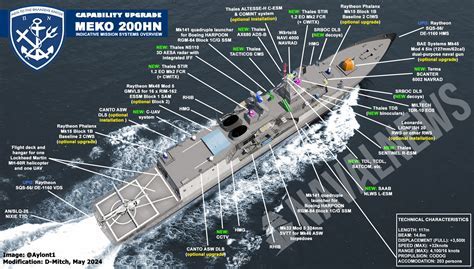
At 121 meters in length with a beam of 16.4 meters, the MEKO A-200 sits comfortably in the medium-frigate category. Its full-load displacement of roughly 3,950 tonnes reflects a design philosophy focused on endurance and flexibility rather than sheer size. The ship is optimized for long deployments, with accommodation for a core crew of 125 personnel and space for up to 49 additional embarked specialists.
Propulsion is based on a CODAG-WARP configuration, combining two diesel engines with a powerful gas turbine driving a centerline waterjet. This arrangement delivers speeds exceeding 29 knots while maintaining impressive fuel efficiency. At a cruising speed of 16 knots, the frigate boasts a range of more than 6,500 nautical miles, enabling sustained operations far from home ports without constant replenishment.
This propulsion architecture is not just about speed. It enhances maneuverability, reduces acoustic signature, and supports operations in both open-ocean and littoral environments—an increasingly important requirement for modern navies.
Aviation, Boats, and Mission Flexibility
A defining strength of the MEKO A-200 is its aviation and mission support infrastructure. The flight deck and hangar are capable of operating either two 6-ton-class helicopters or a single 11-ton helicopter such as the NH90. Space is also reserved for unmanned aerial vehicles, reflecting the growing role of drones in maritime surveillance and targeting.
Two rigid-hulled inflatable boats up to eight meters in length can be launched and recovered via side-mounted systems, supporting boarding operations, special forces insertion, and maritime security tasks. Design features such as a forefoot skeg and active fin stabilizers enhance stability, allowing helicopter and boat operations in sea state 6, conditions that would sideline less capable platforms.
Survivability and Signature Reduction by Design
Survivability is engineered into the MEKO A-200 from the keel up. The distinctive X-form hull geometry minimizes radar reflections by reducing right-angle surfaces, while exhaust gases are cooled and discharged in ways that significantly lower the ship’s infrared signature. The absence of a traditional funnel is more than aesthetic—it is a deliberate stealth choice.
Acoustic discretion is achieved through machinery isolation, aft-mounted propulsion components, refined propellers, and the use of a waterjet. A tri-axial degaussing system reduces magnetic signature, complicating detection by mines and sensors. Internally, the hull is divided into multiple watertight sections, each with independent power and firefighting capabilities, enhancing damage control resilience in combat scenarios.
These features collectively ensure that the frigate is not merely survivable on paper, but realistically capable of withstanding modern threat environments.
Global MEKO Legacy and Operational Credibility
The MEKO lineage carries significant weight. Variants of the MEKO 200 family are operated by navies including Turkey, Greece, Portugal, Australia, and New Zealand. The MEKO A-200 subfamily is in service with South Africa, Algeria, and Egypt, providing real-world validation across diverse operational theaters.
Egypt’s expanded order, which includes local construction, highlights the design’s adaptability and export appeal. Combat system configurations vary by customer, with options for 127 mm naval guns, 16 to 32-cell vertical launch systems, and robust anti-ship missile loads. This modularity is central to the MEKO philosophy and would allow Germany to tailor its ships to national doctrine and NATO requirements.
A Calculated Move to Protect Naval Readiness
Germany’s consideration of the MEKO A-200 is ultimately a risk management decision. It reflects an understanding that naval power is measured not just in future promises, but in hulls available today and tomorrow. By keeping the F-126 program alive while advancing a parallel, lower-risk option, Berlin is hedging against uncertainty without abandoning ambition.
If executed as planned, the first MEKO A-200 frigate entering service in 2029 would mark more than a procurement milestone. It would signal that Germany is willing to adapt, prioritize readiness, and ensure that its navy remains a credible force in an increasingly contested maritime environment.