The European A-CDM concept is rooted in the American Collaborative Decision Making model introduced in January 1998. This model was created to address significant capacity reductions caused by poor weather conditions. During trial periods, delays in ground delay programs decreased by 15 percent. In the early 2000s, trials were conducted at major European airports to refine this concept for Europe. This effort led to the formation of the Airport CDM Task Force under the EATM Airport Throughput Division (APT), which guided the Airport Operations Team (AOT) on A-CDM matters. The outcome was the European A-CDM Manual, outlining key elements such as information sharing, turnaround processes, variable taxi times, pre-departure sequencing, and handling adverse conditions. Many airports have successfully implemented A-CDM based on this manual, while others are currently in the process.
A-CDM Benefits
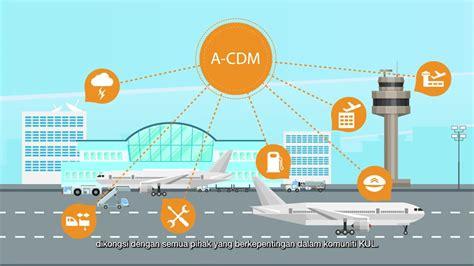
Implementing A-CDM allows each partner to optimize their decisions while collaborating with others, taking into account their preferences and constraints as well as the current and predicted situations. The decision-making process is enhanced by sharing accurate and timely information, along with adapted procedures and tools. The main A-CDM partners include:
-
The Airport Operator
-
Aircraft Operators
-
Ground Handlers
-
De-icing Companies
-
Air Navigation Service Providers (ATC)
-
Network Managers
-
Support Services (Police, Customs, Immigration, etc.)
A-CDM Elements
The A-CDM concept consists of several key elements:
-
Airport CDM Information Sharing: This involves sharing timely and accurate information among partners to achieve a common situational awareness and improve traffic predictability. It serves as the foundation for other A-CDM elements.
-
CDM Turn-round Process – Milestones Approach: This outlines a flight’s journey from planning to takeoff by defining milestones that allow for close monitoring of significant events. The goal is to establish common situational awareness and predict upcoming events for each flight.
-
Variable Taxi Time Calculation: This entails calculating and sharing accurate estimates of taxi-in and taxi-out times to enhance predictions of in-block and takeoff times, ultimately improving traffic predictability.
-
Collaborative Management of Flight Updates: This includes exchanging Flight Update Messages (FUM) and Departure Planning Information (DPI) messages between the Network Manager and a CDM airport. This collaboration aims to provide better estimates for arriving flights and improve slot management for departing flights.
-
Collaborative Pre-departure Sequence: This refers to the planned order of aircraft departures, considering partners’ preferences. It aims to increase flexibility, punctuality, and adherence to slots, allowing partners to express their needs.
-
CDM in Adverse Conditions: This element focuses on managing airport capacity during predicted or unpredicted reductions, ensuring common situational awareness among partners and providing better information for passengers.
-
Advanced CDM: Although not yet fully defined, this future enhancement will utilize advanced technologies to improve collaboration and situational awareness among partners, potentially linking with advanced tools like A-SMGCS and AMAN/DMAN.