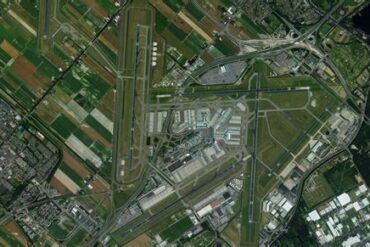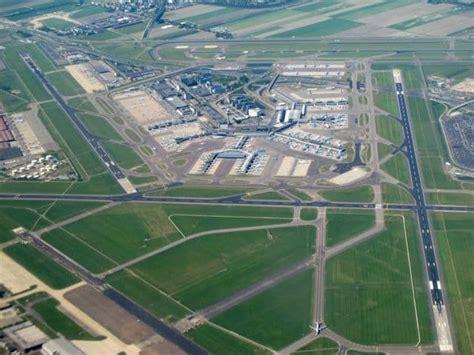
Amsterdam Airport Schiphol stands as the pulsating heart of Dutch aviation, a world-class gateway renowned for its efficiency, architectural elegance, and unwavering commitment to passenger experience. Located merely nine kilometers southwest of Amsterdam’s historic center, this sprawling aviation hub serves as the principal international airport of the Netherlands, blending strategic positioning with cutting-edge infrastructure to secure its place among Europe’s busiest and most innovative airports.
Since opening its doors on 16 September 1916 as a modest military airbase, Schiphol has transformed into a colossal aeronautical powerhouse. Operated by the Royal Schiphol Group, the airport functions as the primary hub for KLM Royal Dutch Airlines, KLM Cityhopper, and Martinair, while also hosting major operations for Corendon Dutch Airlines, easyJet, Transavia, TUI fly Netherlands, and Vueling. In 2024 alone, Schiphol welcomed 66,828,759 passengers, managed 473,815 aircraft movements, and handled 1,491,537 tonnes of freight, affirming its status as a cornerstone of global connectivity.
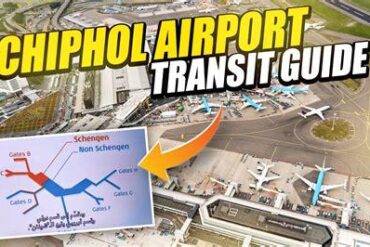
Far more than a transit point, Schiphol embodies a single-terminal concept ingeniously split into three departure halls interconnected airside, creating a seamless journey from check-in to boarding. This unifying design not only optimizes passenger flow but also fosters an immersive experience featuring world-class amenities—from upscale shopping arcades to serene lounge spaces—under one expansive roof.
Etymology and Enduring Legacy
The name “Schiphol” first appeared in records dating back to 1447, with origins shrouded in local lore and linguistic debate. Some historians suggest it derives from a “graveyard of ships,” referencing the treacherous waters of the former Haarlemmermeer lake where countless vessels met their demise. Others posit a connection to “ship-haul,” denoting canals used to tow boats between water bodies, while a less substantiated theory invokes the Gothic term “scip hol,” meaning a coppice in wetland. Regardless of its genesis, the name encapsulates a profound link between land reclamation, maritime history, and modern aeronautics.
Unrivaled Operational Capacity
In 2019, Schiphol handled 71,706,999 passengers, ranking third in Europe for passenger volume and leading in aircraft movements—a testament to its operational prowess. That year, cargo throughput reached 1.74 million tonnes, placing it fourth on the continent and highlighting its pivotal role in global supply chains. Traffic breakdown revealed 70.5% of journeys within Europe, 10.6% crossing the Atlantic to North America, and 10.1% bound for Asia, while cargo flowed primarily between Schiphol and key manufacturing hubs in Asia (46.3%) and North America (17.6%). Today, a network of 102 carriers connects Schiphol to 332 destinations, bridging continents and cultures with unparalleled frequency.
Historical Evolution: From Military Airfield to Aviation Titan
Schiphol’s journey from rural airstrip to international nexus is marked by periods of rapid expansion, wartime upheaval, and visionary planning. Initially established as a military base, civilian flights commenced in December 1920, coinciding with the founding of the Fokker aircraft factory nearby. By 1940, four asphalt runways formed a strategic layout, but World War II saw the airport seized by German forces, renamed Fliegerhorst Schiphol, and subjected to intensive bombardment. Rebuilt swiftly after liberation, the first post-war Douglas DC-3 touched down on 8 July 1945, signaling the airport’s rebirth.
The late 1940s ushered in the airport’s designation as the Netherlands’ principal civil aerodrome, prompting construction of a new terminal in 1949. The 1960s and ’70s witnessed further growth: a terminal area added in 1967, piers modified to accommodate the Boeing 747 in 1970 and 1977, and the inauguration of an on-site railway station in 1978—integrating rail and air travel with luxurious efficiency.
Entering the 1990s, Schiphol unveiled a new air traffic control tower in 1991 and added Departure Hall 3 along with G‑pier in 1993, expanding capacity and refining passenger navigation. The early 2000s brought the Polderbaan runway—situated five kilometers from the main terminal and serviced by its own tower—further alleviating noise impact on surrounding communities and optimizing traffic flow.
However, growth was not without challenges. On 25 February 2005, a meticulously planned diamond heist at the cargo terminal made headlines, with thieves escaping with an estimated €75 million in gems. Later that year, a tragic fire at the detention center claimed 11 lives, igniting national outrage and ministerial resignations amid scrutiny of safety protocols. More recently, the summer of 2022 saw the aftermath of the COVID‑19 pandemic strain operations: five-hour security queues, mass flight cancellations, and the resignation of Schiphol Group CEO Dick Benschop triggered a comprehensive review of crisis preparedness.
In 2024, however, the airport rebounded spectacularly with an 8% surge in passenger traffic and an 8.2% lift in cargo volume, prompting a €6 billion infrastructure investment plan spanning 2024–2029. This landmark initiative targets Pier C renovation, baggage handling modernization, upgraded climate-control systems, and the construction of additional stands and taxiways—culminating in the anticipated opening of a new Pier A by 2027.
State-of-the-Art Infrastructure
Underpinning Schiphol’s success is an expansive terminal radiating from the central Schiphol Plaza. Within its three departure halls—1, 2, and 3—passengers access Piers B through M, collectively offering 223 boarding gates, including 18 dual-widebody gates optimized for aircraft such as the Airbus A380. Design innovations like cantilevered jetways above wing surfaces have been gradually replaced with more conventional configurations, while Gates G9, E18, and E24 remain specially equipped for daily A380 operations by Emirates.
Beyond passenger travel, Schiphol supports general aviation via the KLM Jet Center, inaugurated in 2011 with 6,000 m² of terminal and office space. Sold to Jet Aviation in 2018, the facility caters to private jets and charter services with bespoke lounges and rapid processing.
Cultural enrichment thrives under the same roof: the Rijksmuseum’s airport annex presents rotating exhibitions of Dutch art, while the Schiphol Library houses 1,200 books in 29 languages alongside downloadable Dutch e‑books and music. Aviation enthusiasts can ascend to the Panoramaterras rooftop terrace—complete with a retired Fokker 100 exhibit—and moat-level spotting sites near the Polderbaan runway and McDonald’s vantage point. Additional amenities include an on-site mortuary, a Hilton hotel with 433 rooms and a 41 m glass atrium opened in 2015, a fleet of 52 electric shuttle buses introduced in 2024, and a 5,000 m² expansion of Lounge 1 unveiled in November 2024.
Visionary Future Expansions
Looking ahead, Schiphol is embarking on ambitious expansion projects to sustain growth and elevate the passenger experience. The long-awaited Pier A will nestle southwest of Pier B, incorporating five narrow‑body and three initial wide‑body gates. Originally slated for 2019, construction was halted in November 2021 due to structural and contractual setbacks; a new tender process launched in 2022 aims to recommence build-out with a revised timeline.
Complementing this is the planned fourth terminal hall, conceived to handle over 70 million annual passengers while preserving the single‑terminal ethos. Though postponed by at least two years amid the pandemic, the project remains central to Schiphol’s capacity strategy, promising direct access to Schiphol Plaza and integrated departures and arrivals under one roof.
Simultaneously, the airport is rolling out a third phase of uniform platform expansions from 2022 to 2026, increasing widebody stands to a total of twelve and streamlining aircraft turnaround.
Seamless Connectivity: Public Transportation and Beyond
Schiphol’s integration with ground transport epitomizes multimodal convenience. An extensive overhaul of the train and bus stations—scheduled for completion by 2025—will introduce additional entrances, expanded concourses, and modernized platforms. While proposals for a direct metro link have existed since the 1990s, land acquisition from Chipshol underscores the airport’s commitment to future-proof connectivity, even as formal planning remains at the proposal stage as of 2022.
Global Airlines and Destination Network
At its core, Schiphol thrives as a nexus for more than 100 international carriers connecting to 332 destinations. Its dominance in European routes is matched by robust intercontinental links: passenger traffic to Asia accounts for over 10% of journeys, while cargo flows reinforce Schiphol’s status as a key transshipment point between Europe, Asia (46.3% of freight), and North America (17.6%). From Athens to Osaka, from New York to Johannesburg, Schiphol’s runway labyrinth and scheduling finesse ensure that travelers and cargo alike traverse borders with remarkable regularity and precision.
In an era defined by rapid change and evolving traveler expectations, Amsterdam Airport Schiphol remains steadfast in its pursuit of excellence. Through continuous innovation, strategic infrastructure investments, and an unwavering focus on seamless passenger journeys, Schiphol not only upholds its legacy but charts a visionary course for the future of global aviation.