Located at 51°21′23″N 0°07′02″W, nestled in the heart of South London, Croydon Airport stands as a towering relic in the evolution of international air travel. Opened on 29 March 1920, it was the United Kingdom’s primary international airport until its closure on 30 September 1959. During its prime, Croydon was more than just an airport — it was a symbol of Britain’s ambition in aviation. It pioneered critical developments such as the world’s first air traffic control tower, first airport terminal, and the first airport hotel, the Gate Lodge, known today as the Aerodrome Hotel.
At its peak, Croydon was the epicentre of British civil aviation, handling more cargo, mail, and passengers than any other airport in the UK. It was also the operational hub for Imperial Airways, the nation’s first international airline, formed in 1924 through a government-backed merger.
Military Roots and Royal Wings
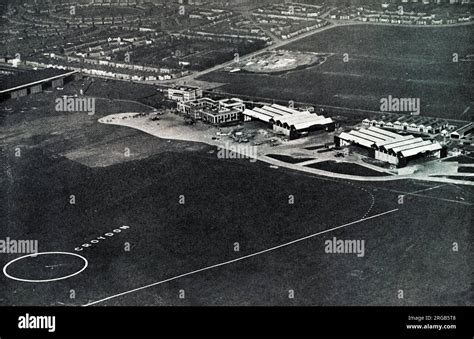
Before becoming a civilian air hub, the site had deep military origins. In December 1915, Beddington Aerodrome was established to protect London from Zeppelin air raids during World War I. This was followed in 1918 by Waddon Aerodrome, which was linked to aircraft production at National Aircraft Factory No. 1. Both airfields flanked Plough Lane, which was famously closed during aircraft take-offs.
In 1919, Prince Albert (later King George VI) earned his wings at the site with No. 29 Training Squadron, joined by his brother, Edward VIII, making Croydon one of the first royal air training grounds.
Croydon Takes Flight: International Civil Aviation Begins
The official opening in March 1920 combined Beddington and Waddon into Croydon Aerodrome, replacing the temporary airstrip at Hounslow Heath. It launched regular international flights to Paris, Amsterdam, and Rotterdam, playing a critical role in post-war diplomacy by supporting the Paris Peace Conference with direct flights. By 1923, routes to Berlin Tempelhof were added.
Croydon achieved a world first in February 1920 when it launched the first air traffic control tower — a 15-foot-tall glass-paneled structure. Operated by Jimmy Jeffs, it provided navigation, weather updates, and radio-based position fixing, laying the foundation for modern air traffic systems.
The 1925 Expansion: Transforming a Grass Field Into a Global Hub
A tragic crash in December 1924 involving a de Havilland DH.34 aircraft led to public outcry and the Air Ministry (Croydon Aerodrome Extension) Act 1925. This act authorized the £267,000 expansion (approximately £20.3 million today), leading to the construction of a new neo-classical terminal, a new control tower, and the world’s first airport hotel.
Lady Maud Hoare inaugurated the new facilities on 2 May 1928. The airport soon hosted the world’s busiest route — the Croydon to Le Bourget (Paris) connection. Notably, “Mayday”, the international distress call, originated here.
Moments That Made History
From Croydon, aviator Amy Johnson launched her record-setting solo flight to Australia on 5 May 1930, greeted later by a hero’s welcome. In 1927, Charles Lindbergh landed in his iconic Spirit of St. Louis, drawing a crowd of over 100,000.
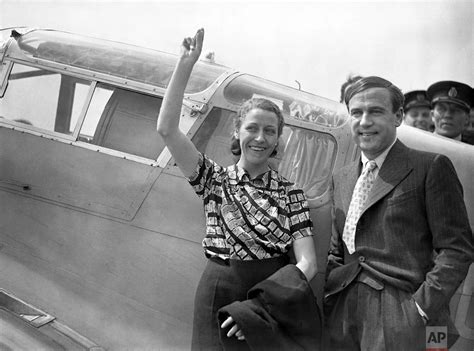
Wartime stories also emerged. On 11 July 1936, Major Hugh Pollard and Cecil Bebb departed from Croydon in a de Havilland Dragon Rapide to transport Francisco Franco to Spanish Morocco, inadvertently igniting the Spanish Civil War.
World War II: RAF Croydon Joins the Battle
When war returned in September 1939, Croydon was rebranded as RAF Croydon, becoming a vital fighter base during the Battle of Britain. Squadrons such as No. 92 (Spitfires) defended London’s skies. Numerous RAF, RCAF, and Polish squadrons rotated through the base, including No. 302 and No. 317 Polish Fighter Squadrons.
On 15 August 1940, the airport suffered a Luftwaffe bombing raid intended for RAF Kenley. The raid devastated buildings and adjacent factories, killed 62 civilians, and injured 192 more. Yet, the defenders downed eight enemy aircraft, showcasing the site’s strategic importance.
Post-War Reality: A Giant Caught in a Box
Despite returning to civilian operations in February 1946, the airport struggled against new post-war realities. Larger aircraft demanded longer runways and greater infrastructure — something Croydon’s limited footprint could not support. With urban sprawl enclosing the site, expansion was impossible.
While still active in 1946, with 218 weekly departures, this dropped dramatically to 56 flights by 1947. The newly opened Heathrow Airport quickly took over as London’s principal hub. Plans for closure were finalized in 1952, and on 30 September 1959, the final scheduled passenger flight — operated by Morton Air Services’ de Havilland Heron — departed at 18:15, followed by a private flight. By 22:20, the airport was officially closed.
A Legacy in Concrete and Memory
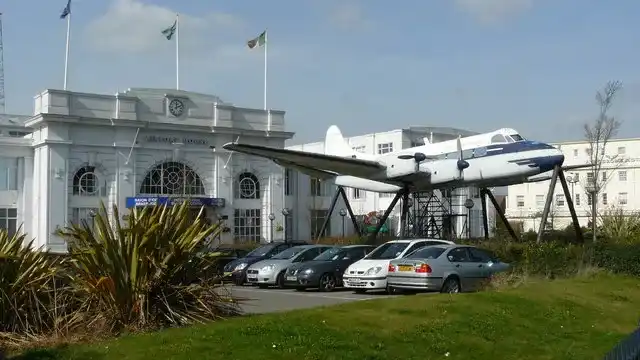
Today, traces of Croydon Airport still echo through Purley Way. The original terminal — now called Airport House — and its control tower remain standing. A de Havilland Heron (painted as G-AOXL) sits mounted at the entrance, commemorating the final flight.
A Battle of Britain memorial and surviving tarmac runway fragments in Roundshaw Park are tangible reminders of the airport’s rich past. The park and surrounding Roundshaw Estate, with streets named after aircraft and aviators, continue to reflect this heritage. A local school, renamed The Aerodrome School in 2010, further anchors this identity in community memory.
Architecture and Preservation
The Aerodrome Hotel and booking hall stand as elegant monuments to neo-classical interwar design. The once-prominent Time Zone Tower — lost to time — was a nod to the airport’s global connections. In 1978, both the terminal building and Gate Lodge received Grade II listing, and in 2017, the terminal was upgraded to Grade II. Unfortunately, the Gate Lodge is now listed as Heritage at Risk*.
Events, Aviation Celebrities, and Milestones
Croydon played host to global icons and milestones:
- Winston Churchill took flying lessons in 1919, surviving a crash.
- Alan Cobham flew roundtrip to Cape Town in 1925.
- Mary, Lady Heath completed the first small open-cockpit flight from Cape Town to London in 1928.
- Tom Campbell Black and C.W.A. Scott won the 1934 MacRobertson Air Race from London to Melbourne.
The airport also featured in popular culture, including Agatha Christie’s Death in the Clouds and Freeman Wills Crofts’ The 12.30 from Croydon.
Incidents That Shaped Aviation Safety
Croydon’s legacy includes pivotal aviation accidents that led to lasting changes. The 1924 Imperial Airways crash prompted parliamentary legislation to improve aviation safety. Other notable incidents include:
- 1936 KLM DC-2 crash: killed 15 out of 17 passengers, including Juan de la Cierva.
- 1947 Spencer Airways crash: 12 fatalities after a failed takeoff.
- 1935 Gold Bullion Heist: £21,000 worth of gold stolen in what became one of Britain’s most notorious airport robberies.
The Enduring Spirit of Croydon Airport
Croydon Airport remains a landmark of British innovation and global aviation history. Though its runways no longer echo with engines, its contributions endure through every controlled airspace, every airport terminal, and every Mayday call.
As we walk its preserved halls, or observe the lone Heron plane standing sentinel, we are reminded not only of what Croydon Airport once was — but what it made possible for the world.