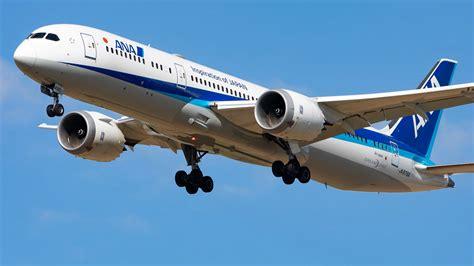
All Nippon Airways experienced one of the most extraordinary “returns to origin” in recent long-haul operations when flight NH223 from Tokyo Haneda (HND) to Frankfurt (FRA) spent more than 14 hours in the air—only to land back where it started. The February 17, 2026 service, operated by a 10-year-old Boeing 787-9 registered JA875A, departed Tokyo with 151 passengers and 13 crew members on what should have been a routine intercontinental crossing. Instead, it became a striking example of operational caution over remote polar airspace.
The aircraft pushed back just 15 minutes behind schedule at 10:55AM local time and climbed out smoothly, heading not west toward Europe, but east. Because ANA avoids Russian airspace, its Frankfurt service follows a polar routing across the Pacific, over Alaska, across the Arctic Ocean, and onward via Greenland before descending into continental Europe. The eastbound trajectory is longer geographically, yet strategically essential in the current geopolitical climate.
For more than six hours, the flight progressed as expected. The Dreamliner crossed Alaska and tracked northward over the Beaufort Sea, a remote extension of the Arctic Ocean. Then, at roughly the halfway mark of the journey, the crew made a pivotal decision: turn back.
Mechanical Concern Prompts Mid-Polar Reversal
The catalyst for the diversion was a low oil level indication in one of the aircraft’s engines. While modern turbofan engines are engineered with multiple redundancies and monitoring systems, oil plays a fundamental role in lubrication and cooling. A low oil reading does not automatically signal imminent failure, but it raises a technical question no long-haul captain ignores—particularly over isolated terrain.
At the moment of the decision, Frankfurt was technically closer in flight time than Tokyo. Yet aviation decision-making is never about simple geography. The aircraft was approaching one of the most remote regions on Earth, where suitable diversion airports are sparse and logistical support is limited. While the 787-9 is ETOPS-certified—meaning it is approved to operate long distances from alternate airports—ETOPS is a framework for safety, not a license for complacency.
Continuing deeper into the Arctic with a known mechanical abnormality would have narrowed future options. Turning back early preserved flexibility.
The Complex Calculus of Arctic Operations
Polar flights operate within carefully calculated performance envelopes. Winds, fuel burn, and alternate airport availability all factor into real-time command decisions. Once the aircraft reversed course, it encountered stronger headwinds in the westbound direction, extending the return segment to roughly eight hours. Ultimately, the Dreamliner touched down back at Haneda at 12:59AM on February 18—14 hours and 4 minutes after departure.
Ironically, that duration exceeds the typical gate-to-gate time from Tokyo to Frankfurt. Passengers endured a full long-haul experience without ever leaving Japan.
This outcome underscores a lesser-known reality of ultra-long-haul aviation: sometimes the safest destination is home base. While diversion to Alaska was technically possible, handling 151 passengers in a remote environment would have introduced operational and passenger-care complexities. Returning to Tokyo ensured immediate access to ANA’s maintenance infrastructure, spare parts inventory, and rebooking capacity.
Why Returning to Base Often Makes Strategic Sense
Airlines frequently prioritize returning aircraft to their primary maintenance hubs when circumstances allow. The reasoning is practical and strategic. Maintenance teams familiar with the specific fleet can inspect and troubleshoot more efficiently. Replacement aircraft are readily available. Passenger reaccommodation can be coordinated through established ground operations.
In contrast, an unscheduled diversion to a remote outstation may involve limited technical support, potential overnight delays, and complex regulatory considerations.
The crew’s actions indicate that the oil level issue did not escalate into an emergency requiring immediate landing. If it had, Anchorage or other Alaskan airports would have been viable. The measured decision to turn back suggests caution rather than crisis.
Passenger Impact and Operational Resilience
For travelers onboard NH223, the experience was undoubtedly frustrating. Fourteen hours confined to a long-haul cabin only to disembark at the origin is a rare scenario even in global aviation. Yet from a safety standpoint, the outcome reflects procedural discipline.
Modern aircraft generate continuous engine health data. Pilots receive detailed performance indications long before issues become critical. A low oil level warning triggers systematic checklists and consultation with airline operations control. The final decision reflects collaboration between cockpit and ground engineering teams.
The Boeing 787-9 remains one of the most reliable widebody aircraft in service, widely praised for its fuel efficiency, composite airframe design, and advanced systems monitoring. Incidents like this highlight not failure, but the system’s built-in conservatism. Aviation culture rewards prudence.
A Journey to Nowhere—But Not Without Purpose
The ANA 787’s Arctic U-turn is remarkable not because of drama, but because of restraint. Faced with a non-emergency mechanical concern over some of the planet’s most isolated airspace, the crew chose operational certainty over schedule integrity.
In an era where long-haul flights routinely span continents and oceans, such decisions reinforce the fundamental hierarchy of commercial aviation: safety first, schedule second. The passengers of NH223 may have logged a 14-hour round-trip without reaching Frankfurt, but they experienced the invisible layers of redundancy and caution that define modern air travel.
The result was a flight that went nowhere geographically—yet demonstrated exactly how global aviation keeps millions moving safely every day.