
For years, Arnold Palmer Regional Airport in Latrobe, Pennsylvania quietly served as an unlikely success story in the ultra-low-cost airline world. Tucked roughly 40 miles southeast of Pittsburgh, the small airport relied almost entirely on Spirit Airlines to connect western Pennsylvania travelers with vacation destinations across Florida and beyond. That long-standing partnership kept the airport alive in the commercial aviation ecosystem for more than a decade.
Now, following Spirit Airlines’ collapse and shutdown in May 2026, Arnold Palmer Regional Airport has entered a category no American airport wants to join: it has exactly zero scheduled commercial passenger flights.
Unlike airports that lose one airline but retain regional connections or legacy carrier service, Latrobe’s situation is absolute. There are no daily departures, no ticket counters processing passengers for commercial airlines, and no scheduled aircraft listed on booking platforms. For ordinary travelers searching flights from LBE, the airport has effectively vanished from the national route map.
That reality makes Arnold Palmer Regional Airport the only airport in Spirit Airlines’ former 75-airport network to lose all scheduled passenger service after the airline’s demise.
The airport still supports general aviation operations, including private aircraft and charter activity, but commercial aviation — the lifeblood that connects small communities to the broader transportation network — has disappeared entirely.
Spirit Airlines Was The Airport’s Lifeline For Fifteen Years
Spirit Airlines first launched operations at Arnold Palmer Regional Airport in 2011, beginning a relationship that would ultimately define the airport’s modern identity. Over the next 15 years, the airline transformed the small Pennsylvania facility into a gateway for budget-conscious leisure travelers seeking affordable nonstop flights to warm-weather destinations.
What made the partnership unusual was Spirit’s willingness to maintain service at a relatively small airport despite the presence of nearby Pittsburgh International Airport. Pittsburgh offered far larger passenger volumes, stronger business demand, and broader airline competition. Yet Spirit found value in Latrobe’s lower operating costs and simplified airport experience.
Travelers from western Pennsylvania embraced the model. Many passengers preferred avoiding Pittsburgh’s larger terminals, parking costs, and congestion. Latrobe offered convenience, shorter security lines, and direct access to vacation routes that mattered most to local travelers.
Throughout its history at LBE, Spirit operated flights to several destinations, including:
- Orlando
- Fort Lauderdale
- Myrtle Beach
- Fort Myers
- Tampa
- Las Vegas
- Chicago O’Hare
- Dallas/Fort Worth
Orlando became the airport’s most enduring route, operating continuously from 2012 until Spirit’s final shutdown in 2026. Myrtle Beach also survived until the airline’s last days, reinforcing how deeply the airport depended on leisure-focused traffic rather than business travel.
The now-defunct Las Vegas route, launched briefly in 2015, represented Spirit’s longest nonstop service from Latrobe and highlighted the airline’s willingness during its expansion years to experiment aggressively with secondary markets.
Why No Other Airline Replaced Spirit At Latrobe
Small airports regularly lose airlines, but complete commercial abandonment is exceptionally rare in the United States. Most communities retain at least a regional feeder connection to a major hub. Latrobe did not.
The reason comes down to economics.
Arnold Palmer Regional Airport lacked the diversified airline presence that protects many regional airports during industry disruptions. Spirit was not merely a participant at LBE — it was essentially the entire commercial aviation market.
Legacy carriers never established meaningful service there because Pittsburgh International Airport already fulfilled the region’s hub connectivity needs. Low-cost competitors also stayed away, likely unwilling to split demand between two airports located within driving distance of each other.
Once Spirit collapsed, there was no backup carrier positioned to absorb the abandoned routes.
That left Latrobe uniquely exposed. Among all 75 airports Spirit served during its final operating period in 2026, every other airport retained at least one commercial airline afterward. Only Arnold Palmer Regional Airport became completely disconnected from scheduled passenger aviation.
The airport’s geographic location further complicates recovery efforts. Pittsburgh International Airport sits close enough to absorb regional demand efficiently, making it difficult for airlines to justify launching separate service from Latrobe unless heavily subsidized or strategically targeted toward niche leisure markets.
Spirit Airlines Once Moved Millions Of Passengers Through LBE
Despite its small size, Arnold Palmer Regional Airport handled surprisingly significant traffic during Spirit Airlines’ peak years.
Across its entire operation at Latrobe, Spirit carried more than 3.26 million round-trip passengers through the airport. For a facility primarily associated with general aviation and regional traffic, those numbers were remarkable.
Passenger activity surged particularly during the mid-2010s, when Spirit’s ultra-low-cost model gained traction nationwide. The airport’s strongest year came in 2015, when Spirit transported 357,277 passengers through Latrobe.
Load factors during that era demonstrated consistently healthy demand. In multiple years, Spirit achieved occupancy rates exceeding 80%, including:
- 85.07% in 2013
- 86.45% in 2014
- 83.94% in 2019
Those figures proved an important point within the airline industry: low-cost carriers could successfully stimulate demand even at smaller secondary airports if routes targeted leisure travelers effectively.
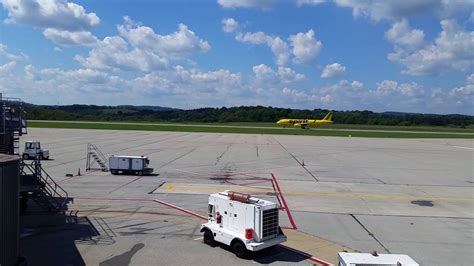
Florida destinations played a central role in that success. Travelers from western Pennsylvania responded strongly to inexpensive nonstop access to Orlando, Fort Lauderdale, Tampa, and Fort Myers, especially during winter months.
But the airport’s fortunes began changing after the pandemic period.
Passenger numbers weakened, load factors deteriorated, and Spirit’s network strategy shifted under mounting financial pressure. By 2025, annual traffic at Latrobe had dropped to just 119,221 passengers, while load factors slipped below 70%.
That decline reflected broader problems within Spirit Airlines itself. Rising operational costs, changing traveler behavior, intense competition, and financial instability gradually eroded the airline’s once-aggressive expansion model.
When Spirit ultimately ceased operations, Latrobe’s dependence on a single airline became impossible to ignore.
The Collapse Revealed How Fragile Secondary Airports Can Be
Arnold Palmer Regional Airport’s sudden disappearance from commercial aviation illustrates a larger issue facing secondary airports across the United States.
Many small airports survive only because one carrier sees temporary strategic value in operating there. Unlike major hubs with diversified airline ecosystems, regional facilities often depend heavily on a single operator or route category. When that airline leaves, the airport can unravel almost overnight.
Latrobe became an extreme example of that vulnerability.
While airports such as Atlantic City, Myrtle Beach, and Fort Lauderdale also maintained strong ties to Spirit Airlines, those cities retained enough alternative service to survive the carrier’s collapse. Atlantic City lost a dominant airline presence, but not its entire commercial existence. Fort Lauderdale continued functioning as a major aviation hub. Myrtle Beach retained substantial traffic from competing carriers.
Latrobe had no such safety net.
Its situation now raises difficult questions about the long-term future of small regional airports in an increasingly consolidated airline industry. Major airlines continue prioritizing high-demand hubs, while low-cost carriers increasingly focus on markets capable of delivering stronger margins and higher passenger density.
That leaves airports like LBE trapped in a dangerous middle ground: too small for large-scale airline investment, yet too close to major airports to justify independent expansion.
Arnold Palmer Regional Airport Still Holds Historical Importance
Even without scheduled flights, Arnold Palmer Regional Airport retains deep symbolic significance in western Pennsylvania.
Named after legendary golfer Arnold Palmer, who was born nearby in Latrobe, the airport has long served as a recognizable regional landmark. Palmer himself maintained close ties to the airport throughout his life, and the facility became part of the broader identity of the community.
Today, private aviation activity still continues there. General aviation pilots, corporate aircraft, and charter operations continue using the airfield, ensuring the airport itself remains operational despite the disappearance of airline service.

Yet the absence of commercial flights changes the airport’s role dramatically. What was once a functioning passenger gateway has become a reminder of how quickly aviation networks can shift when an airline collapses.
For local residents, the closure means longer drives to Pittsburgh International Airport for every commercial journey. For the aviation industry, it serves as a stark example of how dependent some regional airports have become on fragile low-cost carrier business models.
Unless another airline eventually steps forward, Arnold Palmer Regional Airport may remain America’s only commercial airport with scheduled passenger service reduced completely to zero.