India’s military has suffered a significant setback in the wake of intensified cross-border hostilities with Pakistan, as visual evidence confirms the apparent loss of at least two Indian Air Force (IAF) fighter jets. The incident marks one of the gravest aerial losses for India in recent memory and could have far-reaching geopolitical ramifications.
Visual Analysis Confirms Jet Crashes Amid Pakistan Strikes
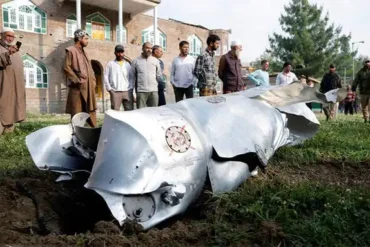
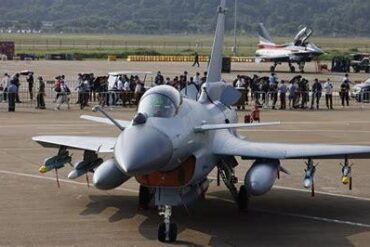
A meticulous analysis of imagery and videos posted online, corroborated by defense analysts and former military personnel, indicates that two Indian fighter jets — a Rafale and a Mirage 2000, both manufactured by Dassault Aviation of France — were either shot down or crashed following Indian airstrikes on sites in Pakistan and Pakistani-administered Kashmir.
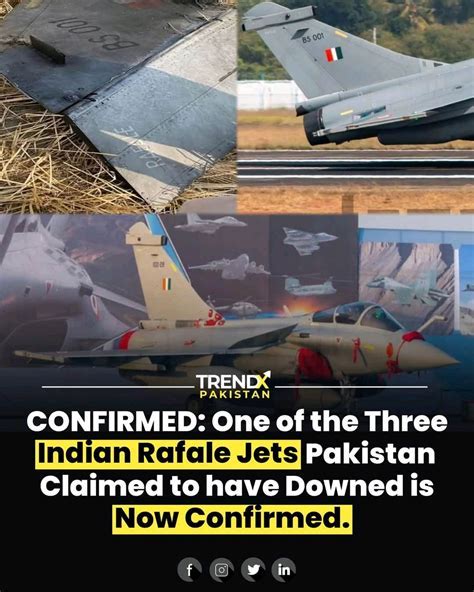
The debris analysis was spearheaded by experts including Trevor Ball, a former explosive ordnance disposal technician for the U.S. Army, Etienne Marcuz of the Foundation for Strategic Research, and an unnamed French airpower specialist. Their evaluation of a dozen high-resolution images and geolocated video clips provided compelling evidence of aircraft wreckage consistent with Indian Air Force models.
A close-up of one image unmistakably shows the word “Rafale” stenciled in white on the vertical stabilizer, alongside the designation “BS 001” and an Indian flag, identical to markings found in archival imagery of Indian Air Force Rafales. The same wreckage was allegedly found near Akalia Khurd, a village in the Indian state of Punjab, roughly 45 miles from the Pakistan border.
Ground Evidence: Craters, Fuel Tanks, and Missiles
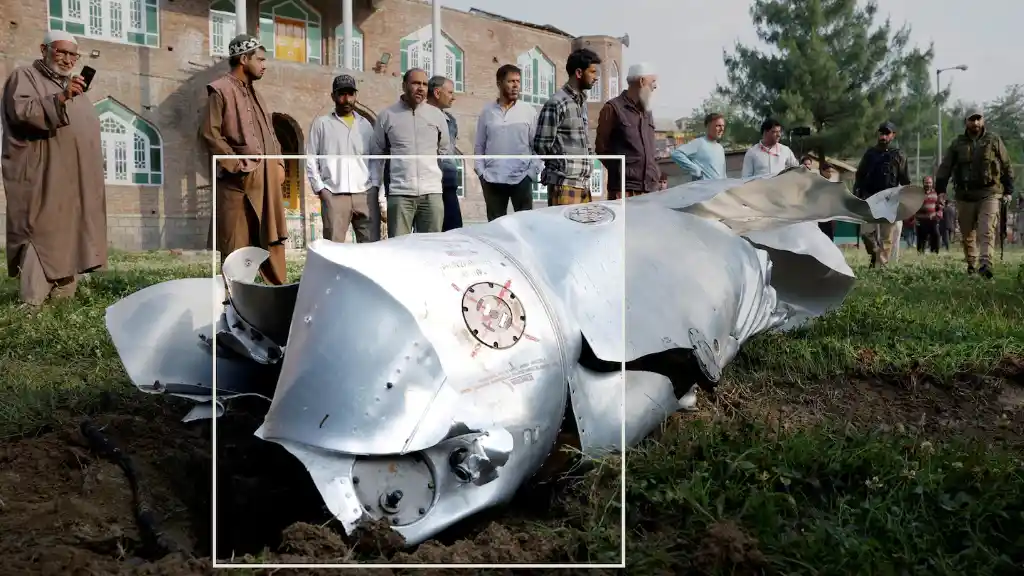
Additional images posted from Wuyan, a village in Indian-administered Kashmir, revealed a jettisoned fuel tank matching those used by Mirage 2000 jets. Although the detachment of such fuel tanks can occur during combat maneuvers or due to mechanical issues, the context strongly points to an in-battle event.
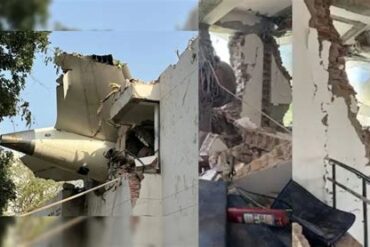
Eyewitness reports from Wuyan detail a horrifying moment when a jet appeared to crash into a primary school, with videos showing flaming debris and part of a jet engine inside the wreckage. Analysts confirmed the jet engine part to be consistent with the Mirage 2000’s design, reinforcing the belief that a second aircraft went down.
Adding to the growing list of evidence, a separate video from near Akalia Khurd shows an unexploded French-made MICA missile, still attached to its aircraft launch rail. According to Trevor Ball, the missile’s presence on the ground, combined with surrounding fire damage, suggests the jet carrying it suffered catastrophic failure, most likely during combat.
A Third Likely Crash Site in Akhnoor
Another suspected crash site has been identified in Akhnoor, also in Indian-administered Kashmir. While videos and on-the-ground news reports confirm the presence of aircraft wreckage, analysts could not definitively identify the aircraft type. Nevertheless, the existence of multiple confirmed or suspected crash sites illustrates the intensity of the confrontation.
India Maintains Silence Amid Escalating Tensions
India’s government has so far refrained from confirming or denying the reports of aircraft losses. Neither the Ministry of External Affairs nor the Indian Air Force responded to media queries, maintaining a calculated silence that has become standard procedure in high-stakes conflict scenarios.
Experts suggest this reluctance is part of India’s broader crisis communication strategy. Arzan Tarapore, a Stanford University scholar specializing in Indian military doctrine, notes, “India during a crisis is typically very guarded about operational details. Admitting to severe losses can limit strategic maneuverability.”
Pakistan’s Tactical Advantage and Claims of Victory
Pakistan’s government, in stark contrast, has been vocal in its claims. Prime Minister Shehbaz Sharif asserted that Pakistani fighter jets only engaged after Indian planes had delivered their payloads inside Pakistan’s territory. Islamabad claims it shot down five Indian jets, although current visual evidence supports the loss of at least two.
The disparity in official responses is shaping international narratives. Pakistan is positioning itself as a restrained but capable military actor, while India’s silence is enabling its neighbor to score diplomatic points. According to Sushant Singh, a Yale University lecturer and former Indian military officer, “The lack of response from New Delhi is creating space for Pakistan to claim a win, which could provide a diplomatic off-ramp.”
The Rafale’s Strategic Significance
The Dassault Rafale represents a crown jewel in India’s military modernization efforts. First delivered in 2019, the multi-role fighter jet was acquired under a $9 billion deal aimed at boosting India’s air superiority, especially in light of growing tensions with both Pakistan and China. Losing such an asset is more than a tactical loss — it is a strategic and symbolic blow.
“Losing a Rafale in combat this early in its service history with the Indian Air Force is a deeply troubling development,” said one anonymous French airpower expert involved in the analysis. “This will almost certainly prompt internal evaluations of both strategy and readiness.”
Collateral Damage and Civilian Casualties
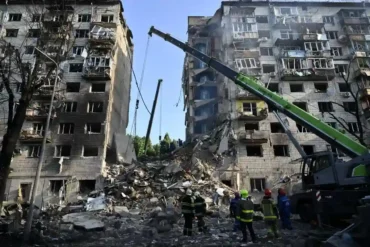
The civilian cost of these strikes cannot be ignored. In Akalia Khurd, a local farmer was reportedly killed by a secondary explosion while approaching the crash site. In Wuyan, where a plane crashed into a school, the psychological trauma inflicted on the children and families is incalculable, even though no fatalities were reported from that specific incident.
The broader fallout from these crashes — both material and human — adds to the urgency of de-escalation. The danger of a localized skirmish spiraling into a full-blown war between two nuclear-armed nations cannot be overstated.
Deeper Than Balakot: Historical Context of the Airstrikes
These airstrikes represent the deepest Indian penetration into Pakistani territory in over fifty years, surpassing the scale of the 2019 Balakot airstrikes. Those attacks were also in response to a suicide bombing, and led to the downing of an Indian MiG-21 and the capture of pilot Abhinandan Varthaman — who was later released in a symbolic gesture by Pakistan.
This time, the context is even more volatile. The Indian air raids followed a militant attack on tourists in Indian-administered Kashmir, an incident which has drawn strong domestic pressure on the Indian government to retaliate decisively. The resulting strikes, combined with drone activity and artillery skirmishes along the Line of Control (LoC), have pushed both nations closer to the edge.
Strategic Implications and The Road Ahead
This aerial confrontation — marked by the loss of modern fighter jets, ambiguity over pilot fates, and symbolic losses of prestige — signals a new phase in Indo-Pakistani hostilities. The involvement of top-tier aircraft like the Rafale escalates the stakes substantially.
According to Sameer Lalwani of the Center for Strategic and Budgetary Assessments, the aircraft carry “a lot of political weight,” especially when both nations are navigating the treacherous line between punitive strikes and all-out war. The deliberate ambiguity maintained by New Delhi is part of a balancing act to avoid crossing the threshold into full-scale conventional warfare.
Yet, as visuals and verified data accumulate online, the truth is becoming harder to manage through silence alone. India’s leadership may soon face pressure to address the losses publicly, both to reassure its domestic constituency and to control the narrative internationally.
Until then, the skies over Kashmir remain as tense and unpredictable as ever — with each piece of falling debris telling a story of escalating confrontation and unresolved rivalries that could yet ignite a broader conflict.