In the early hours of Tuesday morning, Kyiv was rocked by a massive wave of Russian drone and missile strikes, the deadliest on the Ukrainian capital in nearly a year. According to Ukrainian authorities, at least 10 civilians were killed, including a 62-year-old American citizen, and more than 100 were injured in a sprawling assault that left neighborhoods smoldering and entire families shattered. The Ukrainian Air Force reported the attack involved 440 drones and decoys and 32 missiles, targeting not only Kyiv but multiple cities across the southern and western regions.
The scale and coordination of the offensive marked a new escalation in the ongoing war, coinciding with the G7 summit in Canada, where world leaders were expected to discuss global security and support for Ukraine. President Volodymyr Zelensky, addressing the summit, condemned the strike and denounced what he called the international community’s tepid response.
“Putin is doing this solely because he can afford to keep waging war. He wants the war to go on,” Zelensky said, making clear his frustration at the lack of unified action. His appeal for greater support and intensified sanctions came as former U.S. President Donald Trump appeared to defend Russia’s past actions, criticizing the 2014 expulsion of Russia from the G7 after its annexation of Crimea.
Devastation in the Capital: The Reality on the Ground
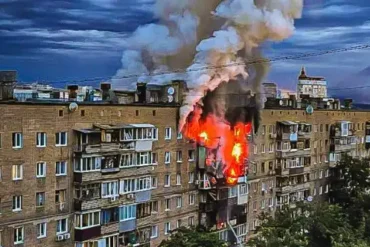
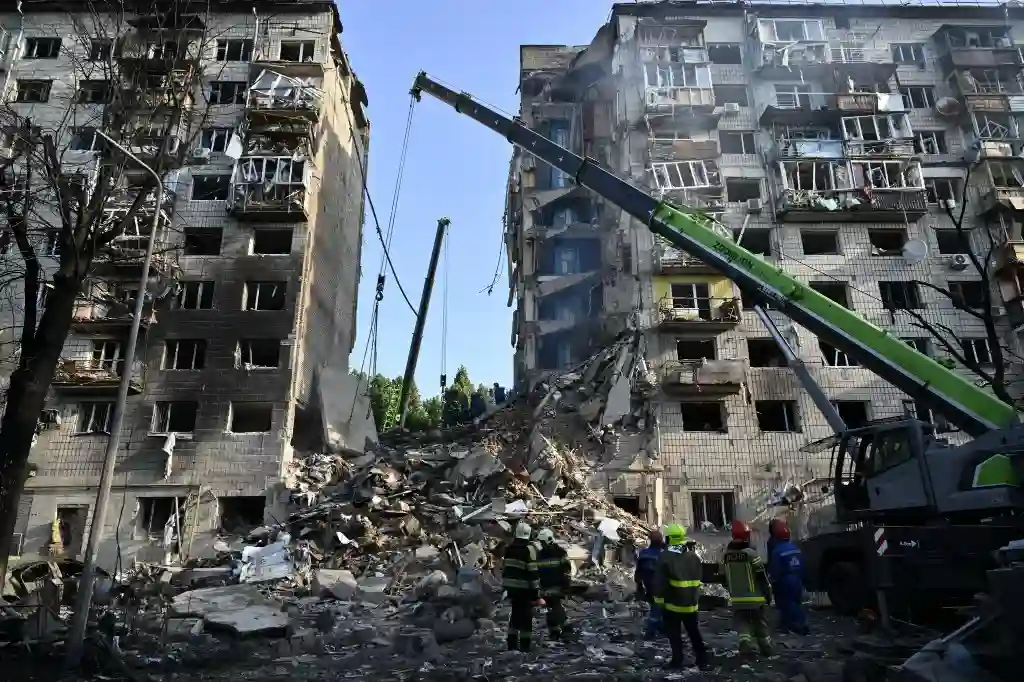
As Kyiv residents endured nearly 10 hours of air-raid sirens, the sounds of buzzing drones, heavy machine-gun fire, and missile intercepts became a chilling routine. When morning broke, plumes of black smoke hovered over the city, and the bitter scent of burning wreckage filled the air. One of the most severely impacted areas was a nine-story residential building outside the city center, which was obliterated by a missile, leaving behind a gaping hole and a trail of ruined lives.
Rescue operations stretched through the morning as emergency crews sifted through rubble, using cranes to lift debris and search for survivors. Among the devastated was Evgeniy Povarenkov, who was jolted awake at 3:45 a.m. by the explosion that knocked him unconscious. He later found his mother wounded and dragged her to safety. “They are killing us, killing the Ukrainian nation. And now the United States has refused to help,” he said, his face streaked with blood and disbelief.
Nearby, Mykola Leschenko was picking through the remains of his apartment. The blast had blown off his door and wrecked his belongings. He had just emerged from a bomb shelter, thinking the attack was over, only to return moments later to the sound of destruction. His mother-in-law, Tetiana Berestova, standing with a cigarette and bitterness in her voice, referred to the Kremlin’s ideology, saying, “This is the Russian world.”
Strategy of Exhaustion: Russia’s Increasingly Relentless Assaults
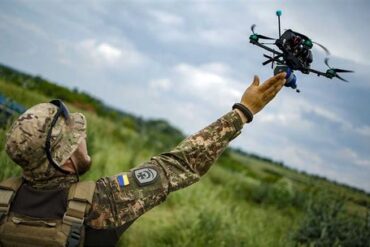
The Russian military’s strategy has evolved into waves of mass nighttime drone attacks, designed to overwhelm Ukraine’s air defenses before unleashing high-speed missile barrages that are harder to intercept. Tuesday’s attack fits into a pattern seen throughout June: coordinated, large-scale assaults with hundreds of unmanned aerial vehicles followed by deadly precision strikes.
According to the United Nations, this is the fourth time in June alone that Russia has launched more than 400 aerial weapons in a single night. In contrast, during the entire month of June 2024, Russia launched only 550 aerial weapons. These staggering numbers are stretching Ukraine’s defense systems to their limits and forcing civilians into makeshift shelters for several nights each week.
Moscow claims its attacks are aimed solely at military targets, but repeated strikes in densely populated urban areas and a lack of reported military casualties strongly suggest otherwise. The UN also reported that civilian casualties in Ukraine have risen by nearly 50% in 2025 compared to the same period in 2024, indicating a worrying trend of increasing indiscriminate violence.
Human Cost: The Lives Behind the Numbers
The sheer number of casualties cannot convey the deep personal losses experienced across Kyiv. The soundscape of sirens and explosions now defines life for many residents, some of whom have lost everything overnight. The psychological toll is mounting as well.
Standing at the edge of the destroyed building, Tetiana Pokholovich, 63, described another sleepless night. Her apartment remained mostly intact, but her spirit was battered. “We want peace,” she said through tears, her words carrying the exhaustion of a nation caught in a cycle of trauma.
In another corner of the same building, rescue workers carefully extracted an injured woman from the rubble. Shards of glass blanketed the ground. Items from everyday life—cooking utensils, children’s toys, family photographs—lay broken and buried in the debris. They told a silent story of what was lost in an instant.
International Response and G7 Tensions
As President Zelensky seeks to rally global powers for a more assertive stance against Moscow, cracks in the Western alliance have become more visible. His confrontation with U.S. leadership—highlighted by Donald Trump’s renewed embrace of Vladimir Putin—suggests a weakening of the political will that once unified allies in supporting Ukraine’s defense.
Zelensky’s remarks at the summit reflected a growing impatience: “It’s a disgrace when the powerful of this world turn a blind eye to it.” His warning wasn’t just for rhetorical effect—it underscored the urgency for fresh sanctions, air defense systems, and humanitarian assistance.
A Battlefield Beyond the Front Lines
While attention often centers on the eastern front, where Russian troops continue to press forward, Tuesday’s attack reminds the world that Kyiv and other cities remain under grave threat. The Black Bird Group reported that Russia captured more than 200 square miles of Ukrainian territory in May 2025, more than double its April gains, illustrating a renewed momentum on the ground that directly contradicts any talk of de-escalation.
Russian forces are currently making advances near Sumy, Kostiantynivka, and Pokrovsk, demonstrating that Putin’s war machine remains very much active. Negotiations between the two nations have produced little beyond prisoner exchanges, and Russia’s battlefield gains suggest that Moscow is more committed to conquest than compromise.
Conclusion: A City Battered, a Nation Resilient
As Kyiv begins to bury its dead and rebuild once more, Ukraine’s resilience remains undiminished. The night of June 17-18 was one of the darkest in recent memory for the capital, a horrific reminder that no place is truly safe while Russia continues its barrage of destruction. Yet amid the ash and dust, there are moments of courage, dignity, and shared grief that bind the people together.
Every shattered window and scorched wall tells the story of a war that has gone on too long—and of a nation that refuses to give in. With air defenses stretched thin and diplomacy faltering, the people of Kyiv live on the edge of survival, even as they hope that the world will finally hear their cries.