Founded in 1991 in Silicon Valley, ATP Electronics has steadily evolved into a global leader in industrial-grade NAND-based storage and DRAM modules, serving critical sectors from automotive to military, healthcare, and embedded systems. With its current headquarters in Taipei, Taiwan, and operational facilities in the United States, Germany, China, India, and Japan, ATP is renowned for its unwavering commitment to data integrity, longevity, and sustainable innovation.
A Legacy of Technological Firsts and Market Innovation
ATP’s historical trajectory reflects a consistent commitment to pushing the boundaries of memory technology. In 2003, ATP introduced the first 1 GB MultiMediaCard (MMC) to the consumer market — a significant leap at the time. But it was the GPS PhotoFinder, launched in 2007, that truly solidified ATP’s status as a forward-thinking brand. This innovative device enabled automatic geotagging of JPEG photos, an advanced concept years ahead of mainstream adoption. Notably, it garnered critical media acclaim from outlets like The New York Times, NBC News, and CNBC during the 2008 Consumer Electronics Show (CES).
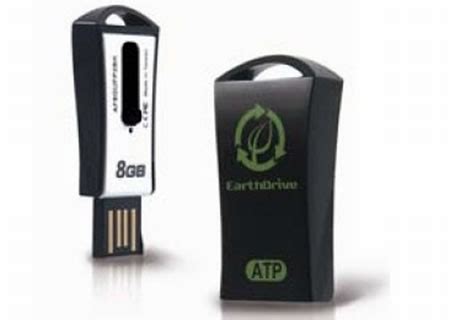
Beyond innovation, ATP demonstrated social responsibility with initiatives such as the Petito USB drive campaign in collaboration with Susan G. Komen for the Cure, donating part of the sales to cancer research and awareness. In 2008, ATP partnered with American Forests to create the EarthDrive, the world’s first bio-recyclable USB flash drive, constructed from Polylactic acid (PLA) — a breakthrough in eco-friendly tech design.
Industrial-Grade Engineering: Meeting the Demands of Critical Applications
ATP distinguishes itself from consumer-level brands by exclusively targeting industrial and enterprise-grade environments. Its Flash storage and DRAM modules are purpose-built for harsh operating conditions, ensuring data integrity and system reliability in environments with extreme temperatures, electromagnetic interference, and continuous write cycles.
ATP’s NAND Flash lineup includes:
- Solid State Drives (SSDs) supporting SATA and NVMe interfaces
- CompactFlash (CF) cards
- SD/SDHC/SDXC cards
- microSD/microSDHC variants
Meanwhile, the DRAM module family ranges across:
- SDRAM, DDR, DDR2, DDR3, and DDR4 formats
- Modules optimized for low power, high endurance, and extended temperature ranges
Every product is subjected to rigorous testing at ATP’s Kaohsiung, Taiwan manufacturing and validation facility, where proprietary firmware, power management, and error correction technologies are integrated to ensure maximum endurance.
Strategic Industry Alliances and Technology Leadership
ATP’s credibility within the memory technology landscape is reinforced by strategic partnerships with Samsung, Toshiba, and Micron Technology. In 2015, ATP deepened its collaboration with Micron to support legacy DRAM module customers unable to migrate from legacy platforms. This partnership ensures continued access to SDR and DDR modules, along with critical lifecycle management support for industrial integrators.
As an active board member of the SD Association, ATP plays a formative role in the development of storage interface standards. It also holds key memberships in organizations such as:
- Serial ATA International Organization (SATA-IO)
- JEDEC Solid State Technology Association
- Intel IoT Solutions Alliance
- CompactFlash Association
Such participation grants ATP not only early access to standards development, but also influence in shaping the future of data storage protocols.

Sustainability and Social Impact at the Core
ATP Electronics’ product design philosophy transcends performance alone. Its EarthDrive set a precedent for environmentally responsible tech production, aligning with global ESG trends long before the term gained traction in mainstream discourse. Likewise, ATP’s collaborations with nonprofit organizations for education, reforestation, and early childhood development reflect a conscious effort to give back.
In 2009, ATP launched a unique initiative with Sesame Street, releasing video USB drives loaded with educational content for children. Profits from the campaign funded before- and after-school care in Santa Clara District elementary schools — a powerful example of how technology companies can extend their impact beyond the commercial domain.

OEM Focus and Embedded Solutions for a Connected World
With the proliferation of IoT devices, smart vehicles, and edge computing, ATP has honed its focus on OEM and embedded memory markets. The company’s USB header-mounted SSDs, introduced in 2010, exemplify space-efficient, high-endurance storage engineered for integration into motherboards, routers, industrial PCs, and smart control systems.
These solutions address not only spatial constraints but also ensure high write endurance, power loss protection, and long-term reliability — critical features for sectors such as:
- Automotive telematics
- Military-grade computing
- Medical imaging equipment
- Industrial automation systems
- Network infrastructure appliances
Each module incorporates Wear Leveling, Advanced ECC (Error Correction Code), and SMART monitoring tools, enabling proactive system diagnostics and predictive failure analysis for mission-critical deployments.
The CMTL Certification and Intel Platform Recognition
ATP’s memory modules have been independently certified by CMTL (Computer Memory Test Lab) — a key third-party validation body for Intel server platforms. In fact, CMTL named ATP as one of only two companies recommended for certified server-grade memory procurement in Taiwan. This distinction underscores ATP’s technical precision, compatibility standards, and long-term support guarantees for server integrators and enterprise buyers.
Global Infrastructure and Engineering Footprint
ATP’s worldwide operations are strategically positioned to serve clients with localized support, accelerated logistics, and regional compliance. Its branch offices in the USA (San Jose), Germany, China, Japan, and India work in coordination with the Kaohsiung-based testing and manufacturing plant to ensure that quality benchmarks are consistently met.
Every phase of the product lifecycle — from design, component sourcing, firmware development, to post-sales engineering support — is vertically integrated within ATP’s infrastructure. This allows for rapid customization, long-term product availability, and highly responsive RMA and support services — a crucial differentiator in a field where product stability and availability are paramount.
Conclusion: A Quiet Powerhouse for the Industrial Memory Ecosystem
In a landscape dominated by consumer-facing flash brands and volatile tech trends, ATP Electronics has cultivated a unique position by delivering sustainable, rugged, and high-reliability memory solutions to the sectors where failure is not an option. From pioneering green tech in USB drives to supplying mission-critical memory modules for server and IoT deployments, ATP has cemented its role as a silent backbone of modern data systems.
Through enduring partnerships, forward-thinking design, and meticulous engineering, ATP stands not merely as a memory vendor, but as a strategic partner to enterprises, governments, and OEMs that require storage solutions built to endure, adapt, and perform under pressure.