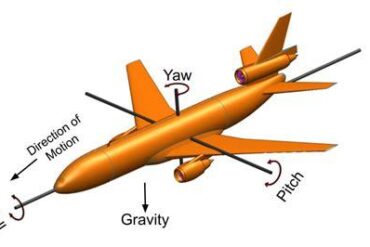
In aviation, the term ‘axis’ refers to an imaginary line around which a body rotates. An aircraft in flight moves in three dimensions, and pilots control this movement by manipulating the flight controls. This causes the aircraft to rotate about one or more of its three axes of rotation: longitudinal, lateral, and vertical. Each axis is perpendicular to the others and intersects at the aircraft’s center of gravity.
The rotations around these axes are known as roll, pitch, and yaw. Roll occurs around the longitudinal axis, pitch around the lateral axis, and yaw around the vertical axis. To control roll, pilots use the ailerons; for pitch, they use the elevator; and for yaw, the rudder.
It’s important to note that rotation around one axis can sometimes lead to uncommanded rotation around another axis. In such cases, pilots need to use the associated flight control surfaces simultaneously to maintain coordinated flight.