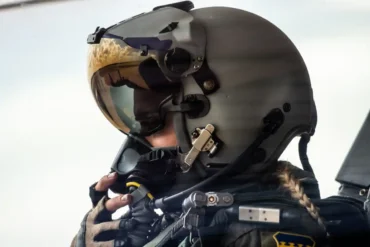
For decades, U.S. Navy aviators strapped into cockpits wearing variations of the HGU-55P and HGU-68P flight helmets. Built by Gentex Corp., these helmets became standard-issue guardians of naval aviation beginning in the 1980s and 1990s. They were reliable, rugged, and familiar. Yet familiarity can quietly mask stagnation. While aircraft evolved into sensor-fused, data-rich combat systems, the helmet remained largely unchanged — a protective shell in an era that increasingly demanded digital integration.
That era has now shifted.
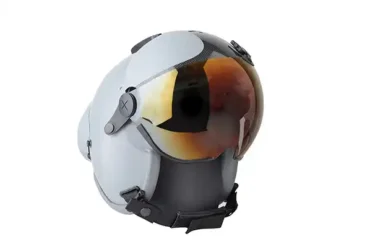
In January, the U.S. Navy signed a $22.6 million contract for more than 5,000 Next-Generation Fixed Wing Helmets (NGFWH) under an Indefinite Delivery/Indefinite Quantity agreement. Once again, Gentex will deliver the hardware, but this time the result is not merely an incremental update. It is the PURSUIT helmet system, a modular and digitally adaptable platform built to serve across the Navy’s entire fixed-wing fleet.
This is not simply a better helmet. It is a wearable combat system.
The PURSUIT NGFWH: A Digital Bridge Between Pilot and Aircraft
The NGFWH was selected by the Naval Aircrew Systems Program Office (PMA-202) after extensive collaboration between Gentex, the U.S. Navy, the U.S. Air Force, helmet-mounted display manufacturers, and international partners. That cooperation matters because modern cockpits are no longer mechanical dashboards; they are digital ecosystems.
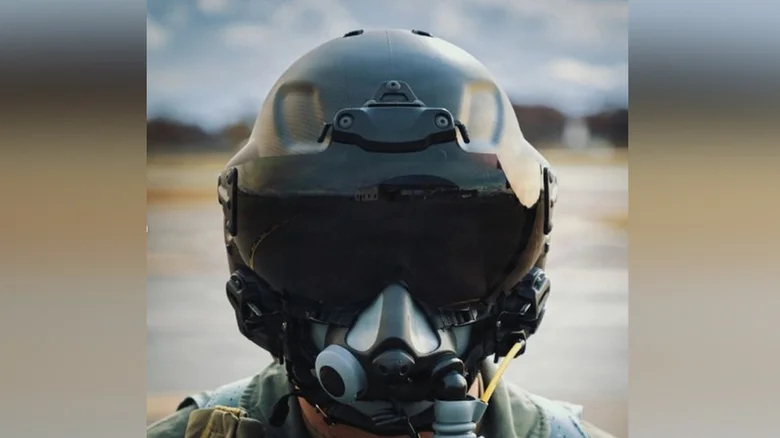
Unlike its predecessors, the PURSUIT helmet is designed as a modular architecture. Earlier helmets often required redesigns when display systems evolved. The NGFWH flips that equation. Instead of replacing the helmet to accommodate new technology, the system allows integration of modernized head-up displays, advanced night-vision systems, and upgraded communication modules without rebuilding the entire structure.
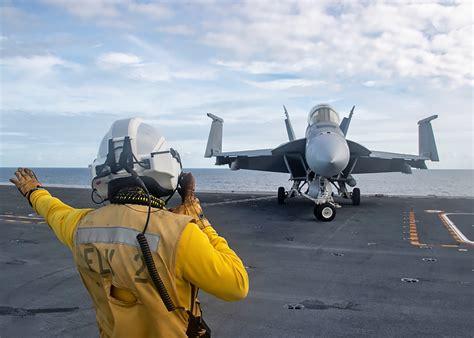
This approach reflects a strategic shift. Aircraft such as the F/A-18 Super Hornet, EA-18G Growler, E-2D Advanced Hawkeye, and the outgoing T-45 Goshawk operate in data-dense combat environments. Information is survival. A helmet that cannot evolve alongside avionics risks becoming the weakest link in a high-tech chain.
By making the helmet adaptable, the Navy ensures that pilots are not locked into outdated display or sensor configurations. The helmet becomes future-ready — a platform that grows with mission demands rather than aging out of relevance.
Engineering for Human Endurance, Not Just Impact Protection
Protection remains fundamental. A flight helmet must absorb impact, resist penetration, and secure life-saving oxygen masks and visors. But the PURSUIT system expands the definition of protection beyond crash survivability.
Naval aviators endure punishing physical forces. High-G maneuvers multiply head weight dramatically; a helmet that weighs a few pounds on the ground can feel exponentially heavier under acceleration. Over years of flying, that strain accumulates into chronic neck and back injuries — an issue documented and acknowledged across military aviation communities.
The NGFWH addresses this with a lighter carbon-fiber shell and an optimized center of gravity. These are not cosmetic refinements. Carbon fiber reduces overall mass while maintaining structural integrity. Optimizing the center of gravity minimizes forward or lateral imbalance, reducing torque on the cervical spine during high-G turns.
Captain Joseph Kamara, Naval Aircrew Systems program manager, emphasized that reducing long-term physical toll was a design priority. A helmet that saves a pilot’s neck over a career may be just as valuable as one that saves their life in a single emergency.
The internal liner further stabilizes the helmet under dynamic conditions. Stability is not merely about comfort; it directly affects system performance. Helmet-mounted displays must remain precisely aligned with the pilot’s line of sight. A shift of even a few millimeters can distort targeting symbology, disrupt situational awareness, or compromise night-vision effectiveness.
In combat aviation, misalignment is not an inconvenience. It is a risk multiplier.
Integrated Technology That Enhances Combat Effectiveness
The modern naval aviator operates within a networked battlespace. Data from radar, infrared sensors, electronic warfare systems, and off-board platforms converge in real time. The helmet must serve as a seamless interface between pilot cognition and aircraft intelligence.
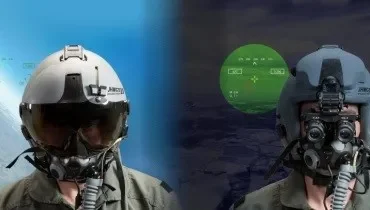
The PURSUIT system is built to support helmet-mounted display technologies that overlay critical information directly onto the pilot’s field of view. This reduces head-down time and keeps eyes focused outside the cockpit — where threats emerge and decisions unfold in fractions of a second.
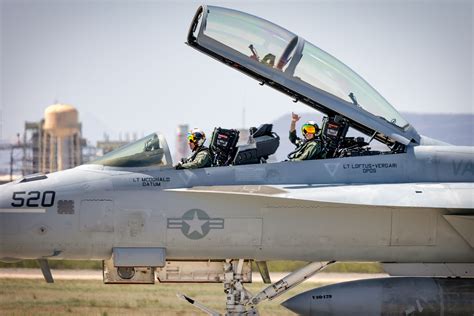
Night-vision capability is another cornerstone. Carrier operations frequently occur in low-light conditions, and night combat demands visual clarity without sacrificing depth perception or situational awareness. The modular design allows night-vision systems to integrate cleanly, avoiding awkward add-ons that can disrupt balance.
Communication systems also receive enhancement under the NGFWH architecture. Clear, resilient communications are essential in high-noise, high-stress environments. By modernizing integration pathways, the helmet supports advanced audio systems without compromising weight distribution or fit.
Robert McCay, Vice President of Gentex Aircrew Systems, described the system as delivering advancements in safety, comfort, and mission performance. That triad reflects the Navy’s recognition that survivability is multidimensional. A pilot must be physically protected, cognitively supported, and technologically empowered.
A Fleet-Wide Standard for the Future
One of the most consequential aspects of the NGFWH program is its scope. The helmet is intended to support all Navy fixed-wing aircraft under the current contract structure. Standardization simplifies logistics, training, and sustainment while ensuring that every fixed-wing aviator benefits from the same baseline technological capability.
This approach mirrors broader trends in defense procurement: modularity, scalability, and lifecycle adaptability. Rather than fielding disparate helmet systems across aircraft types, the Navy is investing in a unified platform capable of adapting as aircraft evolve — including whichever jet ultimately replaces the T-45 trainer.
The helmet thus becomes more than equipment. It becomes infrastructure.
More Than a Shell: A Strategic Evolution in Pilot Systems
Comparisons to advanced systems like the F-35 helmet-mounted display are inevitable. While platforms differ in complexity and integration, the underlying philosophy is shared: the helmet is no longer passive gear. It is an active node in the combat system.
The PURSUIT NGFWH signals that the Navy understands something fundamental. As aircraft become smarter, the human-machine interface becomes decisive. The helmet sits at that intersection — literally wrapped around the pilot’s sensory perception.
Reducing strain extends careers. Modular architecture preserves relevance. Integrated displays enhance lethality. Communication upgrades improve coordination. Each element reinforces the others.
In naval aviation, the margin between mission success and failure is often razor-thin. By transforming the helmet from protective headgear into a digitally integrated combat platform, the U.S. Navy ensures that its aviators are not just shielded from harm but equipped to dominate the increasingly complex skies they patrol.