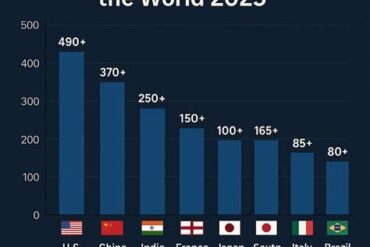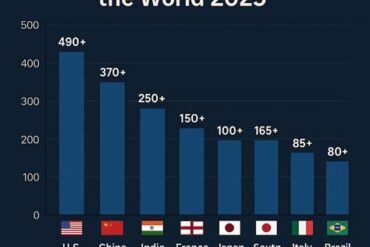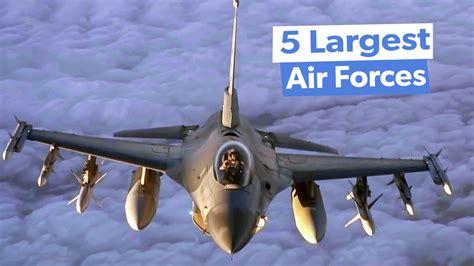
In 2025, the composition and total strength of fighter jet inventories across major world powers reveal not just military priorities but technological ambitions. As of this year, the United States maintains an overwhelming lead, possessing a total of 2,358 fighter jets, more than any other nation by a considerable margin. This count integrates assets from the US Air Force, Navy, Marine Corps, and Army aviation components. The gap between America and its closest competitor, China, remains hundreds of aircraft wide, even as China’s People’s Liberation Army Air Force (PLAAF) rapidly expands.
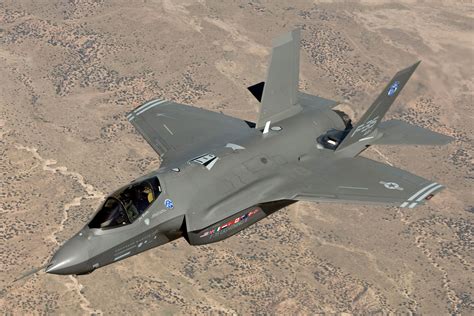
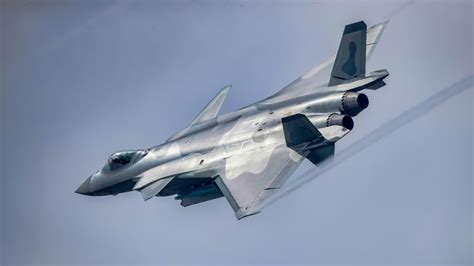
China, with 1,975 fighters, has steadily climbed the ranks due to consistent production and induction of fourth- and fifth-generation fighters, notably the J-10C, J-16, and stealth-capable J-20 Mighty Dragon. Russia follows in third place with 1,008 fighters, anchored by legacy Soviet platforms supplemented by modern Sukhoi aircraft. India’s air force occupies the fourth position with 542 fighter jets, highlighting a diverse inventory and rapid modernization strategy. Meanwhile, Japan, with 253 fighters, rounds out the top five after recently integrating F-35A/B variants into its Self-Defense Forces.
United States: Global Apex of Air Power
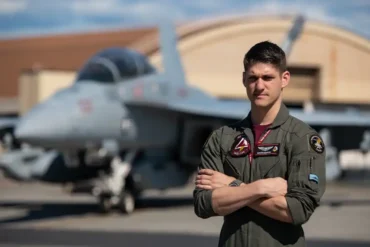
The United States has built its overwhelming numerical and qualitative edge through a multi-service approach. It operates over 600 F-16 Fighting Falcons, more than 450 F/A-18E/F Super Hornets, and maintains elite fleets of the F-22 Raptor and the multirole F-35 Lightning II in all three of its variants. The F-35 program alone has added over 1,200 aircraft globally, with most belonging to US forces.
The United States leads not only in quantity but in fifth-generation technology, stealth, and future-forward concepts. While Russia and China attempt to narrow the gap with Su-57s and J-20s, no competitor has matched the United States’ fleetwide integration of stealth, sensor fusion, and global logistics support.
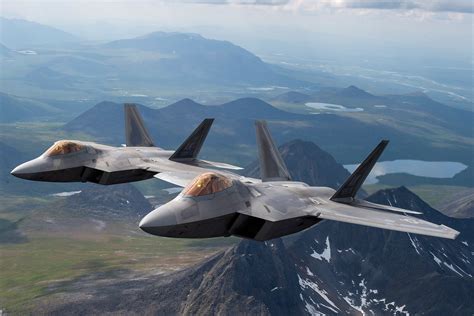
Moreover, the upcoming Next Generation Air Dominance (NGAD) program promises to redefine air superiority again. With platforms like the Boeing F-47 stealth fighter, AI-driven control systems, and drone-wingman support (Loyal Wingman concepts), the US is poised to lead into the sixth-generation fighter era.
China: A Rising Aviation Giant
China’s PLAAF has rapidly grown in both capability and size, making it the second-largest air force by fighter count. The PRC’s strategic emphasis has shifted towards indigenous production, with the J-20 as its flagship stealth platform. While the J-10C, J-11, and J-16 comprise the core fleet, China is aggressively developing the J-35, a stealth naval fighter intended for carrier operations.
A significant concern remains engine development. China has struggled to produce indigenous engines comparable to Russian AL-31 or American F119 engines. Nonetheless, recent sightings of prototype sixth-gen aircraft and the expansion of aircraft carrier capability signal Beijing’s commitment to becoming a peer military competitor.
Russia: Quantity Meets Complexity
The Russian Air and Space Forces (VKS) maintain a diverse inventory built on Cold War-era platforms and upgraded successors. With 1,008 fighters, Russia has the third-largest fleet globally. The force comprises MiG-29s, Su-27s, Su-30SM2s, Su-34s, and the high-performance Su-35S, a 4.5-generation fighter known for agility and thrust vectoring.
The Su-57 Felon, Russia’s only fifth-generation fighter, remains limited in numbers and capabilities. As of mid-2025, estimates suggest fewer than 12 operationally capable Felons, plagued by production delays and performance issues. However, Russia continues work on sixth-generation platforms and complementary systems like the Sukhoi Okhotnik-B unmanned combat drone.
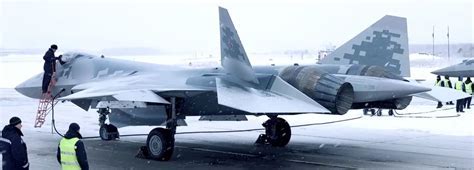
Despite the technical hurdles, the legacy Soviet fighters in Russian service provide a large tactical reserve and a capable surge force. The emphasis remains on mass and variety, with modernization efforts constrained by economic and logistical realities.
India: A Diverse and Evolving Arsenal
India’s 542-strong fighter fleet is one of the most varied in the world, blending Russian, French, and indigenous platforms. The Sukhoi Su-30MKI serves as the backbone, complemented by the Dassault Rafale, the lightweight HAL Tejas, and older MiG variants.
India has made strategic investments in the Advanced Medium Combat Aircraft (AMCA), an indigenous fifth-gen stealth fighter, while rejecting Russian Su-57 exports in favor of self-reliance. India is also in talks to co-produce F-21 jets (an F-16V variant) with Lockheed Martin, boosting industrial capabilities and combat readiness.
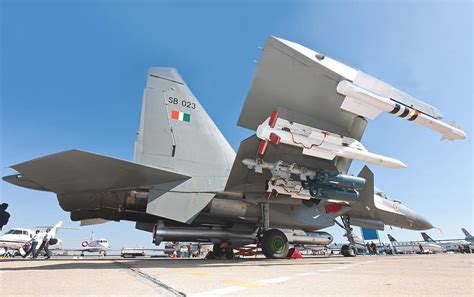
The Indian strategy emphasizes flexibility, localization, and future-readiness, making its air force one of the most dynamic and rapidly modernizing in Asia.
Japan: Precision and Modernization
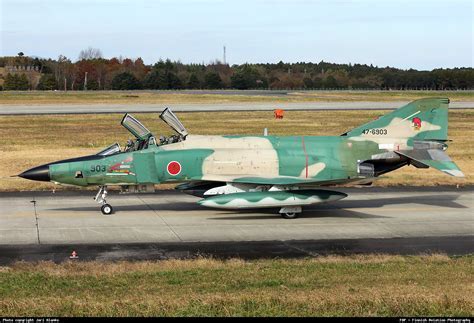
Japan’s fleet of 253 fighters features the Mitsubishi F-15J and the F-2, a heavily modified version of the American F-16. As part of Japan’s modernization drive, the country has committed to acquiring 127 F-35 fighters, divided between F-35A for air superiority and F-35B for carrier operations aboard its modified Izumo-class ships.
Japan is also a co-lead on the Global Combat Air Programme (GCAP), formerly Tempest, which represents a sixth-generation joint development with the United Kingdom and Italy. This project signifies a shift in Japan’s defense posture towards high-end deterrence.
Naval Fighters and Maritime Power Projection
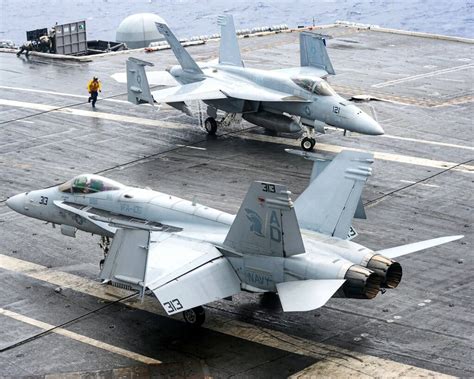
Naval aviation plays a pivotal role in projecting power beyond borders. The United States Navy and Marine Corps operate over 748 fighters, with the F/A-18E/F Super Hornet as the mainstay alongside F-35B/C variants.
China’s PLAN Naval Air Arm is transitioning from the J-15 to the stealthier J-35, supported by newer aircraft carriers like the Fujian (Type 003). India’s MiG-29K jets operate from the INS Vikramaditya and INS Vikrant, while Japan employs the F-35B from its helicopter carriers.
Russia remains the only major player without an active blue-water naval fighter capability, as the Admiral Kuznetsov aircraft carrier is undergoing extended maintenance with no clear reactivation date.
Fighter Jet Generations: The Technological Timeline
Fighter jet evolution is typically segmented by generation. The fifth generation includes stealth, sensor fusion, and supercruise—embodied in the F-22, F-35, Su-57, and J-20. The sixth generation, represented by ongoing programs like NGAD, Tempest, and FCAS, adds AI, autonomous drones, hypersonic capability, and unmatched interoperability.
Fourth-generation aircraft, such as the F-16, Mirage 2000, MiG-29, and Su-27, remain prevalent in current inventories. Upgraded 4.5-gen fighters like the Su-30SM2, Rafale, Typhoon, and F/A-18E/F continue to perform frontline roles.
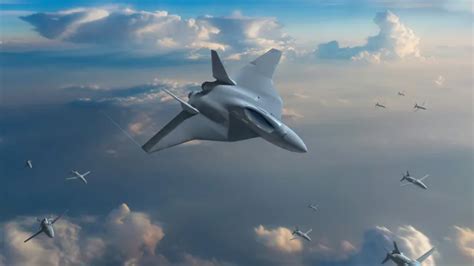
Jet generations reflect not only performance upgrades but doctrinal shifts in how nations approach air dominance. Modular systems, electronic warfare capabilities, and seamless satellite communication define the battlefield superiority of the coming decade.
Conclusion: Power in the Skies
The global hierarchy of air power in 2025 reflects not just numbers but technological integration, training, and industrial capacity. The United States maintains an overwhelming lead, but nations like China and India are quickly closing the gap with focused investment and innovation.
A modern fighter force is no longer just about speed or stealth—it’s about systems integration, platform diversity, and logistical sustainability. While quantity still matters, quality and readiness determine who owns the skies in 21st-century warfare.