The modern aerospace industry runs on precision, timing, and an almost invisible choreography of parts moving across continents. When that choreography is disrupted, even slightly, the consequences ripple across production lines, delivery schedules, and ultimately airline operations. In early 2026, Boeing found itself confronting a growing threat not from within its factories, but along the routes that connect them. As instability intensifies across the Middle East, the company has begun quietly orchestrating what may become one of the most complex logistical reroutes in recent aviation history.
Global Supply Chains Under Pressure from Conflict Zones
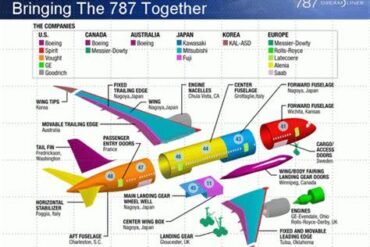
Aircraft manufacturing is uniquely dependent on global integration. Thousands of suppliers contribute specialized components, from precision-machined turbine blades to advanced avionics systems. These parts rarely originate in one region alone. Instead, they travel through interconnected logistics networks, often passing through key transit hubs in the Middle East.
While the region itself produces relatively few aerospace components, its geographic position makes it indispensable. Air cargo corridors and maritime shipping lanes linking Europe, Asia, and Africa converge here. When conflict disrupts these pathways, the impact is not localized—it is global.
Boeing’s recent request for suppliers to evaluate their exposure to Middle Eastern routes signals a shift from reactive to proactive strategy. The company is not waiting for disruption to escalate; it is mapping vulnerabilities before they materialize into delays.
The Hidden Fragility of Aircraft Production Networks
Unlike many industries, aerospace manufacturing cannot easily absorb delays. Production lines are synchronized with remarkable precision, often relying on “just-in-time” delivery models. A single delayed component—no matter how small—can stall the assembly of an entire aircraft.
This fragility has been exposed repeatedly in recent years. The aftermath of the COVID-19 pandemic left lingering shortages of semiconductors, castings, and skilled labor. Manufacturers have been operating with minimal buffers, meaning the margin for error is razor-thin.
The emerging situation in the Middle East compounds these challenges. Cargo operators are increasingly rerouting flights to avoid risk zones, leading to longer transit times and reduced capacity. Each diversion adds complexity, increasing the likelihood of bottlenecks that can cascade through the entire supply chain.
Rerouting the Arteries of Global Aviation Logistics
At the heart of Boeing’s response lies a simple but formidable task: rerouting the arteries of its supply chain without disrupting the flow. This involves identifying alternative paths for thousands of shipments, many of which are time-sensitive and require specialized handling.
Air freight, already under strain, is becoming even more constrained. Reduced capacity means higher competition for cargo space, while longer routes increase fuel consumption and operating costs. Shipping lanes face similar pressures, as vessels adjust to avoid high-risk areas.
The financial implications are significant. Oil prices approaching $100 per barrel amplify transport costs across the board. For an industry that moves high-value, often oversized components across vast distances, even marginal increases translate into millions of dollars in additional expenses.
Rising Costs and the Domino Effect on Aircraft Production
The consequences of these logistical shifts extend far beyond transportation budgets. Increased costs and delays directly influence production timelines and, ultimately, aircraft pricing.
Boeing’s production system is designed for consistency. When parts arrive late or out of sequence, assembly lines slow down. This not only delays deliveries but also disrupts contractual commitments with airlines, many of which operate on tight fleet expansion schedules.
The ripple effects can be profound. Airlines awaiting new aircraft may face capacity constraints, forcing them to adjust routes or delay expansion plans. Meanwhile, manufacturers must navigate rising input costs while maintaining competitive pricing—a balancing act that becomes increasingly difficult as disruptions persist.
The Strategic Importance of the Middle East Market
The Middle East is not just a transit hub; it is also a critical market for widebody aircraft. Airlines such as Emirates and Qatar Airways rely heavily on long-haul fleets to connect global passengers through their hubs. These carriers represent a substantial portion of demand for large, long-range aircraft.
Any prolonged instability in the region could therefore affect both supply and demand. On one hand, logistical disruptions complicate production. On the other, uncertainty may influence airline investment decisions, potentially reshaping order books and delivery schedules.
This dual exposure makes the situation particularly complex for Boeing. It is not merely a question of moving parts efficiently—it is about sustaining confidence in a key growth market.
Defense Priorities and Commercial Constraints
Another layer of complexity arises from the overlap between commercial aerospace and defense manufacturing. Many suppliers serve both sectors, producing components that can be adapted for military or civilian use.
In times of geopolitical tension, governments may prioritize defense production. This shift can divert resources away from commercial programs, tightening supply even further. For Boeing, which operates in both domains, the challenge is to balance competing demands without compromising either.
The risk is not hypothetical. Historical precedents show that defense priorities can quickly reshape industrial output, leaving commercial manufacturers scrambling to secure critical components.
A Turning Point for Aerospace Supply Chain Strategy
The current situation may mark a turning point in how aerospace companies approach supply chain resilience. For years, efficiency and cost optimization have driven decision-making. Now, resilience and flexibility are taking center stage.
Boeing’s initiative to map supply chain exposure reflects this shift. By identifying vulnerabilities across multiple tiers of suppliers, the company is building a more comprehensive understanding of its operational risks. This knowledge can inform future strategies, from diversifying suppliers to redesigning logistics networks.
Over time, these adjustments could lead to a more decentralized supply chain, reducing reliance on specific transit corridors. While such changes may increase costs in the short term, they offer greater stability in an increasingly unpredictable world.
The New Reality of Aviation Logistics
The rerouting of aircraft components around a conflict zone is more than a temporary workaround—it is a glimpse into the future of global manufacturing. As geopolitical tensions continue to influence trade routes and transportation networks, companies like Boeing must adapt in real time.
What makes this moment particularly significant is the speed at which external events are reshaping internal operations. Decisions that once unfolded over months are now being made in days, driven by the need to maintain continuity in a fragile system.
Boeing’s response underscores a broader truth about modern aviation: the industry is only as strong as the networks that support it. When those networks are disrupted, even the most advanced manufacturing systems must evolve.
In this high-stakes environment, the ability to anticipate, adapt, and reroute may prove just as critical as engineering innovation itself.