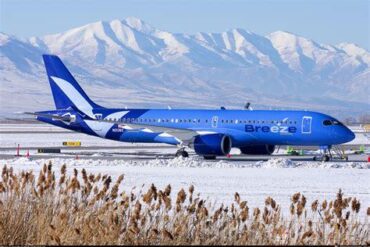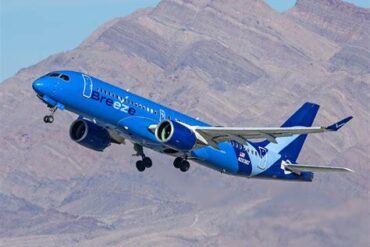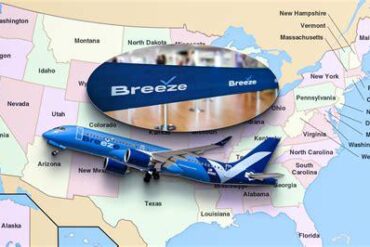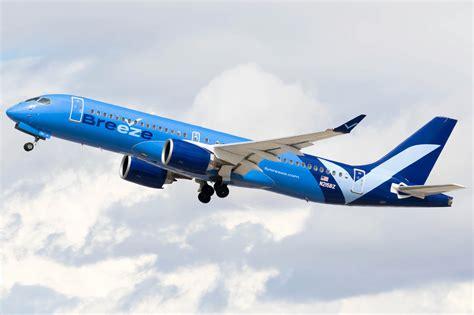
Breeze Airways, the ambitious low-cost carrier founded by airline industry veteran David Neeleman, is once again turning heads with its interest in a potential stretched version of the Airbus A220, tentatively referred to as the A220-500. This move aligns with Breeze’s strategic vision to provide affordable and comfortable travel to underserved U.S. markets, while preparing for future expansions that include long-haul and international destinations.
Breeze’s Vision and the Appeal of the A220-500
In a recent LinkedIn Q&A, Breeze CEO David Neeleman shed light on the airline’s fleet aspirations. Currently operating the Airbus A220-300, Neeleman confirmed Breeze’s interest in a larger variant, saying:
“There’s no doubt with this newer technology, that will be the replacement airplane. Just better fuel burn, better technology, lighter structure, and 2/3 seating as opposed to 3/3 seating.”
This statement underscores several key reasons why the A220-500 is an attractive proposition for Breeze:
- Fuel Efficiency: Lighter airframe and next-generation engines offer significantly improved fuel burn.
- Pilot Commonality: Common type ratings between A220-300 and a potential -500 streamline crew training and operations.
- Fleet Flexibility: A stretched version maintains fleet uniformity while offering increased capacity for more profitable routes.
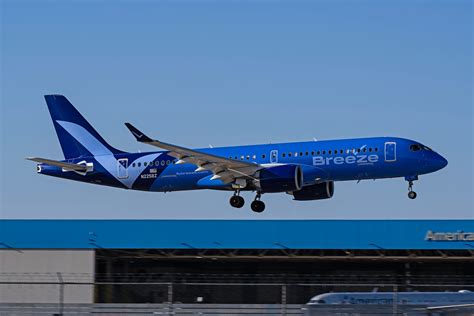
The A220-500, though not officially confirmed by Airbus, could serve as a bridge between current regional jets and larger narrowbodies like the A320neo, without overshooting Breeze’s business model focused on smaller markets.
Why Breeze Chose the A220 Platform Over Competitors
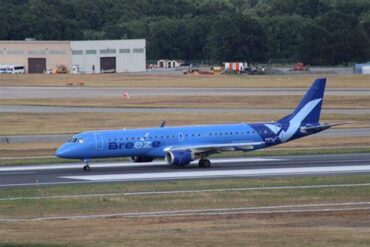
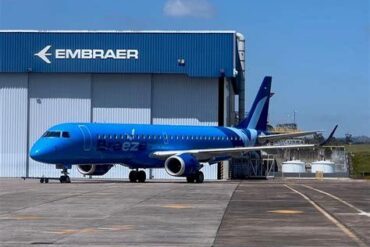
While Breeze began operations using Embraer E190 aircraft due to immediate availability, the airline always had its sights on the Airbus A220. The reasons are rooted in the A220’s range, efficiency, comfort, and operational versatility, all of which are crucial for Breeze’s target network.
Unlike the Boeing 737 or Airbus A320, which are often too large and too costly for Breeze’s thinner routes, the A220-300 offers a sweet spot in capacity with transcontinental range and modern cabin amenities. Compared to Embraer’s E2 series, the A220 offers better economics and greater range — an essential requirement as Breeze eyes new destinations including Hawaii and possibly transatlantic routes in the coming years.
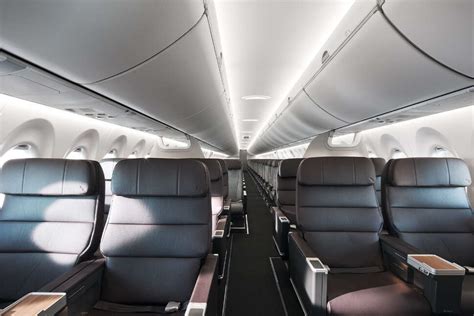
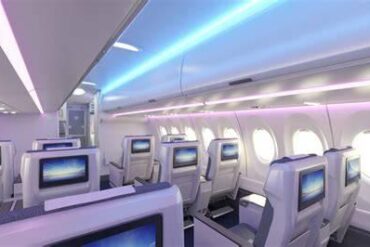
Notably, Neeleman emphasized the 2-3 seating configuration, which provides a unique passenger experience with fewer middle seats, larger windows, and quieter cabins thanks to advanced Pratt & Whitney engines. This configuration becomes a strong passenger-centric advantage, especially as Breeze continues to build a loyal customer base in the leisure segment.
Potential Market Role of the Airbus A220-500
If Airbus moves forward with the A220-500, it could fill an important gap in the narrowbody market — sitting just below the A320neo in capacity, while maintaining the A220’s technological and operational advantages. Industry speculation around the A220-500 has existed for years, but the public interest from a launch customer like Breeze adds renewed momentum.
The stretched version would likely seat 160–170 passengers, compared to 135 in the A220-300, effectively replacing older aircraft like the A319 or lower-density 737-700s while preserving fuel economy. However, Airbus must carefully weigh the market cannibalization risk: the A220-500 could siphon sales from its own A320neo family.
Despite the internal competition, there are compelling reasons Airbus may go ahead with the stretch:
- Airline Interest: Breeze is not the only carrier expressing interest. JetBlue, Air France, and even Delta have likely evaluated the -500 concept.
- Production Investment: With production already established at Mirabel (Canada) and Mobile (USA), expanding the product line could deliver economies of scale.
- Sustainability Goals: The A220-500 would align with aviation’s carbon-reduction goals by enabling more fuel-efficient medium-capacity flying.
Neeleman’s Long-Term Strategy: A220 As the Core of Breeze
David Neeleman has a track record of building successful, innovative airlines — from Morris Air to JetBlue to Azul. Each venture demonstrates his affinity for advanced technology, high efficiency, and unconventional routes. Breeze is no different, and Neeleman appears confident that the Airbus A220 family will anchor Breeze’s future, possibly without ever needing to purchase the A320 or 737 families.
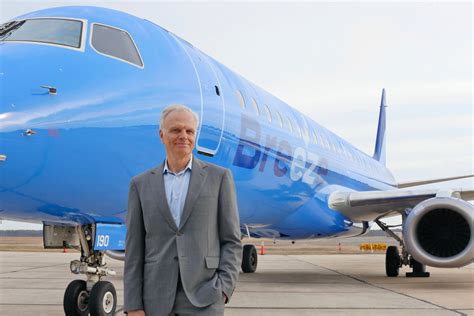
“I used to be a Boeing guy,” Neeleman admitted, referencing how he originally turned to Airbus during JetBlue’s early days due to a lack of favorable offers from Boeing. That strategic pivot appears to have extended into Breeze’s playbook, with Airbus now firmly embedded in the airline’s growth roadmap.
This long-term fleet simplification has cascading benefits:
- Maintenance Efficiency: Fewer aircraft types mean reduced parts inventory and streamlined logistics.
- Training Simplicity: Pilots, flight attendants, and maintenance personnel all benefit from single-family specialization.
- Brand Consistency: Passengers experience a unified cabin and product experience across all Breeze flights.
What Happens If the A220-500 Isn’t Built?
Should Airbus ultimately decide against launching the A220-500, Breeze’s growth could still continue but with more limitations. The airline may be forced to re-evaluate the Airbus A320neo or Boeing 737 MAX 7/8 as alternatives — decisions that would complicate operations and diverge from its uniform fleet strategy.
Alternatively, Breeze could push for more high-density configurations of the A220-300 or explore seat densification strategies to boost per-flight revenue. However, none of these options offer the same clean operational solution that a stretched A220 would provide.
Given the A220-500’s potential to enable longer routes, boost revenue-per-flight, and maintain crew and maintenance commonality, it’s easy to understand why Breeze — and perhaps others — are watching Airbus closely.
International Horizons: A220 Unlocking New Frontiers
Breeze has been open about its ambition to launch international services starting Fall 2025. The A220’s performance makes this possible, with the -300 already capable of crossing the U.S. coast-to-coast. With an A220-500, Breeze could comfortably launch new medium-haul services to the Caribbean, Central America, or even parts of Europe.
Such expansion fits neatly with Breeze’s brand promise of offering “nice” flights at affordable prices from cities that legacy carriers often ignore. A larger A220 would not only support higher-density leisure routes but also open access to slot-constrained airports like LaGuardia or Washington National, where noise and performance restrictions favor quieter, modern jets like the A220 family.
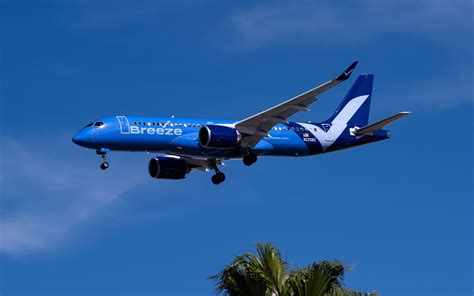
Final Thoughts: Breeze and the Future of Regional Mainline Flying
Breeze Airways is demonstrating once again that it doesn’t just follow industry trends — it helps shape them. By publicly stating its interest in the Airbus A220-500, Breeze is reinforcing its commitment to lean, efficient, customer-friendly operations powered by next-gen aircraft technology.
Whether or not Airbus officially greenlights the A220-500, the fact that one of the most visionary airline CEOs is advocating for it may very well influence industry dynamics. Should the variant come to life, Breeze might not only be among its earliest buyers but perhaps its launch customer, further elevating its position as an innovative disruptor in U.S. aviation.
For now, all eyes are on Airbus, as both Breeze and other global carriers wait to see if the A220 family will take its next evolutionary step — one that could redefine the future of mid-capacity air travel.