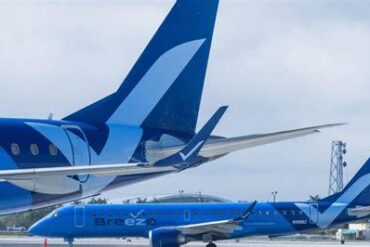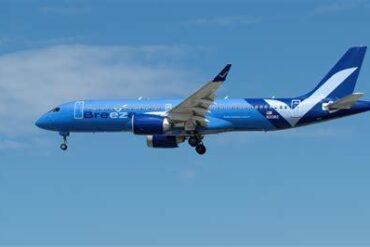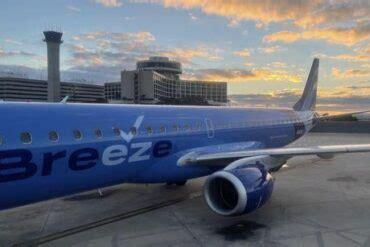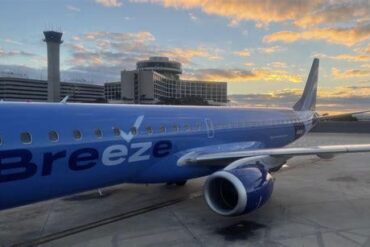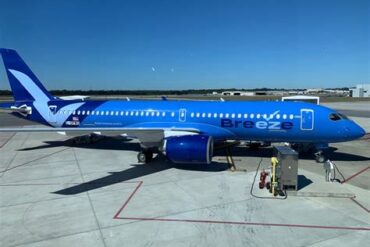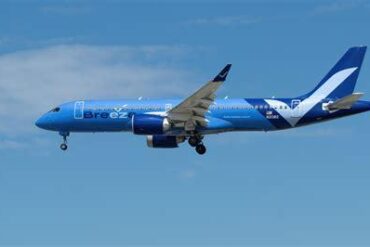
Breeze Airways is entering one of its busiest expansion periods yet, launching 19 new and returning routes between July 1 and July 3. The rapid rollout further strengthens the carrier’s reputation for identifying underserved markets, connecting smaller cities with nonstop flights, and avoiding heavily saturated competition whenever possible.
Rather than focusing exclusively on major airline hubs, Breeze continues to build a network centered on leisure travelers, regional connectivity, and destinations that have either lost nonstop service or have never enjoyed it before. By the first week of July, the airline’s network will reach 353 scheduled routes, including 346 domestic and six international services, highlighting the remarkable pace at which the young airline continues to expand.
Breeze Airways Accelerates Growth With 19 Route Launches
The latest expansion represents one of the largest short-term network additions by any U.S. airline this year. Over just three days, Breeze will introduce 17 completely new routes while bringing back two previously operated services.
Unlike traditional legacy carriers that prioritize dense hub-to-hub schedules, Breeze has built its business around connecting secondary airports and underserved city pairs. This strategy enables travelers to bypass lengthy connections while providing airports with valuable nonstop service that would otherwise not exist.
The airline typically operates each route only twice weekly on average, allowing it to efficiently match demand while testing emerging markets with relatively low operational risk.
After these additions, Breeze’s route map stretches across 20 airports, significantly increasing travel options for passengers seeking direct leisure and visiting-friends-and-relatives flights.
Most New Flights Face Little or No Direct Competition
One of the defining characteristics of Breeze’s network planning is its emphasis on markets with minimal competition. Among the 19 newly introduced airport pairs, approximately 63% will operate without another airline offering the same nonstop route at the airport level.
Only seven of the new services will compete directly against another airline. One example is the new Tampa International Airport to Punta Cana service, although competitive pressure is expected to ease after Frontier Airlines exits the market later in the summer.
Many of Breeze’s latest additions also capitalize on routes recently abandoned by other carriers. Several markets had previously been operated by Spirit Airlines before the airline withdrew service earlier this year. Rather than creating entirely new demand, Breeze is strategically stepping into markets where passenger demand has already been demonstrated but nonstop capacity has disappeared.
This approach reduces uncertainty while giving travelers renewed access to direct flights that had recently vanished.
Four Brand-New Nonstop Markets Stand Out
Among the 19 additions, four routes have never previously enjoyed scheduled nonstop commercial service, making them especially significant within the U.S. aviation landscape.
These include:
- Akron-Canton to Portland, Maine
- Fort Lauderdale to Wilkes-Barre/Scranton
- Fort Lauderdale to Salisbury
- Raleigh-Durham to Tallahassee
These city pairs represent genuine network innovation rather than simple replacements of discontinued flights.
One particularly interesting example is Akron-Canton to Portland, Maine. Government passenger data shows relatively little direct demand between the two cities themselves. However, Breeze is clearly targeting the broader regional market by positioning Akron-Canton as an alternative airport for travelers throughout northeastern Ohio, including portions of the Cleveland metropolitan area.
When viewed from that wider perspective, passenger demand becomes considerably stronger, illustrating how Breeze evaluates catchment areas instead of relying solely on airport-to-airport statistics.
Tallahassee Becomes Breeze’s Newest Destination
Beginning July 2, Breeze will officially add Tallahassee Regional Airport to its growing network.
The Florida capital gains two nonstop routes:
- Fort Lauderdale – Tallahassee
- Raleigh-Durham – Tallahassee
These services fill an important gap left after previous operators suspended flights. Fort Lauderdale had previously been connected to Tallahassee by Silver Airways until mid-2025, while JetBlue exited the route even earlier.
Without nonstop flights, thousands of travelers were forced to connect through hubs such as Atlanta and Charlotte. Historical passenger numbers demonstrate that demand remained healthy whenever direct service was available, making Breeze’s entry a logical business decision.
The new routing also creates efficient aircraft utilization. Aircraft arriving from Fort Lauderdale continue onward to Raleigh-Durham before reversing the pattern later in the day, maximizing productivity while serving multiple markets.
Birmingham Joins Breeze’s Expanding Alabama Network
Another milestone arrives on July 3, when Breeze begins operations at Birmingham-Shuttlesworth International Airport.
Although Breeze has served Alabama since 2021 through Huntsville—and briefly Mobile—the addition of Birmingham significantly expands its presence within the state.
Birmingham provides access to one of Alabama’s largest metropolitan regions while complementing the airline’s existing regional strategy. Instead of concentrating traffic into major national hubs, Breeze continues building direct links that reduce travel times for passengers across medium-sized cities.
The expansion demonstrates that the airline remains committed to strengthening its footprint throughout the southeastern United States.
Breeze’s Network Strategy Continues to Differentiate the Airline
The latest expansion reflects a business model that differs sharply from most U.S. airlines. Instead of maximizing daily frequencies on highly competitive routes, Breeze prioritizes market gaps, seasonal leisure demand, and communities that have historically lacked nonstop connectivity.
Many of the newly announced routes revive markets abandoned after industry restructuring, while others create entirely new travel opportunities. This measured approach enables Breeze to grow efficiently without immediately confronting the largest legacy carriers on their strongest routes.
As the airline surpasses 350 scheduled routes, its network increasingly serves travelers seeking convenient point-to-point service rather than traditional hub connections. With 19 routes launching within just three days, Breeze continues demonstrating that carefully selected regional markets remain one of the strongest opportunities for expansion in the U.S. airline industry.