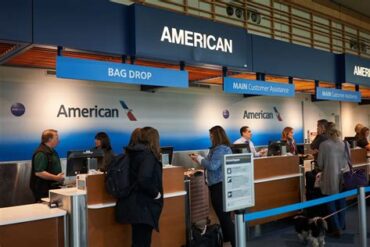
Budget air travel has rewritten the rules of flying, and nowhere is that more obvious than in the quiet war being fought at the boarding gate. What looks like a harmless carry-on can instantly become a costly mistake, with fees climbing to $100 or more in a matter of seconds. The surprising part is not that airlines charge for bags—it’s how easily a perfectly “normal” carry-on crosses the invisible line from acceptable to chargeable.
Passengers often assume that if a bag looks small enough, it will pass. That assumption is exactly where things go wrong. Airlines are not measuring appearances; they are enforcing precise dimensional limits, and the smallest design detail can tip the balance. A few extra centimeters from a wheel, a slightly raised handle, or an expanded zipper panel can transform a free personal item into a gate-checked expense.
Understanding how these rules are applied in practice is not just helpful—it’s financially essential. The difference between boarding smoothly and paying a triple-digit fee often comes down to details most travelers never think to check.
Why Airlines Turn Carry-Ons Into Profit Engines
Low-cost carriers have mastered a strategy that feels deceptively simple: offer a rock-bottom base fare, then build profit through add-ons. Bags sit at the center of that strategy. What used to be a standard inclusion is now one of the most aggressively monetized aspects of air travel.
The economics are deliberate. When a passenger purchases baggage allowance during booking, the fee is relatively modest. Wait until check-in, and the price increases. Delay until the gate, and the cost spikes dramatically. This tiered pricing system is not accidental—it nudges behavior while ensuring that last-minute decisions come with a penalty.
For airlines like Spirit, Frontier, Ryanair, and easyJet, baggage fees are not a side hustle. They are a primary revenue stream. This explains the strict enforcement at boarding gates, where staff are often incentivized to identify non-compliant bags. The moment your carry-on fails the test, the transaction becomes unavoidable. No negotiation, no exceptions—just a swift payment before boarding continues.
The Real Size Limits Most Travelers Misjudge
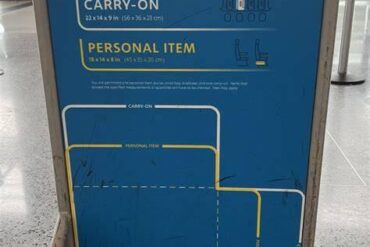
The biggest misconception in modern air travel is the definition of a “carry-on.” Most travelers picture a standard roller suitcase, typically around 22 x 14 x 9 inches. On budget airlines, that assumption is a fast track to extra fees.
The free allowance is usually limited to a personal item, not a full carry-on. On airlines like Spirit and Frontier, that means dimensions closer to 18 x 14 x 8 inches. European carriers operate in centimeters, but the principle remains identical: the free bag must fit under the seat, not in the overhead bin.
That distinction changes everything. A bag marketed as “cabin approved” may still exceed these stricter limits. Manufacturers often design luggage for legacy carriers with more generous allowances, leaving budget airline passengers unknowingly out of compliance.
Even more misleading is how dimensions are advertised. Luggage brands typically measure the main shell only, ignoring protruding elements. Airlines, on the other hand, measure the bag exactly as it exists in real life—wheels, handles, bulges, and all.
What Happens the Moment Your Bag Fails
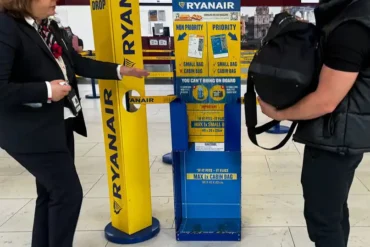
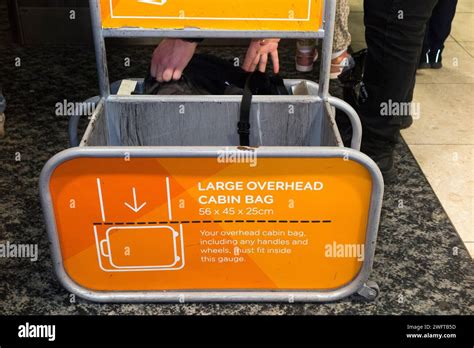
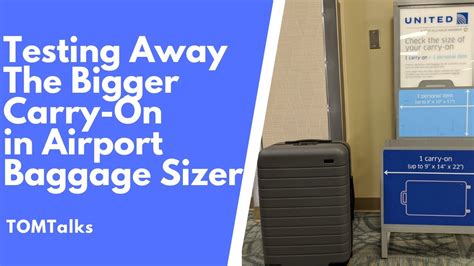
The gate is where theory becomes reality. When a bag is selected for inspection, it must fit into a metal sizing frame. This device doesn’t care how close your bag is to the limit. It either fits cleanly or it doesn’t.
If it fails, the consequences are immediate. The bag is tagged and sent to the cargo hold, and the passenger is charged a gate-check fee that can range from $70 to over $100 depending on the airline and route.
What makes this situation particularly frustrating is its unpredictability. Enforcement varies widely. One flight may allow a borderline bag without question, while another applies strict checks to every passenger. Full flights tend to trigger tighter enforcement, as limited overhead space forces airlines to act.
The inconsistency creates a risky gamble. A bag that has passed unnoticed multiple times can suddenly become a liability on a busy travel day. When that happens, the fee is not just high—it’s unavoidable.
The Hidden Carry-On Features That Trigger Fees
The most expensive mistakes are rarely obvious. Bags don’t usually fail because they are dramatically oversized. Instead, they exceed limits by small margins caused by built-in features.
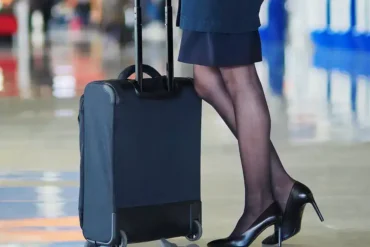
Wheels are the most frequent offender. On hard-shell suitcases, wheels extend beyond the base, adding several centimeters that cannot be compressed. A bag that technically meets size limits without wheels becomes oversized the moment those wheels are included.
Handles create a similar issue. Even when retracted, top grab handles often sit slightly above the bag’s surface. That extra height is enough to prevent a clean fit in a sizer, especially on airlines with tight tolerances.
External pockets introduce another layer of risk. These compartments expand when filled, pushing the bag beyond its flat dimensions. A laptop charger, water bottle, or stack of documents can turn a compliant bag into a failing one without any obvious visual cue.
Expandable zippers are perhaps the most deceptive feature. Many travelers use them for extra packing space, not realizing they are effectively increasing the bag’s depth beyond the airline’s limit. Once expanded, the bag is no longer what the airline considers a standard size.
Why Hard-Shell Luggage Is More Likely to Fail
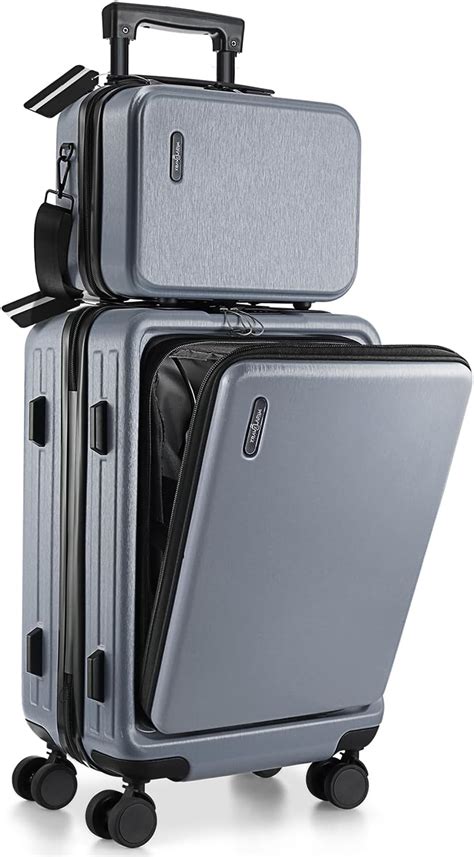
Hard-shell suitcases offer durability and protection, but they come with a critical disadvantage in strict baggage environments: zero flexibility. If the bag exceeds the limit by even a small margin, there is no way to compress it into compliance.
Soft-sided bags, by contrast, provide a margin of error. A slightly overfilled backpack or duffel can often be squeezed into a sizing frame, especially when made from flexible materials. This adaptability gives experienced travelers a subtle but powerful advantage.
The difference becomes especially important on airlines with rigid enforcement tools. A metal sizer does not forgive rigidity. A hard case either fits perfectly or fails outright, while a soft bag can adapt just enough to pass.
The Psychology Behind Gate Enforcement
Gate enforcement is not just about rules—it’s about behavior. Airlines design their systems to encourage compliance long before passengers reach the airport. The steep jump in fees at the gate acts as a deterrent, pushing travelers to make decisions earlier in the process.
There is also a human element. Gate agents operate under time pressure, balancing boarding efficiency with policy enforcement. On less crowded flights, they may allow borderline cases to pass. On full flights, where overhead space is scarce, enforcement becomes stricter and more systematic.
In some cases, incentives play a role. Reports have indicated that certain airlines reward staff for identifying oversized bags, adding another layer of motivation to enforce rules consistently. This creates an environment where the same bag can receive completely different treatment depending on timing and context.
How to Avoid Paying a $100 Surprise Fee
Avoiding these fees requires a shift in mindset. It’s not about packing less—it’s about packing smarter and choosing the right equipment.
A bag designed specifically for under-seat compliance is the safest option. Backpacks and compact duffel bags outperform traditional carry-ons in this category because they lack rigid components that add to external dimensions.
Equally important is measuring the bag in its fully packed state. Empty dimensions are irrelevant if the bag expands beyond limits when filled. Every element—wheels, handles, pockets—must be included in the measurement.
Timing also plays a decisive role. Purchasing baggage allowance during booking is significantly cheaper than paying later. Waiting until the gate is essentially choosing the most expensive option available.
The Fine Line Between Free and Fee
The modern carry-on landscape is defined by precision. The difference between a free bag and a $100 charge is often measured in millimeters, not inches. Features that seem minor during purchase become critical at the gate, where enforcement is absolute and immediate.
For frequent travelers, the lesson becomes clear over time: compliance is not about luck. It’s about understanding how airlines interpret size, how bags are constructed, and how enforcement works in real-world conditions.
The smartest approach is proactive. Choose a bag that aligns with the strictest airline you fly, pack with awareness of external dimensions, and treat every centimeter as valuable space. Because at the gate, that tiny margin is exactly where airlines make their money—and where passengers either pass through smoothly or pay the price.