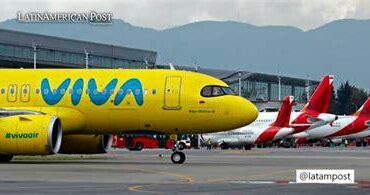
On the afternoon of December 18, 2025, the bustling airspace above New York’s JFK Airport bore witness to an alarming breach of procedural aviation safety. Viva Aerobus flight VB100, an Airbus A321neo registered as XA-VXR, inbound from Mexico City, approached one of the world’s busiest airports in what can only be described as an astonishingly unprepared and dangerous manner.
Unfolding Chaos: Viva’s Misguided Descent into JFK
The situation unfolded dramatically when the Viva crew, tasked with flying a challenging RNAV Z approach to runway 13L, showcased blatant confusion over basic navigation protocols. As captured by the YouTube channel You Can See ATC, the communication between the approach controller and the pilots quickly descended into miscommunication and missed acknowledgments.
Despite being instructed to proceed direct to ASALT, the initial approach fix crucial for this procedure, the pilots failed to read back the clearance accurately. When prompted, they demonstrated a lack of familiarity with the term, even requesting the controller to spell out ASALT, a move that exposed their lack of briefing and preparation for JFK’s unique airspace.
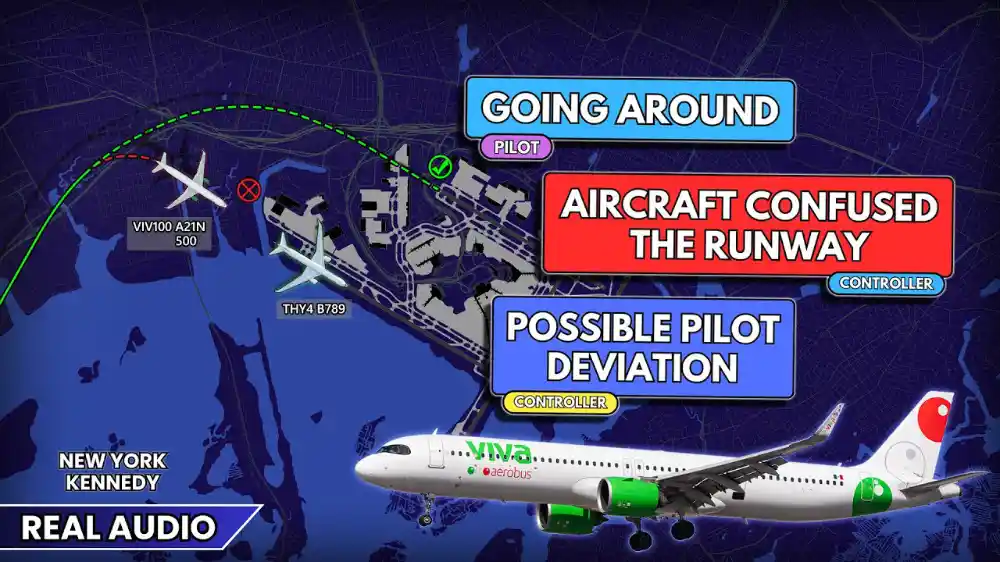
Eventually, the crew was handed off to the tower controller and cleared to land on runway 13L. However, as JFK’s air traffic system juggled multiple arrivals and departures, another aircraft — a Turkish Airlines Boeing 787-9 — was cleared to line up and wait on runway 13R, JFK’s parallel runway.
This is when the crisis peaked. The Viva pilots, still disoriented, mistakenly lined up for runway 13R instead of 13L, descending to within 500 feet above ground before executing a go-around. The near-catastrophic error was narrowly averted thanks to keen situational awareness in the control tower, where someone audibly warned, “don’t do it, Viva lined up for 13R.”
Tower’s Composure vs. Cockpit Confusion
What stands out just as much as the pilots’ shocking lack of preparation is the exceptional calm displayed by the JFK ATC team. Historically known for their clipped, sometimes abrasive tone given the pressure of handling dense traffic, the controllers in this instance maintained a steady and composed demeanor throughout the unfolding drama.
The tower controller’s calm reinforcement—emphasizing the clearance to land on runway 13 LEFT—was a subtle yet unmistakable warning. When the aircraft eventually landed correctly after a second attempt, the crew was unsurprisingly given a “number to call” — aviation-speak for a mandatory discussion with the FAA about a probable pilot deviation.
Training, Culture, or Complacency? A Pattern Emerges
This incident is more than a simple case of human error. It reflects deeper concerns about training standards, operational culture, or possibly both within Viva Aerobus. The A321neo is a modern, technologically advanced aircraft. The tools available to the pilots — including the flight management system, visual approach aids, and detailed approach plates — should have made it straightforward to follow a standard RNAV Z approach.
But the evidence suggests the pilots didn’t study the approach chart, didn’t anticipate the ASALT fix, and worse, didn’t ask for clarification until it was too late. That lack of preparedness in Class B airspace like JFK’s — with heavy inbound and outbound international traffic — creates a volatile scenario.
This isn’t an isolated incident for the airline. In previous years, another Viva flight was involved in a major procedural error at Chicago O’Hare, where a crew attempted to take off from a taxiway instead of the assigned runway. That pattern points to potential systemic flaws in procedural compliance and pilot training at the carrier.
Anatomy of a Preventable Error
To contextualize how serious the error was, one must understand the layout of JFK’s runway system. Runways 13L and 13R are not adjacent. In fact, they are separated by the airport’s central terminals, making the mistake of choosing the wrong runway especially egregious. This wasn’t a visual ambiguity; it was a failure to grasp basic spatial orientation in a clearly marked and charted environment.
The RNAV Z 13L approach is known for its late turn and precision requirements, yet is routinely handled by competent crews around the world. In this case, the fact that the Viva crew still lined up incorrectly after being given exact instructions multiple times reflects a fundamental breakdown in cockpit communication and procedure.
It’s also notable that the pilots initially acknowledged only part of the instructions, using noncommittal responses like “roger,” which further complicated the controller’s expectations. Clear, full readbacks are not just procedural formality — they’re critical safety barriers.
The Aftermath: Accountability and Lessons Learned
The FAA will undoubtedly scrutinize this event, especially considering the near-incursion of a fully occupied parallel runway. While no collision occurred, the error could have easily triggered a serious runway conflict had the tower not caught the mistake in time. For Viva Aerobus, this should spark a deep internal review of their pilot readiness programs, approach briefing standards, and English language proficiency in international airspace.
As global aviation becomes more interconnected, it is imperative that low-cost carriers, especially those expanding into high-density international markets like New York, uphold the same rigorous standards expected of legacy airlines.
Conclusion: A Wake-Up Call in One of the World’s Busiest Skies
This incident at JFK serves as a stark reminder that aviation safety is only as strong as its weakest procedural link. Despite modern avionics and experienced ATC personnel, a poorly prepared cockpit can transform a routine landing into a potential disaster.
The professionalism of JFK’s air traffic controllers likely prevented what could have become a tragic headline. But such close calls should not be the norm. They are red flags, signaling the urgent need for industry-wide vigilance, especially when airlines with rapid expansion models enter high-complexity environments without adequate crew training.
As we reflect on the almost surreal ATC recording of flight VB100’s blunder, one truth is undeniable: technology can only go so far. In the end, pilot preparation, situational awareness, and strict adherence to protocols remain the final guardians of safety in the skies.