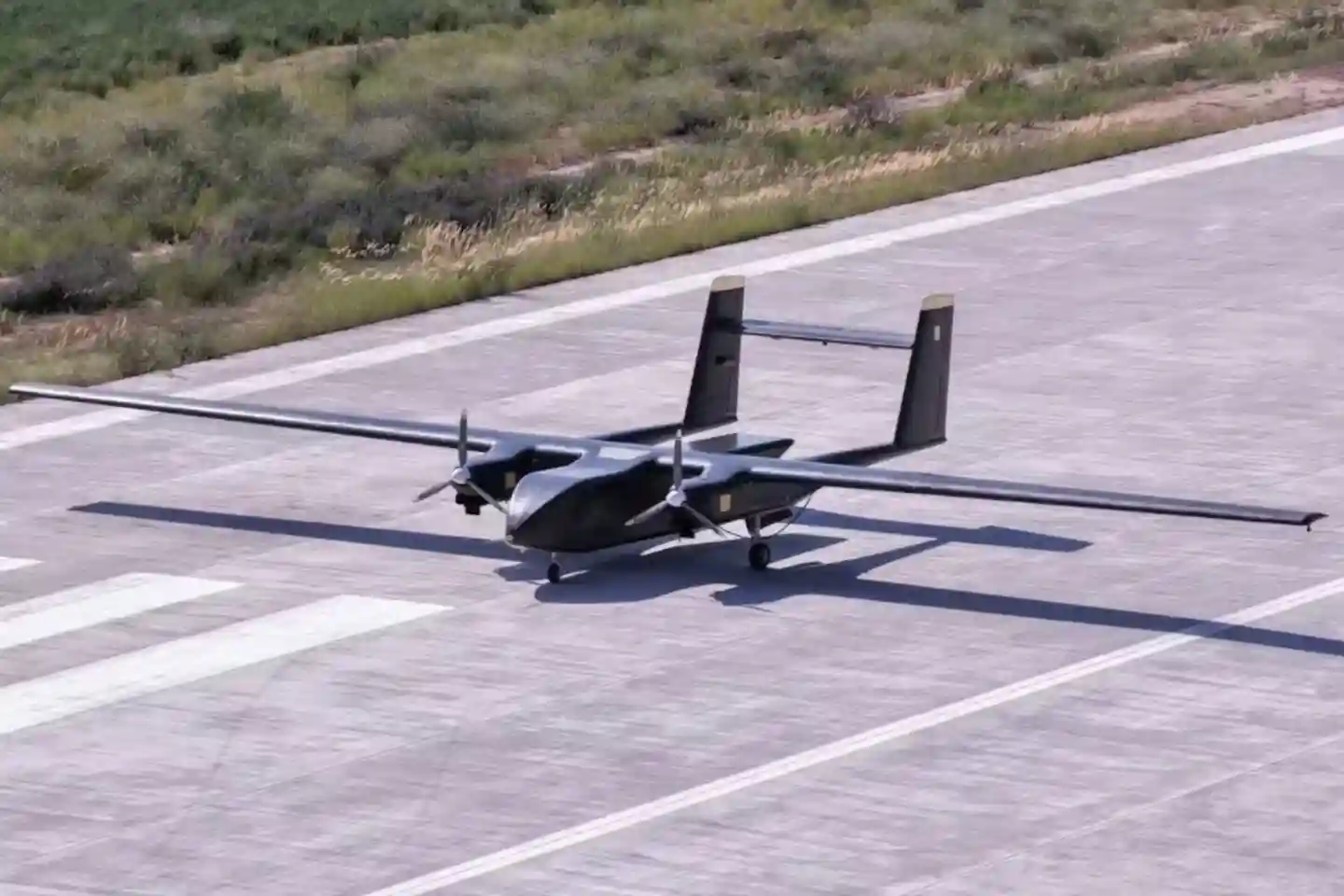
China has marked a significant milestone in autonomous aviation with the successful first flight of the Tianma-1000 heavy unmanned cargo drone, a platform designed to transform long-range logistics, emergency response, and future aerial supply networks. The maiden sortie validated all primary performance parameters, confirming the aircraft’s readiness to advance into expanded flight testing and operational evaluation. Developed within the Aviation Industry Corporation of China (AVIC) industrial system and announced by China North Industries Group Corporation Limited (NORINCO), the achievement highlights the rapid pace at which China is pushing large-scale unmanned transport aircraft from concept to reality.
The Tianma-1000 occupies a strategic niche between small logistics drones and traditional manned transport aircraft. With a payload capacity of up to one ton, a maximum range of 1,800 kilometers, and a service ceiling of 8,000 meters, the aircraft is tailored for time-critical delivery missions across vast distances. Flight test data confirmed a takeoff and landing distance of under 200 meters, enabling operations from short, improvised, or damaged runways where conventional cargo planes cannot safely operate.
Beyond raw performance, the program reflects a broader shift in China’s aviation strategy toward intelligent, autonomous systems that reduce manpower demands while expanding reach and resilience. Engineers involved in the first flight described the test as a complete success, emphasizing that the aircraft demonstrated stable handling, precise navigation, and full compliance with design expectations during its inaugural mission.
The aircraft’s twin-engine configuration is a deliberate design choice aimed at balancing endurance, safety, and redundancy. This setup supports sustained inter-regional logistics routes while providing additional reliability for operations over rugged terrain or sparsely populated areas. In disaster response scenarios, developers estimate that the Tianma-1000 can deliver ton-level supplies within half a day, dramatically compressing response timelines compared with ground transport in mountainous regions or areas affected by infrastructure damage.
Autonomous Architecture Designed for All-Weather Operations
At the core of the Tianma-1000 is an advanced autonomy architecture that allows the aircraft to execute the entire mission cycle without human intervention. From route planning and cargo handling to in-flight execution and unloading, the system relies on a regional control and hierarchical management framework fused with artificial intelligence. This design enables the drone to adapt dynamically to changing conditions, reroute around hazards, and maintain mission integrity even in unfamiliar airspace.
The flight control suite integrates optical guidance and landing assistance systems capable of high-precision autonomous landings in challenging environments. According to program documentation, the Tianma-1000 can operate reliably in fog, snow, heavy rain, and low-visibility conditions, a capability that significantly broadens its utility for both civilian and government users. All-weather performance is increasingly viewed as a critical requirement for modern logistics platforms, particularly as climate volatility and extreme weather events become more frequent.
Intelligent Cargo Handling and Rapid Turnaround
One of the most distinctive features of the Tianma-1000 is its highly automated cargo handling system. The aircraft is equipped with an intelligent loading and unloading mechanism capable of processing multiple tons of cargo in approximately five minutes, minimizing ground time and maximizing sortie efficiency. This rapid turnaround is especially valuable for emergency logistics, where speed often determines mission success.
Autonomous obstacle avoidance and dynamic route optimization further enhance operational safety. The system continuously analyzes terrain, weather, and airspace constraints, allowing the drone to adjust its flight profile in real time. By reducing reliance on large ground crews and manual oversight, the Tianma-1000 promises lower operating costs and improved scalability for high-frequency logistics operations.
Modular Design Enables Multi-Role Flexibility
Modularity is a central principle in the Tianma-1000’s design philosophy. The aircraft features rapidly replaceable mission bays, allowing it to transition quickly between different operational roles without structural modification. While the primary focus remains cargo transport, NORINCO has confirmed that additional mission modules are under development.
These include cluster delivery systems, communication relay payloads, and reconnaissance and monitoring suites, expanding the platform’s applicability beyond logistics alone. Such flexibility positions the Tianma-1000 as a multi-role unmanned aircraft capable of supporting disaster relief, infrastructure monitoring, and specialized transport missions with minimal downtime between taskings.
Strategic Implications for China’s Low-Altitude Economy
The successful maiden flight carries implications that extend well beyond a single aircraft program. It underscores China’s accelerating investment in unmanned logistics as a pillar of its expanding low-altitude economy, a national initiative aimed at unlocking economic value from low-altitude airspace through drones, air mobility platforms, and intelligent aviation services.
While officially framed around civil logistics and emergency response, the Tianma-1000’s performance parameters closely align with military sustainment requirements. Ton-class autonomous airlifters are increasingly seen as essential assets for distributed logistics concepts, particularly in environments where manned aircraft face elevated risk, limited access, or political constraints. The convergence of civilian innovation and defense utility is a defining characteristic of modern aerospace development in China.
A Milestone in China’s Unmanned Transport Ecosystem
The Tianma-1000 program also illustrates how state-backed aerospace conglomerates are leveraging advances in artificial intelligence, flight control systems, and modular engineering to compress development timelines and accelerate fielding. By integrating the project into broader economic and governance strategies, AVIC and NORINCO are positioning the aircraft as both a commercial enabler and a strategic asset.
As the Tianma-1000 moves into expanded testing and eventual operational deployment, it is poised to become a cornerstone of China’s emerging unmanned transport ecosystem. The successful first flight not only validates a sophisticated piece of aviation engineering but also signals a future in which large autonomous cargo drones play a central role in logistics, emergency response, and national infrastructure resilience.